


Six Building Blocks Of Digital Transformation Powerpoint Presentation Slides





Try Before you Buy Download Free Sample Product
 Impress Your
 Audience
 100%
100% Editable
 Save Hours
 of Time


Six Building Blocks of Digital Transformation PowerPoint Presentation Slides is an effective presentation to create new digital business capabilities. The digital transformation business model PowerPoint complete deck includes ready to use templates such as strategy and innovation, customer decision journey, process automation, operation and technology, data and analytics, etc. It has templates with professional background images and relevant content. This content ready presentation is fully editable. Modify content as per your need. The graphics used in our PPT allow you to clearly demonstrate each step of the digital transformation process. Our set of Digital Transformation PPT visuals will assist you in find, develop and acquire digital skills. Discuss the five stages of process automation. Enhance your knowledge with our well-researched deck and deliver your ideas in an effective way. Download the six strategies for delivering digital services Presentation design to impress your audience.
People who downloaded this PowerPoint presentation also viewed the following :
Content of this Powerpoint Presentation
Slide 1: This slide introduces Six Building Blocks of DIGITAL TRANSFORMATION. State the name of your company and proceed.
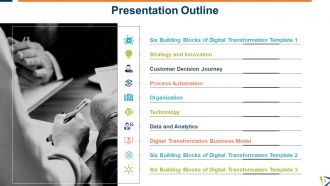
Slide 2: This slide shows Presentation Outline containing- Six Building Blocks of Digital Transformation Template 1, Strategy and Innovation, Customer Decision Journey, Process Automation, Organization, Technology, Data and Analytics, Digital Transformation Business Model, Six Building Blocks of Digital Transformation Template 2, Six Building Blocks of Digital Transformation Template 3.
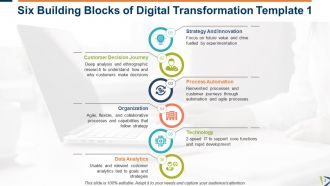
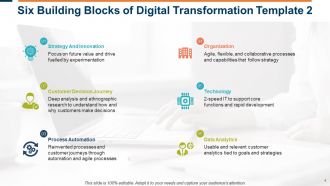
Slide 3: This is Six Building Blocks of Digital Transformation Template 1 slide showing- Strategy And Innovation, Customer Decision Journey, Process Automation, Technology, Organization, Data Analytics.
Slide 4: This slide shows Six Building Blocks of Digital Transformation Template 2.
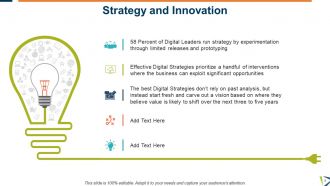
Slide 5: This slide shows Strategy and Innovation with bulb imagery and the following points- 58 Percent of Digital Leaders run strategy by experimentation through limited releases and prototyping, Effective Digital Strategies prioritize a handful of interventions where the business can exploit significant opportunities, The best Digital Strategies don’t rely on past analysis, but instead start fresh and carve out a vision based on where they believe value is likely to shift over the next three to five years.
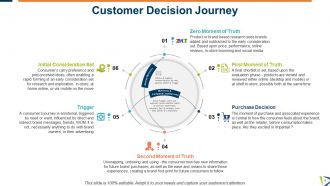
Slide 6: This slide explains Customer Decision Journey with the following six steps- Zero Moment of Truth, First Moment of Truth, Purchase Decision, Second Moment of Truth, Trigger, Initial Consideration Set.
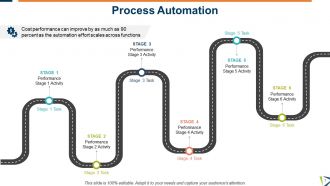
Slide 7: This slide shows Process Automation with six of the stages that we have mentioned.
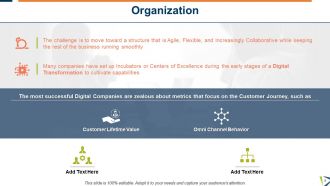
Slide 8: This slide shows Organizational aspects with text boxes to state.
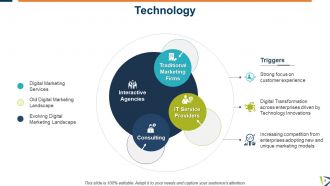
Slide 9: This slide shows the factors that trigger Technology along with the following sub headings- Traditional Marketing Firms, IT Service Providers, Interactive Agencies, Consulting.
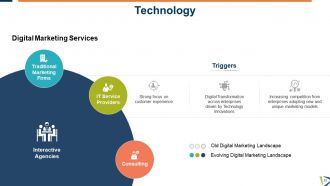
Slide 10: This is another slide showing the Technology with its triggers.
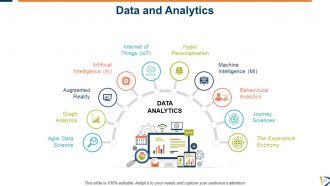
Slide 11: This slide shows Data and Analytics with the following components- Internet of Things (IoT), Artificial Intelligence (AI), Augmented Reality, Graph Analytics, Agile Data Science, The Experience Economy, Journey Sciences, Behavioural Analytics, Machine Intelligence (MI), Hyper Personalisation.
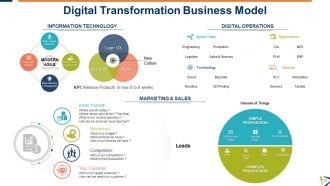
Slide 12: This slide shows Digital Transformation Business Model with three main sub headings- MARKETING & SALES, INFORMATION TECHNOLOGY, DIGITAL OPERATIONS. Each of these headings further includes sub-points which are mentioned by us.
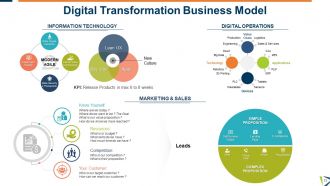
Slide 13: This slide shows another variation of the Digital Transformation Business Model with points and sub points.
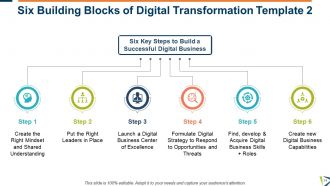
Slide 14: This slide shows Six Building Blocks of Digital Transformation Template 2 with six steps- Create the Right Mindset and Shared Understanding, Put the Right Leaders in Place, Launch a Digital Business Center of Excellence, Formulate Digital Strategy to Respond to Opportunities and Threats, Find, develop & Acquire Digital Business Skills + Roles, Create new Digital Business Capabilities.
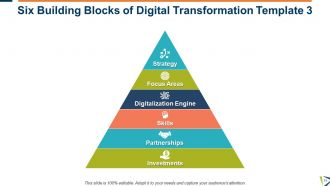
Slide 15: This slide shows Six Building Blocks of Digital Transformation Template 3 in a pyramid form. These six blocks are- Strategy, Focus Areas, Digitalization Engine, Skills, Partnerships, Investments.
Slide 16: This is Six Building Blocks of Digital Transformation Icons Slide. You can use the icons as per your need.
Slide 17: This is also Six Building Blocks of Digital Transformation Icons Slide. Use as per your need.
Slide 18: This slide is titled Additional Slides. You can change the slide content as per your needs.
Slide 19: This slide shows Our Mission with background imagery.
Slide 20: This slide presents Our Goal. State company/organization goals here.
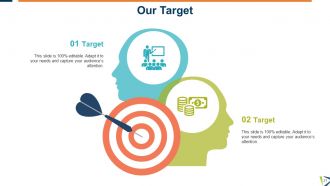
Slide 21: This is Our Target slide. State your targets with icon imagery here.
Slide 22: This is a Quotes slide. Mention a quote or whatever you desire here.
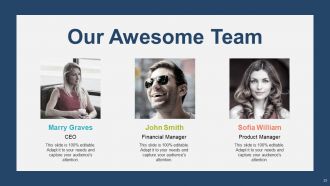
Slide 23: This slide showcases Our Awesome Team with designation, text boxes and image to fit.
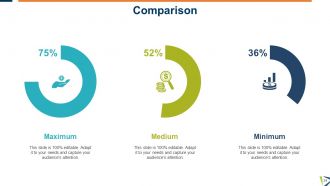
Slide 24: This slide showcases Comparison which can be helpful in comparing products/ entities etc.
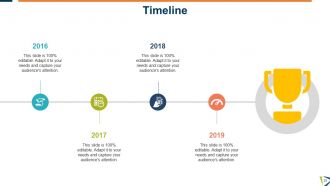
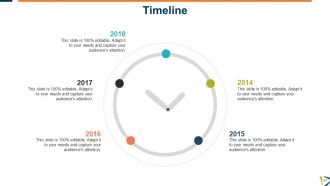
Slide 25: This slide shows a TIMELINE over the years to present in one place.
Slide 26: This slide displays Post It Notes for pinning important facts, notices etc. related to your company.
Slide 27: This is also a Timeline slide. You can present yearly growth etc. with it.
Slide 28: This is a Puzzle slide with text boxes to add relevant text.
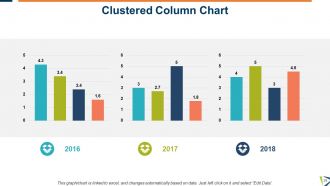
Slide 29: This is a Clustered Column Chart slide to present product/ entity comparison, specifications etc.
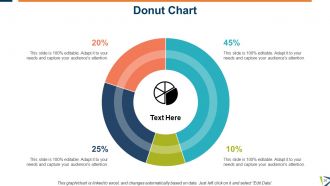
Slide 30: This is a Donut Chart slide to present product or entity comparison, information etc.
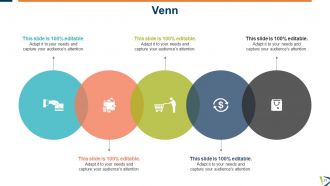
Slide 31: This is a Venn diagram image slide to show information, specifications etc.
Slide 32: This is a Thank You slide with Address, Email Address, and Contact Number.
Six Building Blocks Of Digital Transformation Powerpoint Presentation Slides with all 32 slides:
Use our Six Building Blocks Of Digital Transformation Powerpoint Presentation Slides to effectively help you save your valuable time. They are readymade to fit into any presentation structure.





FAQs for Six Building Blocks Of Digital Transformation
Look, you absolutely need leadership backing this thing from day one. Most digital transformations crash and burn because of people drama, not because the tech sucks. Set clear goals that actually tie to revenue or whatever metrics matter to your business. Getting employees bought in is huge - they'll tank the whole project if they feel left out. Customer experience should drive everything, and base decisions on real data instead of just winging it. Oh, and don't go crazy trying to transform everything at once. Pick one area, run a pilot, show some quick wins first. Build momentum, then expand from there.
Start measuring before you change anything - otherwise you're flying blind. Three things matter most: how much faster your processes get, what you save on costs, and whether you're screwing up less. Time savings will blow your mind honestly. Also track cost per transaction and how happy customers are getting. Set up some basic dashboard that updates monthly so you can actually see what's happening. Employee productivity is huge too but harder to measure cleanly. Get your baselines locked down first, then start your digital transformation. Even if you're still planning, begin tracking now.
Honestly, leadership makes or breaks the whole thing. Without them backing it, you'll just end up with a bunch of expensive pilot projects that go nowhere - trust me, I've watched it happen. Good leaders get people excited about change instead of fighting it. They secure the budget, communicate why it matters, and actually remove obstacles when teams get stuck. Oh, and they need to walk the walk too, not just talk about innovation while using the same old processes. Start by building allies in different departments first. That's probably your best bet.
Honestly, culture beats budget problems every single time when you're trying to go digital. Your biggest enemy isn't money - it's that "we've always done it this way" crowd. Find your tech nerds first (every office has a few). Those people who actually get excited about new software? Let them do the convincing for you. Way easier than fighting the skeptics yourself. Leadership has to be on board though, or you're screwed from day one. Oh, and don't expect perfection - you need people who won't freak out when things break.
Honestly, start with cloud stuff - it's your foundation for everything else. APIs are massive too because without them you're just building random systems that can't communicate (learned that the hard way). Data analytics and automation/AI tools come next. Don't sleep on mobile-first design and solid cybersecurity either. Here's what I'd do: migrate to cloud first for flexibility, then add analytics so you actually know what your data's telling you. After that, automate the boring repetitive tasks. Oh, and pick whatever's causing you the biggest headache right now - don't try fixing everything simultaneously or you'll go crazy.
Honestly, don't try to transform everything at once - you'll just burn out your team. Start with stuff that's actually annoying you daily, like automating invoices or finally moving files to the cloud. Big companies are stuck in meeting hell for months before changing anything, but you can pivot fast. That's your superpower right there. Get one thing working smooth, let everyone get used to it, then tackle the next headache. Pick tools that won't break the bank and can grow with you. Rome wasn't built in a day and all that.
Oh man, you're gonna hit SO many roadblocks. People hate change - like, genuinely despise it. Your old systems will fight every new thing you try to add. Leadership never has a clear plan either, which is super fun. Money's always tight for this stuff too. Then there's all the data stuck in different places that won't talk to each other, security nightmares, can't find anyone who actually knows what they're doing... honestly the people problems are way worse than the tech ones. Companies that don't completely crash and burn usually test small stuff first, get the important people on board early, and actually train everyone properly.
So you know how you usually just go with your gut on business stuff? Data analytics flips that - suddenly you've got actual proof backing up your decisions. All those digital systems you're implementing? They're collecting tons of info about customers, broken processes, whatever. I swear it becomes weirdly satisfying once you see the patterns emerge. You'll catch problems before they explode, figure out what customers actually want (not what we think they want), and track whether your changes are doing anything. Honestly just start with one decision you make all the time and see what numbers could help.
Dude, customer experience literally makes or breaks your whole digital transformation. Seriously, you can dump millions into fancy tech, but if people can't figure out how to use it? Total waste. We did this at my old job - built this "amazing" new portal that was so confusing nobody used it. What a disaster. The trick is flipping your approach completely. Start with what customers actually want and need, then figure out the tech stuff later. Otherwise you're just building expensive paperweights that'll piss everyone off.
Ugh, digital transformation means you're basically always learning new stuff - data analysis, cloud tools, automation platforms, whatever your company decides to throw at you next. It's honestly pretty draining sometimes. But here's the thing: once you can connect the tech side with business needs, you become super valuable. The trick is making learning part of people's actual jobs, not just something they do after hours. Companies need to budget time and money for it too. Otherwise people burn out trying to keep up on their own time, which sucks.
Here's the thing - you can't just slap security on at the end and hope it works. Do risk assessments before rolling out new tech. Encrypt everything, both when it's moving around and when it's just sitting there. MFA isn't optional anymore, honestly don't know why some companies still resist it. Your team needs training on new protocols as you go, since people are usually the weak link anyway (no offense to people, but it's true). Think of security as something that helps your transformation, not something that slows it down. Regular reviews will save your butt later.
Look, without innovation you're basically buying a really expensive computer that'll be outdated in two years. Tech moves so ridiculously fast that what feels cutting-edge today becomes ancient history pretty quick. Your teams need space to mess around with new stuff and fail sometimes - that's honestly where the best ideas come from. Companies that actually succeed long-term? They bake experimentation right into how they operate instead of treating it like some weekend hobby. Set aside real money and time for people to try weird things. Otherwise you're just throwing cash at yesterday's problems.
I'd map everything against impact vs complexity first - grab those high-impact, easy wins to build momentum. Customer stuff usually wins since it drives revenue and makes the bosses happy. Don't forget the boring foundation work like data infrastructure though, that'll bite you later if you skip it. Honestly? Your team's bandwidth matters more than perfect prioritization. Pick maybe 3-5 things max for round one. Get some solid wins, then expand from there. I've seen too many teams try to do everything at once and just burn out.
Look, partnering with the right tech companies can totally fast-track your digital transformation. Instead of building everything yourself, you get their specialized know-how and solutions that already work. They'll handle the setup, train your people, and deal with ongoing support - honestly beats having your team scramble to figure it out. The best part? They bring industry tricks you'd never think of on your own. Oh, and definitely avoid the generic solution pushers. Find partners who actually get your industry's specific headaches. Makes all the difference.
So digital transformation basically gives you superpowers for supply chain stuff. You get real-time tracking of shipments, AI that predicts what you'll need, automated inventory - the whole nine yards. IoT sensors watch everything (temperature, location, whatever), and blockchain keeps things transparent across your network. Way better than the old spreadsheet nightmare, honestly. The automation cuts down on so many manual screwups too. My advice? Don't try to do everything at once - that's just asking for trouble. Pick one thing like shipment tracking first, then expand from there.
-
goood
-
Great presentation