


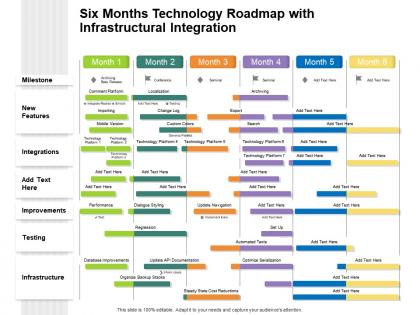
Six months technology roadmap with infrastructural integration




Try Before you Buy Download Free Sample Product
 Impress Your
 Audience
 100%
100% Editable
 Save Hours
 of Time


The success rate of business plans is hugely dependent on the plan of action, and this editable Six Months Technology Roadmap With Infrastructural Integration rightly serves the purpose. Encapsulate all the information related to the project in a well structured manner to obtain maximum efficiency by incorporating our stunning PowerPoint theme. State the critical deliverable, steps involved, time frame, workforce allocation, and lots more in an easy to understand manner by utilizing this pre designed roadmap PowerPoint layout. You can also prioritize your tasks and discuss the problem areas with your colleagues by incorporating this tailor made PPT layout. Empower your work plan by employing this professionally designed PPT theme. Entrepreneurs can download Six Months Technology Roadmap With Infrastructural Integration as a beneficial communication tool that facilitates in collaborating with different tasks and achieve targets.
People who downloaded this PowerPoint presentation also viewed the following :
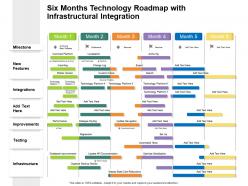
Six months technology roadmap with infrastructural integration with all 2 slides:
Use our Six Months Technology Roadmap With Infrastructural Integration to effectively help you save your valuable time. They are readymade to fit into any presentation structure.
FAQs for Six months technology roadmap
**INPUT**: What are the key components of an effective technology roadmap? **OUTPUT**: Effective technology roadmaps include strategic objectives, current state assessment, future technology requirements, implementation timelines, and resource allocation plans. These components work together by aligning IT investments with business goals, identifying capability gaps, and establishing clear milestones, with many organizations finding that comprehensive roadmaps deliver competitive advantage and streamlined digital transformation.
Organizations align their technology roadmap with business objectives by establishing clear strategic priorities, conducting regular cross-functional reviews, and mapping technological investments directly to revenue goals and operational outcomes. Through collaborative planning sessions involving IT leaders and business stakeholders, companies streamline resource allocation, accelerate digital transformation initiatives, and ensure technology decisions support competitive positioning, ultimately delivering measurable ROI and sustainable growth advantages.
Stakeholder engagement ensures technology roadmaps align with diverse business needs, user requirements, and strategic objectives across departments like IT, operations, finance, and customer service. Through collaborative input sessions and feedback loops, organizations identify critical priorities, avoid costly misalignments, and build consensus around implementation timelines, ultimately delivering solutions that enhance operational efficiency and drive measurable business outcomes.
Technology roadmaps should be reviewed quarterly and updated annually, with major revisions triggered by significant market shifts, regulatory changes, or strategic pivots. Many organizations find that this balanced approach enables them to maintain strategic direction while adapting to emerging technologies, ultimately delivering operational flexibility and competitive advantage in increasingly dynamic markets.
**INPUT**: What are the best practices for visualizing a technology roadmap? **OUTPUT**: Best practices include using clear timelines, color-coding by priority or department, maintaining consistent formatting, incorporating milestone markers, and ensuring stakeholder accessibility across organizational levels. These visualization approaches enhance strategic communication by streamlining complex technical information, facilitating cross-functional alignment, and enabling executives to track progress efficiently, with many organizations finding that well-designed roadmaps accelerate decision-making processes. [Word count: 58 words]
Organizations can prioritize technology roadmap initiatives by evaluating strategic alignment, business impact potential, resource requirements, technical dependencies, and implementation timelines. Through frameworks like value-versus-effort matrices and stakeholder input sessions, companies streamline decision-making while balancing quick wins with long-term investments, ultimately delivering competitive advantage and operational efficiency across departments.
**INPUT**: What tools or software can assist in creating a technology roadmap? **OUTPUT**: Technology roadmap creation tools include Microsoft Visio, Lucidchart, ProductPlan, Roadmunk, and Aha!, each offering specialized features for strategic planning and visualization. These platforms streamline roadmap development by enabling collaborative planning, timeline management, and stakeholder alignment, with many organizations finding that integrated software solutions ultimately deliver enhanced project transparency and accelerated decision-making processes. [Word count: 56 words]
A technology roadmap helps identify potential risks and challenges by visualizing dependencies, resource constraints, timeline conflicts, and integration complexities across planned initiatives. Through systematic mapping, organizations can anticipate technical bottlenecks, budget overruns, and skill gaps, while assessing market timing risks, ultimately enabling proactive mitigation strategies and more resilient technology planning.
Technology roadmap success metrics include ROI measurement, project delivery timelines, budget adherence, strategic alignment scores, and technology adoption rates. These metrics enable organizations to track progress by monitoring cost reductions, implementation efficiency, and business objective achievement, with many enterprises finding that balanced scorecards ultimately deliver comprehensive visibility into roadmap performance and strategic value realization.
Common pitfalls include lack of stakeholder alignment, overly rigid timelines, insufficient market research, ignoring legacy system constraints, and poor communication strategies. These challenges can derail technology initiatives by creating unrealistic expectations, resource misallocation, and implementation delays, with many organizations finding that flexible planning and continuous stakeholder engagement ultimately deliver more successful outcomes.
Technology roadmaps facilitate innovation by aligning emerging technologies with strategic business objectives, identifying research and development priorities, and creating structured pathways for technological advancement. Through systematic planning and resource allocation, organizations can anticipate market trends, coordinate cross-functional innovation efforts, and accelerate time-to-market for new products, ultimately delivering competitive advantage and sustainable growth opportunities.
Cross-departmental collaboration on technology roadmaps requires establishing shared governance structures, implementing regular cross-functional workshops, creating unified communication channels, and developing common success metrics that align with organizational objectives. Through collaborative planning sessions and integrated project management tools, departments like IT, marketing, and operations can streamline coordination, enhance resource allocation, and ultimately deliver cohesive technology strategies.
Technology roadmaps adapt to rapid change through continuous monitoring, regular review cycles, and flexible planning frameworks that accommodate emerging technologies and market shifts. Leading organizations implement quarterly assessments, scenario planning, and modular roadmap structures, enabling them to pivot quickly while maintaining strategic alignment, ultimately delivering competitive advantage in increasingly dynamic markets.
Emerging technologies can be incorporated through phased integration planning, pilot program development, risk assessment frameworks, stakeholder alignment processes, and continuous monitoring systems. These strategic approaches enable organizations to evaluate technologies like AI, blockchain, and IoT systematically, with many companies finding that structured roadmaps deliver reduced implementation risks, enhanced competitive positioning, and accelerated innovation cycles.
Technology roadmaps provide strategic technology direction and timeline planning that directly integrates with project management methodologies like Agile, Waterfall, and DevOps to ensure systematic execution. While roadmaps establish long-term technology vision and priorities, project management methodologies deliver the operational frameworks for implementation, with many organizations finding that this strategic combination enhances resource allocation, timeline adherence, and ultimately delivers competitive technological advantage.
-
Great experience, I would definitely use your services further.
-
Great designs, really helpful.