


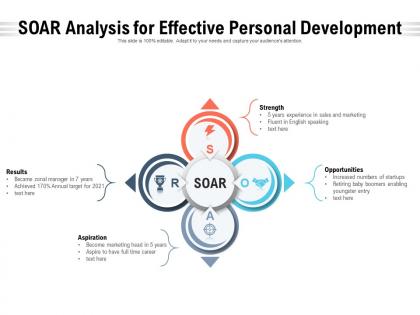
Soar analysis for effective personal development




Try Before you Buy Download Free Sample Product
 Impress Your
 Audience
 100%
100% Editable
 Save Hours
 of Time


Our Soar Analysis For Effective Personal Development are explicit and effective. They combine clarity and concise expression.
People who downloaded this PowerPoint presentation also viewed the following :
Soar analysis for effective personal development with all 2 slides:
Give your audience a fulfilling experience. They will find our Soar Analysis For Effective Personal Development elevating.

FAQs for Soar analysis for
SOAR analysis comprises four key components: Strengths (internal capabilities), Opportunities (external possibilities), Aspirations (future vision and goals), and Results (measurable outcomes and success metrics). These elements interrelate strategically, with organizations leveraging their strengths to capitalize on opportunities while pursuing aspirations, ultimately delivering measurable results and competitive advantage through integrated strategic planning.
Businesses leverage SOAR analysis by systematically evaluating their Strengths, Opportunities, Aspirations, and Results to create forward-focused strategic plans that align resources with growth potential. This framework enables organizations to move beyond problem-solving to opportunity-maximization, with companies in sectors like technology and healthcare finding that SOAR drives innovation-centered strategies, ultimately delivering enhanced competitive positioning and accelerated goal achievement.
Organizations conducting SOAR analysis often face challenges including insufficient stakeholder engagement, difficulty identifying genuine strengths versus perceived ones, resistance to aspirational thinking, and lack of structured facilitation expertise. While these obstacles can initially slow progress, many companies find that investing in proper facilitation training and creating inclusive participation frameworks ultimately delivers more accurate organizational insights and stronger strategic alignment.
SOAR analysis differs from SWOT by focusing exclusively on positive elements—strengths, opportunities, aspirations, and results—rather than including weaknesses and threats. While SWOT provides comprehensive situational awareness, SOAR drives forward momentum by channeling organizational energy toward growth and achievement, with many strategic planning teams finding that this approach generates more actionable initiatives and employee engagement.
SOAR analysis helps identify market opportunities by systematically examining organizational Strengths, Opportunities, Aspirations, and Results to reveal untapped potential, emerging trends, competitive gaps, and strategic positioning advantages. Through this comprehensive assessment, businesses can uncover new customer segments, partnership possibilities, and product development areas, while aligning their core capabilities with market demands, ultimately delivering enhanced competitive advantage and sustainable growth in increasingly dynamic markets.
Companies like Microsoft have used SOAR analysis to identify cloud computing strengths and market opportunities, leading to their Azure expansion strategy. Similarly, Starbucks leveraged SOAR to recognize their brand strength and customer loyalty aspirations, ultimately driving their digital transformation and mobile payment innovations, with many organizations finding that this approach delivers clearer strategic focus and accelerated growth initiatives.
Stakeholder engagement ensures comprehensive perspectives during SOAR analysis by involving employees, customers, partners, and leadership in identifying strengths, opportunities, aspirations, and results. This collaborative approach enhances buy-in, uncovers diverse insights across departments, and creates shared ownership of strategic outcomes, with many organizations finding that inclusive participation ultimately delivers more actionable strategies and smoother implementation.
SOAR analysis integrates seamlessly with frameworks like SWOT analysis, balanced scorecards, OKRs, and strategic planning processes by providing the aspirational foundation for goal-setting and performance measurement. Organizations combine SOAR with Porter's Five Forces or McKinsey's 7S model to create comprehensive strategic assessments, with many finding that this integration enhances decision-making clarity and accelerates strategic execution across departments.
SOAR analysis proves particularly beneficial during strategic planning sessions, organizational restructuring, team development initiatives, and performance improvement projects. Organizations undergoing mergers, launching new products, or entering competitive markets find that SOAR's strengths-focused approach enhances employee engagement, accelerates innovation processes, and builds organizational confidence, ultimately delivering sustainable growth and competitive advantage.
Leaders effectively communicate SOAR analysis findings through structured presentations, visual dashboards, interactive workshops, and clear action plans that translate insights into specific objectives. These approaches enhance team alignment by facilitating collaborative discussions around strengths and opportunities, while establishing measurable goals and timelines, ultimately delivering improved strategic focus and organizational momentum across departments.
Organizations should consider financial performance metrics, operational efficiency indicators, customer satisfaction scores, employee engagement levels, and market share data when evaluating strengths in SOAR analysis. These quantitative and qualitative measures enable businesses to identify competitive advantages across departments, with many companies finding that comprehensive strength assessment through diverse metrics ultimately delivers strategic clarity and enhanced decision-making capabilities.
Businesses should revisit their SOAR analysis quarterly or biannually, depending on market volatility and organizational changes, to ensure strategies remain aligned with evolving opportunities and aspirations. This regular reassessment enables companies to adapt to shifting customer demands, competitive landscapes, and internal capabilities, while many organizations finding that frequent SOAR reviews enhance strategic agility and sustain competitive advantage.
Common misconceptions about SOAR analysis include viewing it as purely positive without strategic depth, assuming it replaces comprehensive planning, believing it's only for struggling organizations, and thinking it ignores competitive realities. While SOAR emphasizes strengths and opportunities, it delivers strategic clarity through realistic aspirational planning, with many organizations finding that balanced SOAR implementation enhances decision-making and accelerates growth initiatives across diverse business environments.
A successful SOAR analysis contributes to organizational culture by fostering collaborative planning, aligning teams around shared strengths and opportunities, and creating forward-focused dialogue that emphasizes possibilities rather than problems. This approach enhances employee engagement by involving staff in strategic visioning, building confidence through strengths recognition, and ultimately delivering increased buy-in and motivation across departments.
Tools for SOAR analysis include specialized software like Lucidchart, Miro, and Microsoft Visio for visual mapping, alongside comprehensive platforms such as Cascade Strategy, ClearPoint Strategy, and StrategyBlocks for strategic planning integration. These technologies streamline collaboration through real-time editing, template libraries, and data visualization capabilities, with many organizations finding that digital platforms enhance team engagement and accelerate strategic decision-making processes.
No Reviews