

Software platform architecture design powerpoint ideas





Try Before you Buy Download Free Sample Product
 Impress Your
Audience
 100%
Editable
 Save Hours
of Time


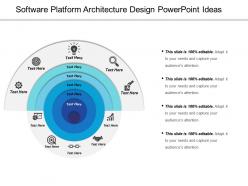
Focus on the job with our software platform architecture design PowerPoint Ideas. This five-stage process shown here focuses on a software platform, software architecture, software stack that are commonly used to organize software systems. Use this PPT to express the optimization of each section of code with the best architecture. The layered architecture is one of the most common because it is usually built around the database. Many applications in organizations naturally lend themselves to storing information in tables. High-quality design displays high contrast and creates an engaging experience your the viewer. This PowerPoint deck highlights the key areas pertaining to software platform architecture design and explains one the advantages of a layered architecture being the separation of concerns. Captivate your audience with our, software platform architecture design PowerPoint deck along with areas like core set of operations that are used repeatedly in different patterns that depend upon the data and the task at hand. Focus on the job with our Software Platform Architecture Design Powerpoint Ideas. Ensure intense concentration during the effort.
People who downloaded this PowerPoint presentation also viewed the following :
Software platform architecture design powerpoint ideas with all 5 slides:
Include complete coverage of every angle with our Software Platform Architecture Design Powerpoint Ideas. Build a composite image.


FAQs for Software platform architecture
**INPUT**: What are the fundamental principles of software architecture design? **OUTPUT**: Software architecture design principles include modularity, separation of concerns, scalability, maintainability, and security integration. These principles streamline development by enabling component reusability, facilitating system updates, and supporting business growth, with many organizations finding that well-architected systems ultimately deliver faster deployment cycles and reduced operational costs. [Word count: 51 words]
Design patterns significantly influence software architecture decisions by providing proven solutions for recurring problems, establishing structural frameworks, and promoting consistency across development teams. These patterns guide architects in making scalable choices for complex systems, with many organizations finding that strategic pattern implementation reduces development time, enhances maintainability, and delivers more robust applications that adapt seamlessly to evolving business requirements.
Scalability serves as a foundational principle in architectural design, influencing technology choices, infrastructure planning, resource allocation, and system integration strategies. It enables organizations to handle growing user bases, increasing data volumes, and expanding business requirements while maintaining performance and reliability, with many enterprises finding that scalable architectures ultimately deliver competitive advantage and operational efficiency.
Microservices architecture enhances development workflows by enabling independent team deployment, parallel development cycles, and technology stack flexibility across services. This approach streamlines release processes, reduces integration bottlenecks, and accelerates feature delivery, with many software organizations finding that decoupled services ultimately deliver faster time-to-market and improved development efficiency.
Serverless architecture offers reduced operational overhead, automatic scaling, cost efficiency, faster deployment cycles, and enhanced developer productivity. While these benefits streamline development and minimize infrastructure management, organizations face challenges including vendor lock-in, cold start latency, and debugging complexities, with many enterprises finding that strategic implementation delivers significant cost savings and accelerated time-to-market.
Software architects ensure resilience through fault tolerance mechanisms, redundancy implementation, circuit breakers, graceful degradation strategies, and comprehensive monitoring systems. These approaches enable applications to maintain functionality during partial failures, automatically recover from errors, and continue serving users with reduced features, ultimately delivering improved uptime and customer satisfaction across distributed systems.
Best practices for documenting software architecture include creating clear architectural diagrams, maintaining up-to-date design decisions, establishing consistent documentation standards, defining component relationships, and documenting quality attributes. These practices streamline development workflows by enhancing team collaboration, reducing onboarding time, and enabling faster troubleshooting, with many organizations finding that comprehensive documentation ultimately delivers improved code quality and accelerated project delivery.
Cloud computing transforms software architecture design by enabling microservices architectures, distributed systems, and scalable infrastructure patterns that replace traditional monolithic approaches. Through cloud-native technologies, organizations streamline deployment processes, enhance system resilience, and optimize resource allocation, with many financial services and retail companies finding that cloud architectures deliver faster innovation cycles and significantly reduced operational costs.
Architectural decisions significantly affect maintainability through modularity choices, dependency management, code organization patterns, technology stack selection, and documentation standards. Well-structured architectures with clear separation of concerns enable development teams to implement changes faster, reduce debugging time, and minimize system-wide risks, while poorly designed systems create cascading maintenance challenges that ultimately increase operational costs and slow feature delivery.
Integrating legacy systems requires evaluating data compatibility, API availability, security protocols, performance bottlenecks, and maintenance costs to ensure seamless connectivity. Organizations in banking, healthcare, and manufacturing often implement middleware solutions, phased migration strategies, and hybrid architectures, ultimately delivering improved operational efficiency while preserving critical business functions and minimizing disruption.
Evaluating performance-simplicity trade-offs requires analyzing system requirements, user load expectations, development timeline constraints, and long-term maintenance costs through prototyping and benchmarking. Organizations often start with simpler architectures, then strategically add complexity where performance bottlenecks emerge, with many finding that measured optimization delivers better outcomes than premature complexity.
Choosing monolithic versus distributed architecture presents both strategic opportunities and implementation considerations, with monoliths offering simpler deployment and faster initial development while distributed systems enable greater scalability, fault isolation, and technology diversity. Many organizations find that monoliths work well for startups and smaller teams, while distributed architectures better serve enterprises requiring independent scaling, with financial services and e-commerce platforms increasingly leveraging microservices for enhanced operational flexibility and competitive advantage.
Security integration from the outset involves implementing secure coding practices, threat modeling, authentication frameworks, encryption protocols, and access control mechanisms during initial design phases. This proactive approach enables organizations to minimize vulnerabilities, reduce remediation costs, and ensure compliance requirements, with many financial services and healthcare institutions finding that early security integration ultimately delivers more robust applications and faster deployment cycles.
**INPUT**: What tools and frameworks are most effective for visualizing software architecture? **OUTPUT**: Effective architecture visualization tools include Lucidchart, Draw.io, ArchiMate, C4 Model frameworks, and enterprise solutions like Sparx Systems Enterprise Architect. These platforms streamline complex system documentation by enabling collaborative modeling, automated diagram generation, and stakeholder communication, with many development teams finding that visual architecture maps accelerate project delivery and enhance cross-functional understanding. **Word count: 56 words**
Agile software architecture emphasizes iterative development, continuous integration, and adaptive design that evolves with changing requirements, unlike traditional approaches that rely on extensive upfront planning and rigid documentation. This flexible methodology enables development teams to respond quickly to market demands, incorporate user feedback seamlessly, and deliver functional software incrementally, ultimately reducing time-to-market while maintaining system quality.
-
Informative presentations that are easily editable.
-
Awesomely designed templates, Easy to understand.