

Solid Waste Handling Vehicle Tracking System Framework Enhancing E Waste Management System




Try Before you Buy Download Free Sample Product
 Impress Your
 Audience
 100%
100% Editable
 Save Hours
 of Time


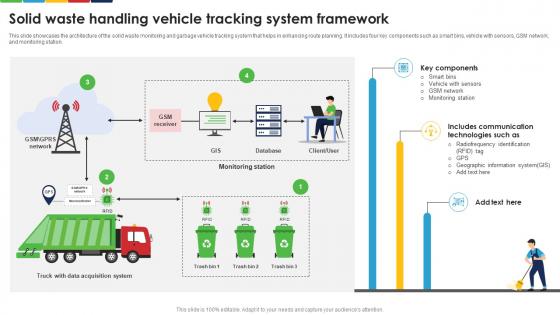
This slide showcases the architecture of the solid waste monitoring and garbage vehicle tracking system that helps in enhancing route planning. It includes four key components such as smart bins, vehicle with sensors, GSM network, and monitoring station.
People who downloaded this PowerPoint presentation also viewed the following :
Solid Waste Handling Vehicle Tracking System Framework Enhancing E Waste Management System with all 9 slides:
Use our Solid Waste Handling Vehicle Tracking System Framework Enhancing E Waste Management System to effectively help you save your valuable time. They are readymade to fit into any presentation structure.








FAQs for Solid Waste Handling Vehicle Tracking System Framework Enhancing E
Primary e-waste components include heavy metals like lead and mercury, toxic chemicals such as cadmium and brominated flame retardants, precious metals, and plastic polymers. These materials present both challenges and opportunities, with improper disposal contaminating soil and water systems while threatening human health through neurological damage, yet strategic recycling programs enable resource recovery, reduce environmental impact, and deliver sustainable waste management solutions.
Local governments can improve e-waste collection by establishing convenient drop-off centers, implementing curbside pickup programs, partnering with certified recyclers, and launching public awareness campaigns. Through strategic placement of collection points in shopping centers, schools, and community hubs, cities like San Francisco and Austin have increased collection rates by 40%, while educational initiatives help residents understand proper disposal methods, ultimately reducing landfill waste and recovering valuable materials.
Effective strategies include educational campaigns highlighting health and environmental risks, community collection events with hands-on demonstrations, school programs teaching proper disposal methods, partnerships with electronics retailers for consumer education, and social media campaigns featuring real-world contamination examples. These approaches work by making abstract environmental concepts tangible, providing convenient disposal alternatives, and empowering consumers with actionable knowledge, ultimately driving behavioral change and reducing improper disposal rates across communities.
Businesses can create sustainable e-waste practices through comprehensive recycling programs, partnering with certified disposal vendors, implementing device lifecycle management, establishing employee take-back initiatives, and conducting regular audits of electronic assets. These strategies streamline resource allocation while reducing environmental impact, with many organizations finding that structured e-waste management delivers significant cost savings, enhanced corporate reputation, and improved regulatory compliance in an increasingly sustainability-focused marketplace.
Legislation drives e-waste management through mandatory producer responsibility, recycling targets, and proper disposal requirements, with the EU's WEEE Directive, Japan's comprehensive recycling laws, and Switzerland's advanced take-back programs leading global efforts. These frameworks enable manufacturers to design sustainable products, consumers to access convenient recycling options, and businesses to recover valuable materials, while countries like Germany and South Korea demonstrate that strict enforcement ultimately delivers significant resource recovery rates and reduced environmental impact.
E-waste recycling facilities face challenges including complex material separation, hazardous substance handling, rapidly changing technology designs, high processing costs, and inconsistent supply chains. These challenges can be addressed through advanced sorting technologies, automated disassembly systems, strategic partnerships with manufacturers for design-for-recycling initiatives, and government incentives, with many facilities finding that investing in specialized equipment and workforce training ultimately delivers improved recovery rates and operational efficiency.
Blockchain enhances e-waste recycling transparency by creating immutable tracking records, enabling real-time supply chain visibility, and providing verified certification of recycling processes. Through distributed ledger technology, manufacturers, recyclers, and regulators can monitor component lifecycles from disposal to material recovery, while consumers gain verifiable proof of responsible disposal, ultimately delivering greater accountability and trust in circular economy initiatives.
Developing a circular economy model for electronic products delivers significant cost reductions through material recovery, extended product lifecycles, and reduced manufacturing expenses. Companies like Dell and HP have found that refurbishment programs, component harvesting, and strategic partnerships with recycling facilities create new revenue streams while minimizing raw material costs, ultimately delivering competitive advantage in an increasingly sustainability-focused marketplace.
Manufacturers can be incentivized through tax credits for sustainable design, extended producer responsibility programs, regulatory compliance requirements, and consumer demand for eco-friendly products. These approaches encourage circular design principles by reducing disposal costs, enhancing brand reputation, and creating competitive advantages, with many electronics companies finding that recyclable products ultimately deliver cost savings and stronger market positioning.
Consumer behaviors significantly influence electronic product lifecycles through purchasing frequency, usage patterns, disposal methods, and maintenance practices, directly impacting e-waste generation rates. Frequent device upgrades, improper disposal habits, and neglecting repair options accelerate e-waste accumulation, while conscious consumption choices, extended product usage, and responsible recycling practices can minimize environmental impact, ultimately enabling more sustainable electronics consumption patterns.
International treaties like the Basel Convention regulate hazardous e-waste movement by requiring prior informed consent for transboundary shipments, establishing import/export controls, and promoting environmentally sound disposal practices. These frameworks help prevent developed nations from dumping electronic waste in developing countries, ultimately protecting vulnerable populations while encouraging proper recycling infrastructure development and creating more equitable global waste management standards.
Educational institutions can incorporate e-waste management through dedicated sustainability courses, hands-on recycling workshops, campus collection programs, interdisciplinary projects, and partnerships with certified e-waste processors. These comprehensive approaches enhance environmental literacy while delivering practical skills, with many schools finding that students become sustainability advocates in their communities, ultimately creating a generation equipped to address growing digital waste challenges in an increasingly technology-dependent world.
Innovative e-waste recycling techniques include bioleaching using microorganisms, hydrometallurgical processes, automated disassembly systems, plasma arc technology, and AI-powered sorting mechanisms. These advanced methods streamline recovery of lithium, cobalt, gold, and rare earth elements by minimizing chemical waste, enhancing precision extraction, and increasing processing efficiency, with electronics manufacturers and recycling facilities finding significantly improved material recovery rates and reduced environmental impact.
Collaboration between private companies, nonprofits, and government agencies enhances e-waste management by combining technological expertise, regulatory frameworks, and community outreach capabilities to create comprehensive recycling networks. This strategic partnership enables streamlined collection processes, standardized disposal protocols, and expanded public awareness campaigns, with many municipalities finding that multi-sector collaboration significantly increases recovery rates while reducing environmental impact.
**INPUT**: What are some successful case studies of communities or countries that have effectively reduced their e-waste footprint? **OUTPUT**: Successful e-waste reduction includes Switzerland's comprehensive collection network, Japan's mandatory recycling laws, Rwanda's electronics refurbishment programs, and South Korea's extended producer responsibility systems. These initiatives streamline waste processing through strategic partnerships, community education, and regulatory frameworks, with many countries finding that combining government policy, industry collaboration, and citizen engagement ultimately delivers significant environmental benefits while creating sustainable economic opportunities.
-
Great quality product.
-
These stunning templates can help you create a presentation like a pro.