


Solution assessment risk severity matrix solution assessment criteria analysis and risk severity matrix




Try Before you Buy Download Free Sample Product
 Impress Your
 Audience
 100%
100% Editable
 Save Hours
 of Time


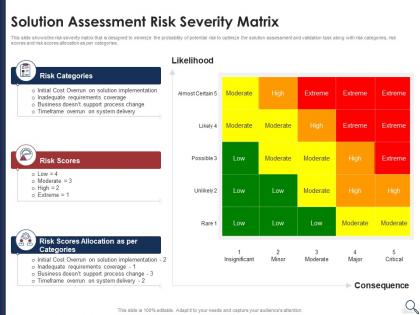
This slide shows the risk severity matrix that is designed to minimize the probability of potential risk to optimize the solution assessment and validation task along with risk categories, risk scores and risk scores allocation as per categories.
People who downloaded this PowerPoint presentation also viewed the following :
Solution assessment risk severity matrix solution assessment criteria analysis and risk severity matrix with all 2 slides:
Use our Solution Assessment Risk Severity Matrix Solution Assessment Criteria Analysis And Risk Severity Matrix to effectively help you save your valuable time. They are readymade to fit into any presentation structure.
FAQs for Solution assessment risk severity matrix solution assessment criteria analysis and
It's basically your "what could go wrong and how screwed are we" checklist. You plot out risks by how likely they are vs how much damage they'd cause - super helpful when everyone's freaking out about every little thing. Focus on the high-probability, high-impact stuff first instead of getting stuck on random worst-case scenarios that'll probably never happen. I learned this the hard way on my last project lol. Start using it early so you can actually plan around the risks instead of scrambling later when shit hits the fan.
Risk matrices are honestly game-changers for figuring out what actually matters. You plot each risk by how likely it is and how badly it'll hurt if it happens. No more treating every single problem like it's the end of the world. What I love about them is they force your whole team to get real about where you're spending time and money. Instead of just going with your gut (which, let's be honest, isn't always right), you've got actual visual proof of what deserves attention first. Start with your top 10 risks and go from there.
So basically you're looking at probability vs impact - like how likely is this mess to happen and how screwed are you if it does? Risk categories cover the usual suspects: technical stuff breaking, operational headaches, money problems, compliance nightmares. Don't forget to assign owners for each risk because someone needs to actually watch this stuff. Timeline matters too, and yeah, budget implications are everywhere. Honestly the hardest part is remembering to update the damn thing regularly since risks shift as your project changes. Oh, and keep the matrix simple - overcomplicated ones just gather dust.
Look at similar projects first - seriously, they'll show you stuff you'd never think of. Walk through each step of your plan asking "what could blow this up?" Get people from other teams involved too since they spot blind spots you miss. I always do a quick brainstorm session because other people see things differently than I do. Oh, and don't get crazy listing every possible tiny risk - focus on the ones that could actually tank your whole project. That's where the real danger is.
Here's what I'd do: Rate severity based on real damage to your project - money, delays, quality problems, safety stuff. Go from minimal to catastrophic impact. Likelihood is trickier though. Dig up whatever data you can find, even if it's messy - past projects, expert opinions, anything beats wild guessing. I always use a 1-5 scale from rare to almost certain. The whole thing falls apart if you're not consistent across risks. Oh, and write down your criteria first so your team isn't all over the place with different standards.
So basically you'll want to tweak the risk categories and probability stuff to match whatever industry you're in. Healthcare folks should focus on patient safety and compliance - that's their bread and butter. Manufacturing? Think supply chain mess-ups and equipment breaking down. Financial services are all about cybersecurity and market chaos these days. Adjust your severity ratings too, based on what actually keeps you up at night in your business. I'd start by picking your top 5-7 risk types that are specific to your field and build everything around those. Makes way more sense than using some generic template, you know?
Look, update that risk matrix whenever big stuff happens - new requirements, scope creaks, tech breakthroughs, you know the drill. Monthly check-ins work for most projects. Fast-moving ones? Maybe weekly. I learned this the hard way on a project last year where we ignored it for three months straight. Bad idea. Schedule it with your team so it doesn't become that forgotten document nobody touches. Way better to spot problems early than deal with chaos later. Sometimes I throw it on the agenda even when things seem fine - risks have this sneaky habit of appearing out of nowhere.
You absolutely need stakeholder input for your risk matrix - can't do it without them, honestly. Each group sees totally different risks. End users will catch usability problems you'd miss. IT spots the technical stuff that flies right past you. Finance freaks out about costs while ops worries about actually rolling it out. I'd run separate workshops for each group instead of cramming everyone into one massive meeting (learned that the hard way). Have them help rate probability and impact too. Different perspectives are everything here.
Dude, color coding is a game changer for risk matrices. Red for high risk, yellow for medium, green for low - boom, instant understanding. Nobody wants to read through walls of text to figure out what's dangerous. Throw in some warning icons or triangles for the scary stuff. I swear, every time I see another gray spreadsheet matrix, I want to cry. Different font sizes help too - make the critical risks pop. Oh, and maybe add some simple graphics if you can. Trust me, people actually pay attention when there's something to look at instead of just boring rows and columns.
Don't be super vague - like writing "technical issues" tells you nothing useful. What specific tech could break? Get your team involved from the start, honestly. I've watched people create these alone and miss huge obvious problems. Your technical leads will catch stuff you won't think of. Also, resist making everything "high risk" - that defeats the whole purpose if nothing stands out. Oh and stakeholders who've done similar projects before? Gold mine for spotting what usually goes wrong. Brainstorm together first, then you can organize it into something that actually helps.
So you can plug it straight into whatever you're already using for risk tracking - don't make another spreadsheet nobody will touch. Most teams connect it to their existing risk registers and decision logs. Works great with stage gates too, especially when you need those go/no-go calls. Agile teams love using it in retrospectives, waterfall folks usually tie it to phase exits. The scores feed right into your dashboards and stakeholder reports without extra work. Honestly, the key is just picking one tool you actually use already and starting there. I've seen too many teams create these beautiful matrices that just sit there collecting dust.
So there's a few ways to tackle this. Most people just do probability times impact for a risk score, which works but is pretty basic honestly. I'd bucket things into "fix now," "fix soon," and "just keep watching." Don't forget about cost though - sometimes a high-risk thing is crazy expensive to fix. Time matters too. Like, a lower-risk item might jump the queue if there's a deadline breathing down your neck. Start with the scary high-impact stuff first, then work down based on what your team can actually handle.
Honestly, these risk matrices are pretty clutch for figuring out where to throw your resources. Plot your solutions based on risk vs impact and boom - you'll spot the obvious wins (low risk, high reward) that you should tackle first. The scary high-risk stuff? That's where you need your A-team, not the interns. I used to just guess at this stuff which... yeah, not great. The visual aspect is nice too because you can literally point at the chart when your boss asks why you need more budget for something. Just map out what you're working on now and I bet you'll be surprised where things actually land.
Start with the scary stuff - high-impact risks first. Skip the jargon and use heat maps instead of boring spreadsheets (trust me on this one). Don't just dump problems on people though. Come with actual solutions and realistic timelines. Tailor your message depending on who you're talking to - finance cares about different things than operations does. Oh, and definitely schedule follow-ups afterward. Otherwise people will just nod along and forget about their action items the second they leave the room. You'll need those check-ins to keep everyone honest.
Yeah, totally! Using your risk matrix after the project wraps up is actually really useful. Check how your original predictions matched reality - were the high-risk stuff actually problematic, or did you worry about the wrong things? Plus you'll spot risks that came out of nowhere during the project. Honestly, I think most teams skip this step but it's gold for getting better at risk assessment next time. Just do it within a month while everyone still remembers what went down.
-
Thanks for all your great templates they have saved me lots of time and accelerate my presentations. Great product, keep them up!
-
Best Representation of topics, really appreciable.
-
Easy to edit slides with easy to understand instructions.
-
Design layout is very impressive.