


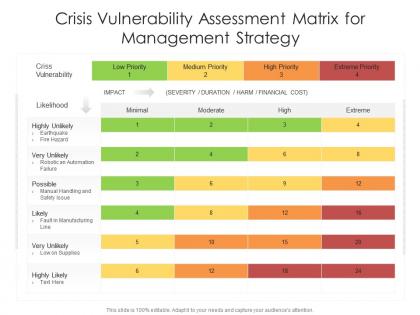
Crisis vulnerability assessment matrix for management strategy




Try Before you Buy Download Free Sample Product
 Impress Your
 Audience
 100%
100% Editable
 Save Hours
 of Time


Our Crisis Vulnerability Assessment Matrix For Management Strategy are topically designed to provide an attractive backdrop to any subject. Use them to look like a presentation pro.
People who downloaded this PowerPoint presentation also viewed the following :
Crisis vulnerability assessment matrix for management strategy with all 2 slides:
Use our Crisis Vulnerability Assessment Matrix For Management Strategy to effectively help you save your valuable time. They are readymade to fit into any presentation structure.

FAQs for Crisis vulnerability assessment matrix
Honestly, start with who's doing what when stuff hits the fan - clear roles save so much chaos later. Communication is everything too, both internally and with customers. Risk assessment sounds boring but you gotta map out different scenarios and responses. Always have backup contacts because your main guy will definitely be unreachable during the actual crisis (classic, right?). The real trick though? Actually test the thing regularly. Run drills, do tabletop exercises, whatever. I've seen too many "perfect" plans completely fall apart because nobody ever practiced them. Short sentences mixed with longer ones work better for readability.
Start by listing out your main business processes, key people, and important assets - basically anything that keeps things running. For each area, brainstorm what could go wrong: natural disasters, cyber stuff, supply chain issues, PR disasters, whatever. I'm telling you, this is where you need to channel your inner pessimist - what's the absolute worst case? Then rate each risk on likelihood and impact. Don't get fancy with complicated charts or anything. Just keep it simple. Focus your planning on the high-probability, high-damage scenarios first. Those are your biggest headaches waiting to happen.
Honestly, communication can make or break your whole crisis response. Get accurate info out fast before rumors take over - and they will, trust me. I've seen companies get buried because they waited too long. Be proactive, not reactive. Once you're chasing the story, you're screwed. Set up protocols beforehand: pick your spokespeople, prep message templates you can customize quickly. Keep everything clear and consistent across all channels. Also sounds obvious but be empathetic in your tone - people can smell corporate BS from miles away.
Look, crisis communication is all about prep work - get a solid plan with clear roles and who makes what calls. Your team needs regular practice through those tabletop exercises (they're actually pretty engaging once people get into it). Pick your spokesperson ahead of time and nail down your communication channels. Keep contact lists fresh and have message templates ready. Here's the thing - when stuff hits the fan, everyone's brain goes to mush, so you've got to drill this stuff. I'd say quarterly practice runs minimum. Oh, and make sure people actually know where to find the plan when they need it!
Honestly, the worst thing companies do is just go quiet when shit hits the fan. People hate that vacuum - they'll fill it with whatever crazy theories they want. Don't try denying everything either, it's so obvious and makes you look worse. Too many people trying to handle messaging is another killer mistake I see all the time. Mixed signals everywhere. Some places think they can just spin their way out, but people aren't stupid. Pick one person to talk, own up to what actually happened fast, then tell everyone how you're gonna fix it. That's really it.
Dude, you HAVE to monitor social media - that's literally where most crises start now. I'm talking Twitter mentions, hashtags, the whole thing. Companies get absolutely destroyed because they miss the early warning signs. Like, by the time it hits the news, you're already screwed. Set up alerts for your brand name and get someone checking regularly (24/7 if things get messy). The goal is catching negative buzz before it snowballs. Trust me, responding fast makes all the difference. Oh, and do this setup now while things are calm - scrambling to set up monitoring mid-crisis is a nightmare.
Dude, crisis leadership is everything. Your team's gonna look to you for direction, so don't panic - people can literally sense that from across the room. Be transparent with everyone, make decisions fast, and get the right people empowered to actually do stuff without waiting for approval on every little thing. Honestly, the leaders who keep it real with their communication usually come out looking way better than the ones who try to spin everything. Oh, and practice your crisis plan beforehand! You don't want to be figuring out who calls who while everything's falling apart.
Oh man, cultural stuff is HUGE for crisis communication. Japan? You gotta be super indirect and help people save face. But like American or German audiences want the facts immediately, no fluff. Some places expect the CEO to bow and apologize right away, others think that's basically admitting you screwed up legally. Timeline-wise, certain cultures need way more time for everyone to agree on the response - even when everything's on fire. Honestly, I learned this the hard way once. Get local people on your crisis team beforehand and draft different message versions for different regions. Trust me on this one.
Move fast and be straight with people - don't let silence drag on because that honestly just makes everything worse. Own up to whatever happened and spell out your fix in plain English, none of that corporate BS that makes you sound sketchy. Obviously check with legal first before you post anything (learned that one the hard way). People get antsy when they don't hear updates, so keep them in the loop even when there's not much to report. Show some actual empathy too - nobody wants to feel like they're talking to a robot during a crisis.
Honestly, the best way is just running practice drills - tabletop exercises, mock scenarios, that kind of stuff. See how fast your team actually responds and where things fall apart. After any real crisis hits, do a proper debrief because that's where you'll figure out what was total BS on paper versus what actually worked. I'd track response times, how quickly you got word out to people, whether operations stayed running. The whole point is getting better each time, right? Maybe do quarterly reviews and tweak things based on what you've learned. Those post-crisis debriefs are gold though - don't skip them.
FEMA's got free online courses that are actually pretty decent for the basics. Red Cross does in-person workplace programs - their tabletop exercises are kinda stressful but you'll remember them forever. HR consulting firms do this stuff too, though they're pricey. Oh, and sometimes local fire departments will partner with businesses for training sessions. I'd mix online modules first to get the foundation down, then do some hands-on simulations. The realistic scenarios work way better than boring PowerPoints. Trust me on that one.
Start with the obvious stuff - data breaches, supply chain mess, bad PR situations. Work backwards from there to figure out who does what and what you'll actually need. We got totally blindsided last year and it was rough. Run practice sessions with your team quarterly (honestly, most people hate these but they work). Don't just write up some fancy document that nobody reads. Keep updating scenarios as new risks pop up, and make sure everyone knows their part. Otherwise you're just scrambling when everything hits the fan.
Look, stakeholders can make or break you during a crisis. Figure out who matters first - employees, customers, investors, media, the whole crowd. Map them by how much influence they have before anything bad happens. Trust me, you don't want to be scrambling during an actual emergency. Keep communication plans ready for each group. When shit hits the fan, give them regular updates even if you're still figuring things out yourself. People hate being left in the dark more than hearing "we don't know yet." Oh, and build those relationships now while things are calm - way easier than trying to earn trust mid-crisis.
Get everyone together within 48-72 hours while it's all still fresh. And I mean *everyone* who was involved - not just the suits who think they called the shots. Compare what actually went down versus what your plan said would happen. What worked? What was a complete disaster? Honestly, the finger-pointing can wait - right now you need real feedback from all departments. Document everything: response time, how communication flowed (or didn't), decision-making process. Then use those findings to actually fix your crisis plan and training. Trust me, you'll thank yourself later when the next crisis hits.
Honestly, get your lawyers involved ASAP - don't wait until you've already screwed something up. Document literally everything because if your company's actions hurt people, you're looking at potential lawsuits. Also, there's disclosure stuff you have to follow, especially if you're publicly traded or in something heavily regulated like healthcare. Employment law gets tricky too if you're laying people off or changing roles. I learned this the hard way at my last job - we thought we could handle things internally first. Bad move.
-
Perfect template with attractive color combination.