


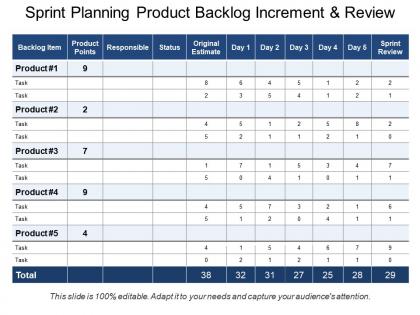
Sprint planning product backlog increment and review




Try Before you Buy Download Free Sample Product
 Impress Your
 Audience
 100%
100% Editable
 Save Hours
 of Time


The Scrum Team and stakeholders analyse what was done in the Sprint and what has changed in their environment throughout the event. Attendees decide what to do next based on this knowledge. The Product Backlog may also be modified to accommodate new possibilities. The Sprint Review is a working session, and the Scrum Team should avoid making it solely about a presentation. If you're looking for a way to take your sprint planning process to the next level, SlideTeam's extensive set of agile technology PowerPoint templates can help. With our templates, you'll have everything you need to create professional-quality slides that help you communicate effectively with your team and stakeholders. So download our agile technology ppt templates now.
People who downloaded this PowerPoint presentation also viewed the following :
Sprint planning product backlog increment and review with all 5 slides:
Use our Sprint Planning Product Backlog Increment And Review to effectively help you save your valuable time. They are readymade to fit into any presentation structure.

FAQs for Sprint planning product backlog
So Agile breaks down into four core values: people over processes, working software beats documentation, collaborate with customers instead of hiding behind contracts, and adapt to change rather than sticking to rigid plans. It's honestly just about staying flexible and not drowning in corporate BS. You want face-to-face convos, ship working stuff regularly, and roll with changing requirements. Trust your team - they'll surprise you. Daily standups and short sprints are good starting points, though I'd probably ease into standups first since they're less intimidating than completely restructuring your workflow.
So basically, traditional project management is like planning your entire vacation down to the minute before you leave. Agile? More like "let's figure it out as we go." You work in these short 1-4 week chunks instead of one massive timeline. With old-school methods, you map out everything upfront - budget, requirements, the works - then just execute. But Agile lets you pivot when things change (which they always do, honestly). You're constantly shipping small working pieces and getting feedback. Way better when you're not 100% sure what the final product should look like.
So you're basically the customer's voice on the team - you own the product vision and write user stories for the backlog. Half your day is saying "no" to random feature requests, trust me on that one. Stakeholders will constantly pull you in different directions for requirements. During sprints, the dev team needs you around to answer questions so they don't get stuck. You also get final say on whether finished work actually meets your acceptance criteria. Oh, and prioritizing what gets built next? That's on you too. Focus on max value first since you can't please everyone.
Yeah totally! Agile works for way more than just coding. My friend's marketing team does it for campaigns and honestly it's pretty smart. Break stuff into 2-week chunks, get feedback fast, then adjust. Works great for event planning too - instead of planning everything upfront and hoping it works, you build pieces and test as you go. The whole point is staying flexible rather than sticking to some massive plan that'll probably change anyway. Start with short sprints and see what happens. Way better than the old "plan everything then pray" approach if you ask me.
Honestly, start with velocity - how many story points your team knocks out each sprint. Sprint burndowns are solid too. Customer satisfaction scores matter way more than people think, plus tracking cycle time from start to finish. I'd throw in team happiness metrics and whether you're actually completing those retrospective action items (we all know how that goes sometimes). Defect rates tell you if you're shipping garbage. Hit rate on sprint commitments is pretty telling too. Don't go crazy though - pick maybe 3-4 that actually align with what you're trying to achieve. Start simple with velocity and customer feedback, then build from there.
Honestly, the worst part is usually role confusion and people hating daily standups. Your devs will probably complain about all the meetings - and yeah, some do feel pointless at first. But they actually work once everyone gets it. Leadership's gonna want those detailed roadmaps upfront, which... good luck explaining that's not how this works. Start small though. Get your Scrum Master trained properly, make sprint commitments crystal clear. Oh and don't change anything major for like 2-3 sprints minimum - I learned that one the hard way. Focus on quick wins early so people don't lose faith in the whole thing.
Look at three main things: business value, how urgent stuff is, and how much work it'll take. Your product owner should help rank things by customer impact and money potential - that's what really matters. Dependencies and time-sensitive items can't wait obviously. Don't just grab the easy stuff though! Sometimes the harder features are worth way more. MoSCoW method works great for this, or try story mapping to see everything laid out. Oh and definitely review your backlog every week during sprint planning. Otherwise it turns into this sad pile of forgotten ideas nobody cares about anymore.
Okay so sprints are just these mini work cycles that keep your team from going crazy on huge projects. Most people do 2-week ones - honestly anything longer and you lose momentum. You start each one by planning what you'll actually finish, do quick daily check-ins so nobody's lost, then wrap up with a demo and "what went wrong" session. The whole point is chopping intimidating stuff into bite-sized pieces. Plus you get feedback way more often instead of working in a cave for months. Just pick whatever timeframe doesn't make your team want to cry and go from there.
So basically, Agile forces everyone to actually talk to each other instead of working in silos. Daily standups keep the team synced up, sprint reviews show real working software to stakeholders (way better than boring status reports), and retrospectives let people give honest feedback. The cross-functional setup is clutch - developers, testers, and business people collaborate daily rather than just passing work around. Delivering something valuable every few weeks keeps stakeholders interested too, which honestly saves everyone headaches. If you're not doing standups yet, maybe try 15-minute daily check-ins first?
Honestly, the biggest thing is making sure people feel safe to actually speak up - no pointing fingers at individuals. I always do the "what worked, what sucked, what's next" structure, though that sailboat thing is pretty fun too. Don't let it drag on forever or everyone checks out mentally. 90 minutes tops. Make sure quiet people get to talk, not just whoever's loudest. But here's what really matters - you've gotta actually DO something with what comes up. Pick one or two real changes for next sprint. Otherwise people will think it's just corporate theater and stop caring.
Check out SAFe, LeSS, or that Spotify model everyone talks about - they're built for scaling Agile across tons of teams. SAFe's super structured (honestly maybe too structured for some places, but whatever works). The trick is keeping teams coordinated without killing their independence. You'll need stuff like Agile Release Trains and shared backlogs, plus regular ceremonies where everyone syncs up. But seriously, don't go company-wide right away. Pick one product area first and test it out there. Way easier to fix problems when you're not dealing with the entire organization at once.
Honestly, Jira's what most teams use for tracking sprints and user stories, but it can be super overwhelming. Trello or Azure DevOps might work better if you want something cleaner. Slack's great for daily standups - way better than endless email chains, trust me. You'll also need Git for version control and some CI/CD setup. Oh, and don't pick tools just because they look impressive. Half your team won't use them if they're too complicated. Better to go with whatever everyone will actually stick with.
So basically you're doing short 1-2 week sprints and showing them actual working stuff constantly instead of waiting months to reveal everything. They can click around and test things - way more useful than just describing features on paper. When they go "oh wait, that's not what we wanted," you can fix it fast instead of being stuck with the wrong thing. Daily check-ins and sprint reviews keep everyone talking. Honestly, the demo sessions are probably the most important part - customers love seeing progress. Just make their feedback part of your planning process and you'll avoid those nightmare "this isn't what we asked for" moments later.
So CI/CD basically lets Agile actually work the way it's supposed to. You're merging code all the time and pushing it out automatically, which catches problems super early. Way better than dealing with massive integration headaches later - trust me on that one. Short sprints and frequent releases need this stuff to function. Manual testing and deployment? That'll kill your momentum fast. Honestly, I'd start with just some basic automated tests first. Then build out the rest of your pipeline once you get comfortable with it.
Honestly, just let your teams make calls without micromanaging every decision. Have real retrospectives where people can actually say what's broken - not just surface-level stuff. Your leadership needs to walk the walk too (this is where like 90% of companies mess up). Build trust so failing fast doesn't terrify everyone. Ditch the hero worship and celebrate when the whole team wins together. Oh, and actually give people breathing room to think and improve instead of shoving more features into every sprint. It's kinda crazy how many places skip that last part.
-
Much better than the original! Thanks for the quick turnaround.
-
Wonderful templates design to use in business meetings.
-
Great designs, Easily Editable.
-
Very well designed and informative templates.
-
Awesomely designed templates, Easy to understand.
-
Excellent products for quick understanding.