

Phasen von Devops Flow Powerpoint-Präsentationsfolien





Try Before you Buy Download Free Sample Product
 Impress Your
Audience
 100%
Editable
 Save Hours
of Time


DevOps ist die Kombination verschiedener Praktiken und Tools, die dazu beitragen, die Fähigkeit von Organisationen zu verbessern, Anwendungen und Dienste schneller bereitzustellen. Schauen Sie sich unsere kompetent gestaltete IT-Vorlage für den DevOps-Prozess an, die die DevOps in einer Organisation definiert, indem sie sich auf Entwicklung, Betrieb und Qualitätssicherung konzentriert. Wir haben die Grundprinzipien der DevOps-Kultur, ihre Ziele und Errungenschaften, Vorteile und Herausforderungen und mehr umrissen. Die Vorlage enthält Details zur Methodik mit den Vorteilen, wobei die Prinzipien an Praktiken und Herausforderungen, der IT-Organisationsstruktur usw. ausgerichtet werden. Man kann sogar die Verantwortlichkeiten der Entwickler, den Prozessablauf, die an der Methodik beteiligten Schritte, den agilen Prozess und mehr darstellen. Die aufschlussreiche PowerPoint-Präsentation zeigt Details in Bezug auf das angenommene Reifegradmodell, die Auswahl der richtigen Tools für das Unternehmen, die bei der Auswahl der Tools berücksichtigten Schritte usw. die Bereitstellungspipeline für die Implementierung und Möglichkeiten zur Implementierung von DevOps in einer Organisation. Laden Sie diese zu 100 Prozent bearbeitbare Vorlage herunter. Passen Sie es jetzt an Ihre Bedürfnisse an.
People who downloaded this PowerPoint presentation also viewed the following :
Inhalt dieser Powerpoint-Präsentation
Folie 1 : Diese Folie zeigt den Titel Phasen des DevOps-Flows an.
Folie 2 : Diese Folie zeigt den Titel Agenda.
Folie 3 : Diese Folie zeigt das Inhaltsverzeichnis.
Folie 4 : Diese Folie zeigt das Inhaltsverzeichnis.
Folie 5 : Diese Folie bietet einen Einblick in die Definition von DevOps in der Organisation, die sich auf Entwicklung, Betrieb und Qualitätssicherung für kontinuierliches Feedback konzentriert.
Folie 6 : Diese Folie bietet einen Einblick in die IT-DevOps-Prinzipien wie Automatisierung, Iteration, kontinuierliche Verbesserung und Zusammenarbeit.
Folie 7 : Diese Folie bietet einen Einblick in die Ziele und Erfolge, um DevOps in der Organisation zu etablieren.
Folie 8 : Diese Folie bietet einen Einblick in die Vorteile und Herausforderungen von DevOps und enthält Einzelheiten zu den Vorteilen und Problemen, mit denen das Unternehmen konfrontiert ist.
Folie 9 : Diese Folie bietet einen Einblick in die geschäftlichen Vorteile von DevOps.
Folie 10 : Diese Folie bietet einen Einblick in die DevOps-Methoden.
Folie 11 : Diese Folie bietet einen Einblick in die DevOps-Prinzipien, -Praktiken und -Herausforderungen für ein besseres Verständnis der DevOps und ihrer Anwendung in der Organisation.
Folie 12 : Diese Folie bietet einen Einblick in die 4 Ebenen der IT-Organisationsstruktur.
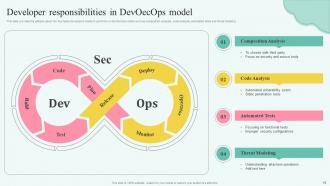
Folie 13 : Diese Folie gibt einen Einblick in die vier Aufgaben, die Entwickler in einem DevSecOps-Modell ausführen müssen.
Folie 14 : Diese Folie bietet einen Einblick in den DevOps-Prozessablauf, der Phasen wie Planen, Kodieren, Erstellen, Testen, Freigeben, Bereitstellen und Betreiben umfasst.
Folie 15 : Diese Folie bietet einen Einblick in die Schritte des DevOps-Prozesses und der DevOps-Methodik.
Folie 16 : Diese Folie bietet einen Einblick in den agilen DevOps-Prozess, der agile Entwicklung, kontinuierliche Integration, Bereitstellung und Tests umfasst.
Folie 17 : Diese Folie bietet einen Einblick in die Einführung des DevOps-Reifemodells, das 5 Schritte abdeckt, wie z. B. anfänglich, verwaltet, definiert, gemessen und optimiert.
Folie 18 : Diese Folie bietet einen Einblick in die DevOps-Tools, die vom Unternehmen zusammen mit ihren Funktionen und Preisen in Betracht gezogen werden können.
Folie 19 : Diese Folie gibt einen Einblick in die sieben Schritte, die bei der Auswahl des richtigen DevOps-Tools für die Organisation erforderlich sind, um die richtige Implementierung anzugehen.
Folie 20 : Diese Folie gibt einen Einblick in den Workflow, der die Toolchain unterstützt.
Folie 21 : Diese Folie bietet einen Einblick in das agile DevOps-Modell, das sich auf Planen, Programmieren, Erstellen, Testen, Freigeben, Bereitstellen, Betreiben und Überwachen konzentriert.
Folie 22 : Diese Folie bietet einen Einblick in den DevOps CI/CD-Prozessablauf, der sich auf Entwicklung, Peer-Review, Qualitätsprüfung, Vorproduktion und Produktion konzentriert.
Folie 23 : Diese Folie bietet einen Einblick in die CI/CD-Pipeline, die sich auf die Codeentwicklung konzentriert.
Folie 24 : Diese Folie bietet einen Einblick in die Schritte zur Implementierung von DevOps in der Organisation.
Folie 25 : Dies ist die Symbolfolie.
Folie 26 : Diese Folie enthält Titel für zusätzliche Folien.
Folie 27 : Diese Folie zeigt die Schritte des DevOps-Prozesses.
Folie 28 : Diese Folie zeigt jährliche Balkendiagramme für verschiedene Produkte.
Folie 29 : Diese Folie zeigt Venn.
Folie 30 : Diese Folie zeigt einen 30-60-90-Tage-Plan für Projekte.
Folie 31 : Diese Folie zeigt eine Mindmap.
Folie 32 : Diese Folie zeigt ein Puzzle zum Anzeigen von Unternehmenselementen.
Folie 33 : Diese Folie zeigt den Jahresverlauf des Unternehmens.
Folie 34 : Diese Folie zeigt generierte Ideen.
Folie 35 : Diese Folie zeigt unser Ziel.
Folie 36 : Dies ist eine Dankesfolie und enthält Kontaktdaten des Unternehmens wie Büroadresse, Telefonnummer usw.
Stages von Devops Flow Powerpoint-Präsentationsfolien mit allen 41 Folien:
Verwenden Sie unsere Powerpoint-Präsentationsfolien zu den Phasen des Devops-Flows, um effektiv dabei zu helfen, wertvolle Zeit zu sparen. Sie sind gebrauchsfertig und passen in jede Präsentationsstruktur.









FAQs for Stages Of Devops Flow
Honestly, you'll want CI/CD as your backbone - that's continuous integration and deployment stuff. Automated testing catches the dumb mistakes before they hit production. Good monitoring is a lifesaver when everything goes sideways at 2am (trust me on this one). Infrastructure as code keeps your environments from being snowflakes that break randomly. Oh, and make sure dev and ops actually talk to each other instead of just lobbing tickets back and forth. My advice? Start by automating whatever manual process makes you want to quit your job first.
So CI automates your code integration - catches problems right when you push instead of later when everything's a mess. Your builds and tests run automatically every time, so you'll know immediately if something breaks. None of that "works on my machine" nonsense anymore. Honestly, the fast feedback is what sold me on it. You can fix bugs right away instead of hunting them down days later when you've forgotten what you even changed. Keeps your main branch actually deployable too, which your future self will thank you for. Start simple with just build automation if you're new to it.
Yeah so automation is huge in DevOps - it cuts out all the tedious manual stuff that bogs teams down. Testing, deployments, infrastructure setup, monitoring. All that can be automated. Your code flows through pipelines way faster with less room for screwups. And honestly, who wants to be doing manual deploys at 2am? (Been there, it sucks.) It frees up your devs and ops people to work on actually interesting problems instead of clicking through the same workflows constantly. My advice? Start with whatever manual process pisses off your team the most and automate that first.
So there are four main things to watch: how often you deploy, lead time from commit to production, failure rates, and recovery time. They're called DORA metrics - pretty much everyone uses them now. Honestly, most teams get a reality check when they first measure this stuff. I'd start with deployment frequency and lead time since those are easiest to track. The failure rate one stings but it's super useful. Set up some basic dashboards to check monthly - you don't need anything fancy at first. You'll spot your biggest problems pretty quickly once you have the data flowing.
Cultural resistance hits hardest tbh. Your dev and ops people don't want their silos broken down - change freaks everyone out. Then you've got technical nightmares like legacy system integration and CI/CD setup. Security teams become massive bottlenecks since they can't keep up with faster deployment cycles. Skills gaps are brutal too. Half your team probably doesn't know containers or infrastructure as code yet. Oh, and tool sprawl will drive you insane if you're not careful. Pick one small project first to show it actually works, then slowly roll it out from there.
Look, DevOps lives or dies by how well your dev and ops teams actually work together. No more of that "build it and throw it over the fence" nonsense. When developers start caring about how their code runs in production and ops gets looped into planning early, everything changes. Deployments get faster, you catch issues before they blow up, and honestly? Way less drama when something inevitably goes wrong. My advice - don't try to revolutionize everything overnight. Start small with something like shared on-call duties or just having both teams in the same retrospectives. Build that trust first.
Git's a must-have, obviously. For CI/CD, Jenkins or GitHub Actions work great. Docker's your friend for containers. Terraform is honestly incredible for managing infrastructure - wish I'd learned it sooner. Monitoring tools like Prometheus will literally save you when everything breaks at 2am (and it will). Slack keeps everyone on the same page and connects to pretty much everything. The real trick isn't picking perfect tools though. Just grab ones that work together nicely. Start simple, then add more complicated stuff as you need it.
Look, monitoring gives you real-time eyes on how your stuff's actually running in production. You'll catch problems before they become disasters - trust me on this one. Basic app monitoring and error tracking is where I'd start, then build up from there. The data feeds back into what you develop next and shows you exactly where things are choking up. It's weird how you never realize how blind you were flying before you had proper monitoring set up. Performance metrics, user behavior, system health - all that flows back into smarter decisions about your next moves.
Honestly, you gotta shift security left - build it into each stage instead of slapping it on later. Get automated scanning in your CI/CD pipeline, do threat modeling during design, set up security gates that'll actually fail builds if needed. Static analysis, dependency checks, container scanning - automate all that stuff. Trust me, manually hunting for vulnerabilities during a 2am hotfix is absolutely miserable. Bring your security folks into sprint planning early, not just when things break. Oh, and start small with one or two checks then expand gradually. Going all-in at once just pisses off developers and creates bottlenecks.
Honestly, containers are a total game-changer for your deployment headaches. Package your app with all its dependencies and boom - it runs the same everywhere. No more "works on my machine" BS between dev and prod. Docker's pretty much the standard now, though the learning curve was steeper than I expected at first. Your CI/CD gets way smoother since there's no environment drift to worry about. Rollbacks become super easy too. I'd say start with containerizing just one service - you'll immediately see how much cleaner everything becomes. Way faster than spinning up whole servers every time.
So DORA metrics are honestly your best bet here - just focus on the big four. Deployment frequency shows how often you're actually shipping stuff. Lead time tracks how long features take from commit to production (this one's usually eye-opening). Change failure rate is basically your quality check, and MTTR tells you how fast you recover when things break. I'd probably start with just these before getting fancy with other metrics - they cover most of what actually matters. Once you track them consistently for a few weeks, you'll see exactly where your team's getting stuck.
Honestly, cloud and DevOps just go together perfectly. You get instant infrastructure whenever you need it, plus all the automation stuff is already there. Spinning up environments takes seconds instead of weeks (remember when we had to wait for hardware?). Most platforms throw in CI/CD pipelines and monitoring tools right out of the box. Auto-scaling happens without you thinking about it. The infrastructure-as-code thing means your environments stay consistent too. I'd definitely start with whatever managed CI/CD service your cloud provider offers - it'll save you tons of headaches.
Honestly, the culture piece is what kills most DevOps attempts. Your dev and ops people need to actually work together instead of that whole "throw it over the wall" thing. Shared responsibility is key - everyone owns both building stuff AND keeping it running. Oh, and ditch the blame game completely. When things break (and they will), focus on what went wrong and how to fix it next time. Joint retrospectives help a lot, plus having devs do some on-call rotations. That last part really opens people's eyes to operational pain points they'd never considered before.
Honestly, the biggest mistake is trying to automate everything right away - total recipe for disaster. Your team will hate you and nothing will work. Most companies just throw tools at the problem without getting people on board first, which is pretty dumb if you ask me. You really need both dev and ops buying in before anything else. Oh, and don't skimp on monitoring because you'll have no clue when stuff breaks. Avoid letting just one team own the whole pipeline too. Pick one app to start with, figure out what works, then expand from there.
Honestly, having a solid DevOps flow is a game changer for speed. You stop wasting time on "wait, what's the next step?" moments and manual approvals that drag everything out. Automated CI/CD pipelines are your best friend here - they'll catch bugs before you're getting angry calls at 2am (trust me on this one). The feedback loops get way faster, deployments actually work, and releases become predictable. Start by mapping out what you're doing now, then figure out which boring manual stuff you can automate. That's how you build something that just flows.
-
The designs are very attractive and easy to edit. Looking forward to downloading more of your PowerPoint Presentations.
-
The best collection of PPT templates!! Totally worth the money.