

Diapositivas de presentación de Powerpoint de flujo de etapas de Devops





Try Before you Buy Download Free Sample Product
 Impress Your
Audience
 100%
Editable
 Save Hours
of Time


DevOps es la combinación de varias prácticas y herramientas que ayuda a aumentar la capacidad de las organizaciones para entregar aplicaciones y servicios más rápido. Consulte nuestra plantilla de TI de proceso DevOps diseñada de manera competente que define DevOps en una organización centrándose en el desarrollo, las operaciones y la garantía de calidad. Hemos esbozado los principios fundamentales de la cultura DevOps, sus objetivos y logros, beneficios y desafíos, y más. La plantilla presenta detalles relacionados con la metodología con las ventajas, alineando los principios con las prácticas y los desafíos, la estructura de la organización de TI, etc. Incluso se pueden exhibir las responsabilidades del desarrollador, el flujo del proceso, los pasos involucrados en la metodología, el proceso ágil y más. La perspicaz presentación de PowerPoint muestra detalles relacionados con el modelo de madurez adoptado, la elección de las herramientas adecuadas para la empresa, los pasos considerados al seleccionar las herramientas, etc. la canalización de entrega de la implementación y las formas de implementar DevOps en una organización. Descarga esta plantilla 100% editable. Personalízalo según tus necesidades ahora.
People who downloaded this PowerPoint presentation also viewed the following :
Contenido de esta presentación de Powerpoint
Diapositiva 1 : esta diapositiva muestra el título Etapas del flujo de DevOps.
Diapositiva 2 : Esta diapositiva muestra el título Agenda.
Diapositiva 3 : Esta diapositiva muestra la tabla de contenido.
Diapositiva 4 : Esta diapositiva muestra el índice.
Diapositiva 5 : esta diapositiva brinda una idea de cómo definir DevOps en la organización, que se enfoca en el desarrollo, las operaciones y el control de calidad para una retroalimentación continua.
Diapositiva 6 : esta diapositiva brinda una idea de los principios de IT DevOps, como la automatización, la iteración, la mejora continua y la colaboración.
Diapositiva 7 : esta diapositiva brinda una idea de los objetivos y logros para establecer DevOps en la organización.
Diapositiva 8 : esta diapositiva brinda una idea de los beneficios y desafíos de DevOps que cubre los detalles de las ventajas y los problemas que enfrenta la empresa.
Diapositiva 9 : esta diapositiva brinda una idea de los beneficios comerciales de DevOps.
Diapositiva 10 : esta diapositiva brinda una idea de las metodologías de DevOps.
Diapositiva 11 : esta diapositiva brinda una idea de los principios, prácticas y desafíos de DevOps para una mejor comprensión de DevOps y su aplicación en la organización.
Diapositiva 12 : esta diapositiva brinda una idea de los 4 niveles de la estructura de la organización de TI.
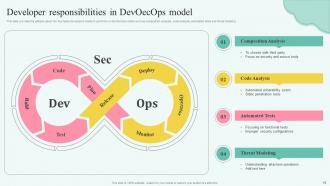
Diapositiva 13 : esta diapositiva brinda una idea de las cuatro tareas que los desarrolladores deben realizar en un modelo DevSecOps.
Diapositiva 14 : esta diapositiva brinda una idea del flujo del proceso DevOps que cubre etapas como planificar, codificar, crear, probar, lanzar, implementar y operar.
Diapositiva 15 : esta diapositiva brinda una idea de los pasos involucrados en el proceso y la metodología de DevOps.
Diapositiva 16 : esta diapositiva brinda una idea del proceso ágil de DevOps que cubre el desarrollo ágil, la integración continua, la entrega y las pruebas.
Diapositiva 17 : esta diapositiva brinda una idea de la adopción del modelo de madurez de DevOps que cubre 5 pasos, como inicial, administrado, definido, medido y optimizado.
Diapositiva 18 : esta diapositiva brinda una idea de las herramientas DevOps que la empresa puede considerar junto con sus características y precios.
Diapositiva 19 : esta diapositiva brinda una idea de los siete pasos necesarios al elegir la herramienta DevOps adecuada para que la organización se acerque a la implementación correcta.
Diapositiva 20 : esta diapositiva brinda una idea del flujo de trabajo de soporte de la cadena de herramientas.
Diapositiva 21 : esta diapositiva brinda una idea del modelo ágil de DevOps que se enfoca en planificar, codificar, construir, probar, lanzar, implementar, operar y monitorear.
Diapositiva 22 : esta diapositiva brinda una idea del flujo del proceso CI/CD de DevOps que se centra en el desarrollo, la revisión por pares, la auditoría de calidad, la preproducción y la producción.
Diapositiva 23 : esta diapositiva brinda una idea de la canalización de CI/CD que se enfoca en el desarrollo de código.
Diapositiva 24 : esta diapositiva brinda una idea de los pasos involucrados en la implementación de DevOps en la organización.
Diapositiva 25 : Esta es la diapositiva de iconos.
Diapositiva 26 : Esta diapositiva presenta el título de las diapositivas adicionales.
Diapositiva 27 : esta diapositiva muestra los pasos del proceso DevOps.
Diapositiva 28 : esta diapositiva muestra un gráfico de barras anual para diferentes productos.
Diapositiva 29 : Esta diapositiva muestra a Venn.
Diapositiva 30 : Esta diapositiva muestra un plan de 30-60-90 días para proyectos.
Diapositiva 31 : Esta diapositiva muestra un mapa mental.
Diapositiva 32 : esta diapositiva muestra un rompecabezas para mostrar elementos de la empresa.
Diapositiva 33 : Esta diapositiva muestra la cronología anual de la empresa.
Diapositiva 34 : Esta diapositiva muestra las ideas generadas.
Diapositiva 35 : Esta diapositiva muestra Nuestro objetivo.
Diapositiva 36 : Esta es una diapositiva de agradecimiento y contiene detalles de contacto de la empresa, como la dirección de la oficina, el número de teléfono, etc.
Stages Of Devops Flow Diapositivas de presentación de Powerpoint con las 41 diapositivas:
Utilice nuestras diapositivas de presentación de Powerpoint de Stages Of Devops Flow para ayudarlo de manera efectiva a ahorrar su valioso tiempo. Están listos para encajar en cualquier estructura de presentación.









FAQs for Stages Of Devops Flow
Honestly, you'll want CI/CD as your backbone - that's continuous integration and deployment stuff. Automated testing catches the dumb mistakes before they hit production. Good monitoring is a lifesaver when everything goes sideways at 2am (trust me on this one). Infrastructure as code keeps your environments from being snowflakes that break randomly. Oh, and make sure dev and ops actually talk to each other instead of just lobbing tickets back and forth. My advice? Start by automating whatever manual process makes you want to quit your job first.
So CI automates your code integration - catches problems right when you push instead of later when everything's a mess. Your builds and tests run automatically every time, so you'll know immediately if something breaks. None of that "works on my machine" nonsense anymore. Honestly, the fast feedback is what sold me on it. You can fix bugs right away instead of hunting them down days later when you've forgotten what you even changed. Keeps your main branch actually deployable too, which your future self will thank you for. Start simple with just build automation if you're new to it.
Yeah so automation is huge in DevOps - it cuts out all the tedious manual stuff that bogs teams down. Testing, deployments, infrastructure setup, monitoring. All that can be automated. Your code flows through pipelines way faster with less room for screwups. And honestly, who wants to be doing manual deploys at 2am? (Been there, it sucks.) It frees up your devs and ops people to work on actually interesting problems instead of clicking through the same workflows constantly. My advice? Start with whatever manual process pisses off your team the most and automate that first.
So there are four main things to watch: how often you deploy, lead time from commit to production, failure rates, and recovery time. They're called DORA metrics - pretty much everyone uses them now. Honestly, most teams get a reality check when they first measure this stuff. I'd start with deployment frequency and lead time since those are easiest to track. The failure rate one stings but it's super useful. Set up some basic dashboards to check monthly - you don't need anything fancy at first. You'll spot your biggest problems pretty quickly once you have the data flowing.
Cultural resistance hits hardest tbh. Your dev and ops people don't want their silos broken down - change freaks everyone out. Then you've got technical nightmares like legacy system integration and CI/CD setup. Security teams become massive bottlenecks since they can't keep up with faster deployment cycles. Skills gaps are brutal too. Half your team probably doesn't know containers or infrastructure as code yet. Oh, and tool sprawl will drive you insane if you're not careful. Pick one small project first to show it actually works, then slowly roll it out from there.
Look, DevOps lives or dies by how well your dev and ops teams actually work together. No more of that "build it and throw it over the fence" nonsense. When developers start caring about how their code runs in production and ops gets looped into planning early, everything changes. Deployments get faster, you catch issues before they blow up, and honestly? Way less drama when something inevitably goes wrong. My advice - don't try to revolutionize everything overnight. Start small with something like shared on-call duties or just having both teams in the same retrospectives. Build that trust first.
Git's a must-have, obviously. For CI/CD, Jenkins or GitHub Actions work great. Docker's your friend for containers. Terraform is honestly incredible for managing infrastructure - wish I'd learned it sooner. Monitoring tools like Prometheus will literally save you when everything breaks at 2am (and it will). Slack keeps everyone on the same page and connects to pretty much everything. The real trick isn't picking perfect tools though. Just grab ones that work together nicely. Start simple, then add more complicated stuff as you need it.
Look, monitoring gives you real-time eyes on how your stuff's actually running in production. You'll catch problems before they become disasters - trust me on this one. Basic app monitoring and error tracking is where I'd start, then build up from there. The data feeds back into what you develop next and shows you exactly where things are choking up. It's weird how you never realize how blind you were flying before you had proper monitoring set up. Performance metrics, user behavior, system health - all that flows back into smarter decisions about your next moves.
Honestly, you gotta shift security left - build it into each stage instead of slapping it on later. Get automated scanning in your CI/CD pipeline, do threat modeling during design, set up security gates that'll actually fail builds if needed. Static analysis, dependency checks, container scanning - automate all that stuff. Trust me, manually hunting for vulnerabilities during a 2am hotfix is absolutely miserable. Bring your security folks into sprint planning early, not just when things break. Oh, and start small with one or two checks then expand gradually. Going all-in at once just pisses off developers and creates bottlenecks.
Honestly, containers are a total game-changer for your deployment headaches. Package your app with all its dependencies and boom - it runs the same everywhere. No more "works on my machine" BS between dev and prod. Docker's pretty much the standard now, though the learning curve was steeper than I expected at first. Your CI/CD gets way smoother since there's no environment drift to worry about. Rollbacks become super easy too. I'd say start with containerizing just one service - you'll immediately see how much cleaner everything becomes. Way faster than spinning up whole servers every time.
So DORA metrics are honestly your best bet here - just focus on the big four. Deployment frequency shows how often you're actually shipping stuff. Lead time tracks how long features take from commit to production (this one's usually eye-opening). Change failure rate is basically your quality check, and MTTR tells you how fast you recover when things break. I'd probably start with just these before getting fancy with other metrics - they cover most of what actually matters. Once you track them consistently for a few weeks, you'll see exactly where your team's getting stuck.
Honestly, cloud and DevOps just go together perfectly. You get instant infrastructure whenever you need it, plus all the automation stuff is already there. Spinning up environments takes seconds instead of weeks (remember when we had to wait for hardware?). Most platforms throw in CI/CD pipelines and monitoring tools right out of the box. Auto-scaling happens without you thinking about it. The infrastructure-as-code thing means your environments stay consistent too. I'd definitely start with whatever managed CI/CD service your cloud provider offers - it'll save you tons of headaches.
Honestly, the culture piece is what kills most DevOps attempts. Your dev and ops people need to actually work together instead of that whole "throw it over the wall" thing. Shared responsibility is key - everyone owns both building stuff AND keeping it running. Oh, and ditch the blame game completely. When things break (and they will), focus on what went wrong and how to fix it next time. Joint retrospectives help a lot, plus having devs do some on-call rotations. That last part really opens people's eyes to operational pain points they'd never considered before.
Honestly, the biggest mistake is trying to automate everything right away - total recipe for disaster. Your team will hate you and nothing will work. Most companies just throw tools at the problem without getting people on board first, which is pretty dumb if you ask me. You really need both dev and ops buying in before anything else. Oh, and don't skimp on monitoring because you'll have no clue when stuff breaks. Avoid letting just one team own the whole pipeline too. Pick one app to start with, figure out what works, then expand from there.
Honestly, having a solid DevOps flow is a game changer for speed. You stop wasting time on "wait, what's the next step?" moments and manual approvals that drag everything out. Automated CI/CD pipelines are your best friend here - they'll catch bugs before you're getting angry calls at 2am (trust me on this one). The feedback loops get way faster, deployments actually work, and releases become predictable. Start by mapping out what you're doing now, then figure out which boring manual stuff you can automate. That's how you build something that just flows.
-
The designs are very attractive and easy to edit. Looking forward to downloading more of your PowerPoint Presentations.
-
The best collection of PPT templates!! Totally worth the money.