


Stakeholder management plan for different roles




Try Before you Buy Download Free Sample Product
 Impress Your
 Audience
 100%
100% Editable
 Save Hours
 of Time


Our Stakeholder Management Plan For Different Roles are topically designed to provide an attractive backdrop to any subject. Use them to look like a presentation pro.
People who downloaded this PowerPoint presentation also viewed the following :
Content of this Powerpoint Presentation
Once a business is established, it is really all about stakeholder management in ensuring that projects go onstream well. For instance, suppliers are stakeholders in the project (be it external); other stakeholders are the quality inspector, the supervisor, the machine maker, etc.
Here's a hands-on stakeholder management plan that lists the steps to create the perfect roster to engage all stakeholders.
If the stakeholders are not managed correctly to ensure that they are aligned with the project's success, work stalls.
SlideTeam has designed PPT templates that offer exquisite solutions to the predicament faced by businesses.
With this template, business management knows exactly what to do with varied stakeholders and which stakeholders are interested in which results. This makes it easy to ensure pinpoint accuracy in showcasing the project's progress.
Each of the project's templates is also 100% editable and customizable, ensuring you have a starting point and the ability to customize.
Let's explore!
Template 1 Stakeholder Management Plan for Different Roles PPT Template

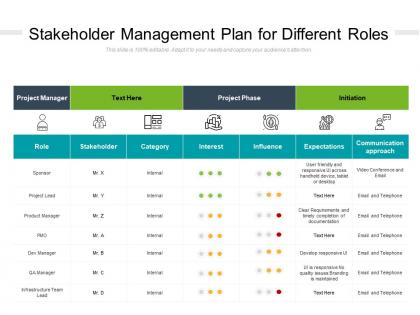
Use this prebuilt stakeholder management plan PowerPoint Template to plan, implement, and monitor an organization's stakeholder management activities. This ready-to-use presentation template for project managers helps you evaluate the operations and functions of the business in terms of the role of stakeholders, their expectations, and their communication approach.
Showcase the role of the stakeholder, their names, and category (whether internal or external). Then, under the project phases, understand the influence each of these stakeholders wields and the influence each exerts on the outcome of the task and project. This PowerPoint Template also comprises sections on expectations and communications approach. The idea is to understand the expectations and ensure the project is in line to meet these with utmost clarity, focus, and impact. For instance, a quality assurance manager is interested in ensuring that the user interface is responsive, there are no quality issues, and branding is maintained. His influence on the fate of the project is moderate, as is his interest. Get this template now!
TAKE CARE OF HUMAN ELEMENT
It is important to note that stakeholder management is an art in project management and business. It ensures there are no ego clashes and attempts to bring each critical stakeholder's perception in line with reality as businesses execute projects. A good project cannot proceed to the execution stage if stakeholders remain misaligned. Get this template on stakeholder management to set things right.
PS Here's the stakeholder management plan that also gives status. Get it here.
Stakeholder management plan for different roles with all 2 slides:
Use our Stakeholder Management Plan For Different Roles to effectively help you save your valuable time. They are readymade to fit into any presentation structure.
FAQs for Stakeholder management plan
Start with figuring out who all your stakeholders actually are, then plot them on a simple grid - high/low influence vs high/low interest. Here's where people screw up though: ask what they care about instead of assuming you know. Different groups need different approaches for communication. I learned this the hard way on a project last year. Keep talking to them regularly, not just when you need something. Things change fast so you'll have to adjust your strategy as you go. Honestly, just make that stakeholder matrix this week - future you will thank you when everything gets messy.
Honestly, stakeholder analysis is a game-changer because it shows you who actually has power and what they care about. Map everyone out early - you'll catch potential blockers before they become problems and find allies you didn't know existed. I learned this the hard way when a "minor" stakeholder torpedoed my timeline because nobody bothered asking what they needed. Rate people by their influence and interest levels, then adjust how you talk to them accordingly. Some folks just want updates, others need the full strategy. Oh, and don't forget the quiet ones - they're often your best champions once they're on board.
Definitely go with a stakeholder mapping matrix - just plot everyone on a grid based on their power vs how much they care about your project. The power-interest one is super straightforward and honestly does most of the heavy lifting. There's fancier stuff like influence-impact matrices or the salience model (power, legitimacy, urgency) but eh, you can always get into those later. Oh and stakeholder registers are clutch for tracking all the messy details. Start simple though - that basic power-interest grid will get you like 80% there without overthinking it.
Oh man, cultural stuff will totally mess with your project if you're not careful. Some cultures are brutally direct, others hint around problems forever - leads to chaos when people miss the subtext. Meeting styles clash hard too. I did this nightmare project with Japanese and German teams once... completely different approaches to everything! Time zones were bad enough without the cultural confusion. Hierarchy expectations are wildly different depending on where your stakeholders are from. Same with how they handle conflict. Do yourself a favor and research their norms upfront. Then adjust how you communicate with each group.
Okay so first thing - figure out who your stakeholders are and how they like getting info. Some want all the details, others just care about the big wins. Do a quick analysis of who has power and who actually cares (trust me, this step is clutch). Set up regular check-ins based on what each person needs. Your CEO wants totally different stuff than your project team does. Be upfront about problems early - nobody likes surprises. Oh and whatever communication schedule you pick, actually stick to it. People get annoyed when updates just randomly stop happening.
Honestly, just send out quick surveys every few weeks - nothing complicated, just ask how they feel about progress and communication. Watch for the subtle stuff too though. Are they responding to emails quickly? Actually showing up to meetings? Sometimes silence tells you more than words do. Happy stakeholders will throw resources your way when you need them, while frustrated ones start changing scope or dragging their feet on approvals. I learned this the hard way on my last project. Response times and meeting attendance are surprisingly good indicators. Start with a basic satisfaction survey this week and see what you get back.
Honestly, communication makes or breaks everything with stakeholders. You've gotta get ahead of it - share updates, changes, roadblocks before they start freaking out or making stuff up in their heads. I can't tell you how many projects I've watched implode because someone figured "oh they probably know what's going on." Spoiler: they don't. Set up regular check-ins and be straight with them about timelines and constraints. Even bad news is better than radio silence. Trust me on this one - start those conversations now before things get messy.
Tech totally streamlines stakeholder stuff by keeping everything in one spot. CRM systems track all your conversations and send follow-up reminders automatically. Plus you can build stakeholder maps showing who has influence and what they actually care about. Sure, the constant notifications get annoying (I swear my phone never stops buzzing), but it's better than forgetting to check in with someone important. Real-time updates through collaboration platforms are clutch, and analytics help you see if people are actually engaged. Just start basic though - even a Google Sheet works. Don't go crazy with expensive software yet.
Oh man, conflicting priorities are brutal - stakeholders all want different things and nobody talks to each other properly. Map out who wants what from day one, trust me on this. Regular check-ins help catch issues before they blow up. When interests clash (and they will), just be honest about the trade-offs. People can handle not getting everything if they feel heard. Also, stakeholder matrices might sound boring but they're lifesavers. Seriously wish I'd learned that one earlier!
Honestly, just collecting feedback isn't enough - you've gotta actually do something with it. Schedule regular check-ins with your key people (surveys work, but I prefer just talking to them directly). Track everything in a simple doc: what they said, how you responded, what you changed. When feedback conflicts - and it will - prioritize based on who has the most influence on your project's success. Oh, and this is crucial: always circle back to explain what you're implementing and why some ideas won't work. People hate being ignored. Start with your most important stakeholders and get those meetings on the calendar today.
Figure out what each person actually wants first - you'd be surprised how often they're worried about totally different things. Get them talking directly instead of you being the middleman (that's always a mess). Sometimes there's no perfect solution, and that's when you just have to own your decision and explain your reasoning. Write stuff down so people know you listened, even if you went another direction. Oh, and catch up with everyone regularly before small annoyances turn into actual drama.
Honestly, transparency is everything when it comes to stakeholder trust. Being upfront about challenges and decisions makes people feel like they're actually part of what's happening. I've watched so many relationships completely implode because someone tried hiding bad news or making problems sound better than they were. People aren't stupid - they can tell when you're being sketchy about something. Even delivering crappy updates builds more trust than trying to cover things up. Bad news doesn't get better with age, you know? Just make being honest your go-to approach instead of only when it's easy.
Honestly, just be straight with everyone - don't sugarcoat the bad stuff or promise timelines you can't hit. Fairness is huge too. I've watched so many people mess this up by managing up while keeping others totally in the dark about what's actually going on. Oh, and watch out for conflicts of interest or playing favorites. That stuff comes back to bite you. Here's what I do: before making any call, I ask myself if I'd be cool with this decision being public tomorrow. Sounds paranoid but it's saved me more times than I can count. If you get that gut feeling of "hmm maybe not," trust it and find another way.
Start by figuring out what everyone actually wants - like, their real concerns, not just what they say in meetings. Some people's opinions carry more weight, so prioritize accordingly. Document their success metrics and look for areas where interests overlap. When there's conflict (and there will be), get everyone talking openly about constraints and the bigger picture. I swear, half the drama disappears when people understand why certain decisions get made. Keep communication flowing regularly - weekly stakeholder check-ins work well. Track everything so you can spot when priorities shift.
Your stakeholder management plan is basically your "who's who" guide for the project. It spells out who makes decisions, how info gets passed around, and what approval hoops you'll jump through. Without one? Total mess. People will be stepping all over each other or you'll accidentally freeze out someone important. Map out who has real influence first - that's key. Keep it updated too since projects change and so do stakeholders. Honestly, I've seen projects derail just because nobody knew who actually had authority to approve stuff. It's like having everyone's contact info organized before the chaos hits.
No Reviews