


Stakeholders engagement powerpoint slide presentation examples





Try Before you Buy Download Free Sample Product
 Impress Your
 Audience
 100%
100% Editable
 Save Hours
 of Time


Decide on avenues to follow with our Stakeholders Engagement Powerpoint Slide Presentation Examples. They allow you to gauge the future.
People who downloaded this PowerPoint presentation also viewed the following :
Content of this Powerpoint Presentation
Description:
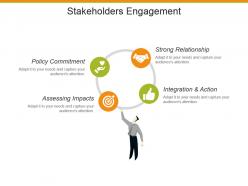
The image depicts a PowerPoint slide titled "Stakeholders Engagement," designed to present a circular process flow with four elements, symbolizing an ongoing cycle of stakeholder engagement. The elements include:
1. Policy Commitment:
This section suggests the need for organizations to develop and commit to policies that consider stakeholder interests.
2. Assessing Impacts:
This indicates the importance of understanding how decisions and actions affect stakeholders.
3. Integration & Action:
This element emphasizes the integration of stakeholder feedback into organizational actions.
4. Strong Relationship:
This final section underscores the goal of building strong relationships with stakeholders through engagement and trust.
Use Cases:
This type of slide is broadly applicable across multiple industries, particularly those where stakeholder engagement is crucial for success. Here are seven industries and respective uses:
1. Environmental Consulting:
Use: Presenting strategies for engaging with community stakeholders in environmental projects.
Presenter: Environmental Project Manager.
Audience: Project team, community leaders.
2. Financial Services:
Use: Outlining how to engage with investors and customers to build trust.
Presenter: Customer Relationship Manager.
Audience: Clients, investors, company staff.
3. Healthcare:
Use: Discussing patient engagement and feedback integration for service improvement.
Presenter: Healthcare Administrator.
Audience: Healthcare providers, patient advocacy groups.
4. Non-Profit Organizations:
Use: Demonstrating engagement with donors, volunteers, and beneficiaries.
Presenter: Program Director.
Audience: Donors, volunteers, beneficiaries.
5. Construction:
Use: Engaging with local communities and authorities in infrastructure projects.
Presenter: Community Relations Manager.
Audience: Local community groups, government officials.
6. Education:
Use: Building relationships with stakeholders such as parents, students, and faculty.
Presenter: School Administrator.
Audience: Parents, students, teaching staff.
7. Technology:
Use: Involving users in the development process of new tech products.
Presenter: User Experience Designer.
Audience: Users, development team members.
Stakeholders engagement powerpoint slide presentation examples with all 5 slides:
Our Stakeholders Engagement Powerpoint Slide Presentation Examples cut across decades. Gain access to the classical and the contemporary.
FAQs for Stakeholders engagement powerpoint
Key elements include stakeholder mapping and analysis, clear communication channels, regular feedback mechanisms, transparent reporting processes, and defined engagement objectives. These components work together by identifying relevant parties, establishing consistent dialogue, and measuring engagement effectiveness, with many organizations finding that strategic stakeholder involvement enhances project outcomes, builds trust, and ultimately delivers sustainable competitive advantage through collaborative decision-making.
Organizations identify and prioritize stakeholders through stakeholder mapping, impact assessment, influence analysis, and engagement surveys. These strategic approaches enable companies to categorize stakeholders by their influence level, project impact, and business relevance, with many organizations finding that systematic prioritization frameworks streamline resource allocation and enhance stakeholder relationships, ultimately delivering stronger project outcomes and competitive advantage.
Communication serves as the foundation for stakeholder trust by ensuring transparency, managing expectations, setting clear objectives, and providing regular updates on progress and challenges. Through consistent dialogue, organizations build credibility, address concerns proactively, and align diverse stakeholder interests, with many companies finding that strategic communication ultimately delivers stronger partnerships and sustainable business outcomes.
Stakeholder feedback can be integrated through regular surveys, focus groups, advisory committees, digital collaboration platforms, and structured review sessions at key project milestones. These engagement mechanisms enable project teams to incorporate diverse perspectives, identify potential risks early, and adjust strategies accordingly, with many organizations finding that systematic feedback integration ultimately enhances project outcomes and stakeholder buy-in.
Best practices for stakeholder analysis include mapping all relevant parties, assessing their influence and interest levels, categorizing by priority, documenting their needs and expectations, and establishing communication preferences. This systematic approach enables organizations to tailor engagement strategies effectively, prioritize resource allocation strategically, and build stronger relationships, with many finding that thorough analysis ultimately delivers enhanced project outcomes and stakeholder satisfaction.
Technology enhances stakeholder engagement through digital collaboration platforms, real-time communication tools, data analytics for personalized outreach, mobile applications, and automated feedback systems. These solutions streamline communication by enabling instant updates, targeted messaging, and continuous dialogue, with organizations in healthcare, finance, and retail finding significantly improved participation rates and stakeholder satisfaction.
Tailoring engagement approaches is essential because different stakeholder groups have distinct interests, communication preferences, influence levels, and decision-making processes that require customized strategies. Investors prioritize financial returns and risk mitigation, while employees focus on job security and development opportunities, and customers emphasize value and service quality, with organizations finding that targeted approaches significantly enhance buy-in and collaboration.
Stakeholder engagement metrics include response rates to surveys and consultations, attendance at meetings and events, sentiment analysis scores, feedback quality assessments, and stakeholder satisfaction ratings. These measurements enable organizations to track participation levels, assess relationship strength, and evaluate communication effectiveness, with many companies finding that consistent monitoring ultimately delivers improved project outcomes and stronger stakeholder trust.
Organizations manage conflicting stakeholder interests through structured dialogue, transparent communication, and strategic prioritization frameworks that identify common ground while addressing diverse concerns. By implementing regular stakeholder forums, mediation processes, and collaborative decision-making models, companies in sectors like healthcare and manufacturing successfully balance competing demands, ultimately delivering sustainable solutions that enhance relationships and maintain operational efficiency.
Common stakeholder engagement challenges include conflicting interests, communication barriers, resource constraints, resistance to change, and managing diverse expectations across multiple groups. These obstacles can be overcome by establishing clear communication channels, conducting regular feedback sessions, and implementing structured consultation processes, with many organizations finding that early involvement and transparent decision-making ultimately delivers stronger buy-in and sustainable project outcomes.
Stakeholder engagement enhances sustainability and corporate social responsibility by incorporating diverse perspectives into decision-making, identifying community needs and environmental priorities, and building transparent accountability mechanisms. Through regular dialogue with employees, customers, investors, and local communities, organizations develop more effective sustainability strategies, reduce operational risks, and strengthen their social license to operate, ultimately delivering enhanced reputation and long-term competitive advantage.
Failing to engage stakeholders creates significant organizational risks including project failures, resource misallocation, reduced buy-in, compliance issues, and damaged relationships. These oversights often result in costly redesigns, delayed implementations, and missed strategic opportunities, with many companies finding that early stakeholder involvement ultimately delivers smoother execution and sustainable competitive advantage.
Visual presentation tools enhance stakeholder engagement communication through interactive dashboards, infographic summaries, stakeholder mapping visualizations, engagement timeline charts, and feedback analysis graphics. These tools streamline complex data into digestible formats, enabling organizations to showcase participation levels, sentiment trends, and actionable insights, while ultimately delivering transparent reporting and stronger stakeholder relationships across diverse audiences.
Stakeholder engagement in risk management involves identifying potential risks through diverse perspectives, ensuring comprehensive risk assessment, building collaborative mitigation strategies, and maintaining transparent communication throughout the process. Through systematic stakeholder involvement, organizations enhance their risk identification capabilities, improve decision-making quality, and build stronger resilience frameworks, with many financial services and healthcare institutions finding that inclusive engagement ultimately delivers more robust risk management outcomes.
Organizations leverage stakeholder engagement to drive innovation by collecting diverse perspectives, identifying unmet needs, co-creating solutions, and accessing external expertise through collaborative partnerships. Through structured feedback mechanisms and innovation workshops, companies like pharmaceutical firms and tech organizations accelerate product development, reduce market risks, and ultimately deliver more targeted solutions while building stronger stakeholder relationships.
-
Best Representation of topics, really appreciable.
-
Great designs, really helpful.