

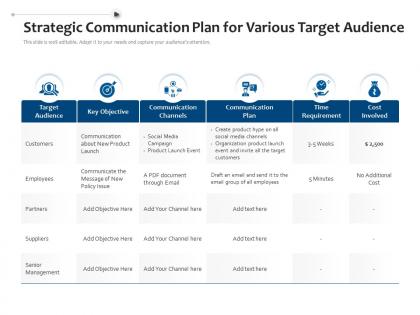
Strategic communication plan for various target audience




Try Before you Buy Download Free Sample Product
 Impress Your
 Audience
 100%
100% Editable
 Save Hours
 of Time


Our Strategic Communication Plan For Various Target Audience are topically designed to provide an attractive backdrop to any subject. Use them to look like a presentation pro.
People who downloaded this PowerPoint presentation also viewed the following :
Strategic communication plan for various target audience with all 2 slides:
Use our Strategic Communication Plan For Various Target Audience to effectively help you save your valuable time. They are readymade to fit into any presentation structure.
FAQs for Strategic communication plan for
Honestly, start by figuring out who actually needs to hear this message - that's your foundation. Then work backwards from there. You'll need clear goals (like what are you even trying to accomplish?), different messages for each audience since your CEO cares about totally different stuff than your customers do, and pick the right channels to reach everyone. Measurable outcomes are key too - otherwise how do you know if it worked? Timeline's obvious but I always forget how everything drags on forever. The messaging thing is probably the trickiest part though.
Honestly, start with KPIs that actually matter - message reach, engagement rates, sentiment stuff, whether people's behavior changed. Track the numbers (website traffic, social shares, media mentions) but also get real feedback through surveys or focus groups. Here's the thing though - vanity metrics are useless. They look nice in reports but don't tell you jack about impact. What you really need to know is if your communication moved things forward on your actual business goals. I'd do quarterly check-ins instead of waiting a whole year. Connect everything back to outcomes your company genuinely cares about.
Honestly, audience analysis is everything - it's what makes or breaks your whole strategy. Think about it: if you don't know who you're talking to, what they actually care about, or how they like getting info, you're just throwing stuff at the wall. And trust me, most of it won't stick. Your messaging needs to flow from understanding your audience first. Same goes for which channels you pick, when you post, even how you sound. I always tell people to build out those audience personas before writing anything. Yeah, it feels like extra work upfront, but it'll make everything you create way more effective.
Look, strategic communication works because you're actually talking TO people instead of AT them. Map out who you're dealing with first - investors obsess over numbers, employees worry about how changes affect their jobs. Listen to what's really bugging each group, then speak their language. Honestly, most companies just blast generic updates and wonder why nobody cares. When you address specific concerns, people feel like you get it. Short version: figure out what keeps each stakeholder group awake at night, then craft messages that actually answer those worries. It's not rocket science, but it works.
Speed is everything here. Don't let silence make you look guilty - others will control the story if you don't act fast. Be upfront about what you actually know (and what you don't). Pick ONE person to speak for your company - mixed messages are a nightmare. Get legal to check everything first, obviously. We screwed this up once by waiting too long, honestly learned my lesson there. Your response needs to match your company values and hit what people are actually worried about. Set up regular updates so stakeholders aren't left hanging. Practice different scenarios ahead of time so you're not totally scrambling when something hits.
Dude, culture totally changes the game with strategic communication. What kills it in Germany might bomb in Japan, you know? Germans want all the data and details upfront. But in a lot of Asian cultures? You've gotta build relationships first - honestly, I learned this the hard way once. Your messaging style needs to shift too. Some places appreciate direct communication, others think it's rude. Even timing matters. Don't forget about hierarchy stuff - some teams expect everything to go through formal channels. My advice? Research the cultural context first and definitely pick the brains of local team members.
Analytics tools are game-changers for tracking how your messages actually perform with audiences. Social listening catches brand conversations before they spiral (trust me, worth it). Automation keeps your messaging consistent across platforms while giving you headspace for bigger picture stuff. AI personalizes content at scale, which sounds fancy but it's basically just smart customization. Sentiment analysis tells you if people love or hate what you're saying - way better than guessing. Oh, and you can pivot fast when something flops. Just pick one tool that fixes your biggest headache right now.
Figure out what your business actually wants to hit - more customers, bigger market share, whatever. Then make sure your messaging points directly at those goals. Every campaign needs to connect back to the numbers that matter. Honestly, I've watched so many teams create gorgeous content that does absolutely nothing for the bottom line. Get your comms people into those quarterly meetings where the real priorities get discussed. Your CEO doesn't care about engagement metrics if they don't translate to revenue. Build tracking that shows how your communication work drives the KPIs leadership obsesses over. Otherwise you're just making pretty things in a vacuum.
Honestly, the worst mistake is trying to talk to "everyone" - that's a recipe for disaster. You gotta nail down your exact audience first. Also, don't set wimpy goals like "raise awareness" without actual numbers to hit. I learned this the hard way, but stakeholder mapping is huge - missed one key person once and it tanked the whole thing. Most people forget communication goes both ways too. You need feedback, not just shouting into the void. Oh, and always start with: who are we actually talking to and what do we want them to DO?
Look, storytelling beats data dumps every time. You're basically wrapping your message in a narrative that hits people emotionally instead of just throwing facts at them. Case studies crush feature lists - way more engaging, right? Customer wins, founder backstories, even made-up scenarios work great for showing value. Here's the thing though: your story structure needs to match what you're actually trying to do. Building trust? Pushing for action? Pick your emotion first, then build a story that gets you there naturally. Honestly works better than most marketing tactics I've tried.
Track your reach and engagement first - that's the easy stuff. Then dig into awareness surveys and see if people actually remember your key messages. Social listening tools are honestly a game-changer here because they'll tell you if your audience totally missed the point. The hard part? Measuring whether people actually change their behavior based on what you're saying. That takes way longer to figure out. I'd start with basic before/after surveys to get your baseline, then watch for your talking points showing up in conversations and feedback.
Honestly, your internal team is like the foundation for everything external. If people inside your company don't get the message or aren't bought in, that confusion bleeds through to customers immediately. Your employees become your best ambassadors when they actually believe in what you're selling - every interaction, every social post, even random conversations at coffee shops. Mixed signals are so obvious to audiences. I learned this the hard way at my last job... we kept wondering why our campaigns felt off until we realized half our team was skeptical about our own strategy. Get your people on board first, then worry about everyone else.
Honestly, leadership makes or breaks the whole thing. If they're not actually living the message, everyone sees right through it - and corporate BS is so obvious these days. You need them bought in from day one, not just rubber-stamping stuff later. The good news? When leaders actually champion your strategy, it gets real momentum fast. They can knock down those annoying department walls too. Get them modeling the messaging and keeping priorities straight. Without that top-down alignment, you're just shouting into the void while different teams pull in opposite directions.
Start collecting feedback from day one - surveys, focus groups, casual chats, whatever works. Social media is honestly your best friend here because people will roast you whether you want it or not lol. The real magic happens when you actually DO something with what you hear. I'd set up something simple: gather feedback weekly, look at patterns monthly, then shift your whole approach every quarter if needed. Don't just collect data and let it sit there though - that's where most people mess up. Quick check-ins with your main audiences will save you so much headache later.
Okay so three things that actually work: tell people WHY you're making the change, start talking about it way earlier than feels comfortable, and hit them through different channels - email, meetings, whatever. Most leaders screw this up by waiting too long to say anything. People hate surprises at work, even good ones sometimes. Don't just broadcast either - create ways for them to give feedback so they feel heard. Oh and map out who's affected most and tailor your message to each group. Generic announcements are basically useless.
-
Out of the box and creative design.
-
Great product with effective design. Helped a lot in our corporate presentations. Easy to edit and stunning visuals.
-
Awesome presentation, really professional and easy to edit.
-
Excellent products for quick understanding.
-
Helpful product design for delivering presentation.
-
Great experience, I would definitely use your services further.
-
Unique research projects to present in meeting.
-
I discovered this website through a google search, the services matched my needs perfectly and the pricing was very reasonable. I was thrilled with the product and the customer service. I will definitely use their slides again for my presentations and recommend them to other colleagues.