


Strategy Palette Powerpoint Presentation Slides




Try Before you Buy Download Free Sample Product
 Impress Your
 Audience
 100%
100% Editable
 Save Hours
 of Time


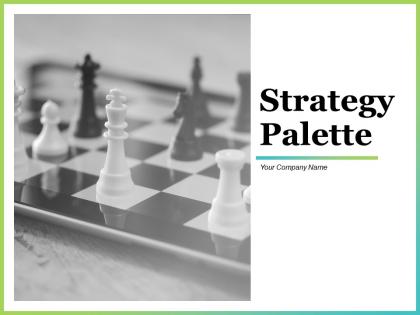
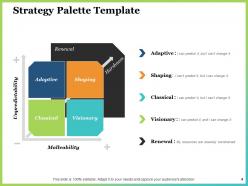
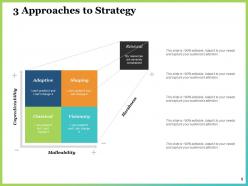
If you are looking for a Strategy Palette framework presentation slide to guide you in selecting the appropriate strategy for your company then this is the one for you. Use our PPT template to decide which strategy or set of strategies is appropriate for the development of your company. Our strategy approach PPT template resembles a typical game of chess. Use our strategy management process PowerPoint slide to allow your management to learn about new strategies in order to improve corporate identity. This template will help you to measure the growth and productivity of your company. You can use this presentation slide to combine different strategies to deal with the changing environment. With the help of this PPT template, you can set the strategies and work according to them to achieve the desired goal. So, without much ado, download this brand strategic planning PowerPoint template at the click of a button. Get to hear the fresh dope with our Strategy Palette Powerpoint Presentation Slides. Discover what is breaking on the grapevine.
People who downloaded this PowerPoint presentation also viewed the following :
Strategy Palette Powerpoint Presentation Slides with all 19 slides:
Use our Strategy Palette Powerpoint Presentation Slides to effectively help you save your valuable time. They are readymade to fit into any presentation structure.


FAQs for Strategy Palette
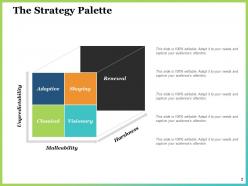
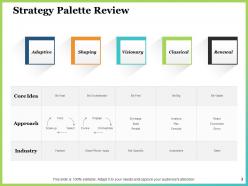
You need three types of strategies working together - classical ones for stable markets, adaptive stuff for uncertainty, and those big visionary bets. Most companies just stick with traditional planning (honestly such a waste of potential). Think of it like having different tools in your toolkit - you wouldn't try fixing everything with just a hammer, right? The trick is reading your market conditions to know which approach fits. Do a quick audit of what you're actually using now. I bet you'll find some gaps where you're missing key approaches that could totally change your game.
Start by figuring out which strategy types actually match what your business does day-to-day. Don't stress if you don't fit perfectly into one category - honestly, most companies are some kind of weird hybrid anyway. Check how you make money, who your customers are, and what you're competing against. That'll show you which approaches make sense. Like if you're doing both B2B and B2C stuff, you might need different strategies for each side. The trick is being real about what actually works for you instead of cramming yourself into whatever framework sounds impressive.
Honestly, the worst thing you can do is throw everything at the wall - stick to maybe 3-5 solid strategies or you'll just freeze up when it's time to decide. Make sure they're actually different from each other too, not just slight variations of the same thing. That's pointless. Test everything with real data first before you go all in. Oh, and here's something people miss - check if you can actually pull off what the strategy demands. I've seen strategies that look amazing but need resources nobody has. Start small, run some pilots, then double down on what works.
So a strategy palette is basically like having different plays in your playbook that everyone can reference. When your team hits a big decision, you've got this shared menu of approaches instead of people just winging it or doing the same thing over and over. Honestly beats those painful meetings where everyone talks in circles for hours. It gives you common language too, which makes discussions way more focused. Oh, and next time you're stuck - try sketching out 3-4 options first. Trust me, it'll save your sanity and actually get you somewhere faster.
Honestly, visual storytelling is a game changer for strategy stuff. People's brains just work better with stories than boring bullet points - like, we're wired that way or whatever. When you sketch out how your strategic options connect, suddenly everyone can see the whole journey from where you are now to where you want to be. You'll catch gaps and overlaps that would've been buried in text. Makes those dreaded strategy meetings actually bearable too. Trust me on this one. Next time you're prepping a strategy review, try drawing it out instead of cramming everything into text-heavy slides. Your stakeholders will thank you.
Honestly, tech makes strategy stuff way less boring now. You can filter and search through frameworks instead of dealing with those awful static PDFs we used to get stuck with. AI tools will actually suggest strategies that fit your company size and industry - which saves tons of time. Plus some platforms let you run simulations or check out real case studies for each approach. The trick is finding something that plays nice with whatever tools you're already using. Your team can collaborate and add notes in real-time too. Way better than emailing Word docs back and forth like it's 2010.
Always start with the big picture - they need to understand WHY first. Then show maybe 3-5 options tops. More than that and everyone gets overwhelmed (learned this the hard way). Lead with what each strategy actually gets you, then touch on downsides and what it'll cost. Skip the text-heavy slides - simple charts work way better. Oh, and definitely come with a recommendation ready. But present it like "here's where I'm leaning and my reasoning" instead of some final decree. You want them discussing it, not just nodding along.
Honestly, most companies do this once a year and call it good. But if you're in something fast-moving like tech or healthcare? Quarterly makes way more sense. I'd say watch for big shifts - new competitors, customer behavior changes, that sort of thing. Those are your real triggers for updates, not just because it's Tuesday and you're bored. Don't change stuff just to change it though. Set some reminders on your calendar now so you're not scrambling when everything hits the fan later.
So basically, a strategy palette is like a visual map showing how your team's daily stuff ties into the big company goals. Map your team's objectives to those strategic themes - you'll probably be shocked at how disconnected everything feels at first (I know I was). It helps everyone get the "why" behind their work instead of just grinding through tasks. Makes prioritization so much cleaner too since you can actually see what moves the company forward vs what just keeps you spinning your wheels. Just start by listing what your team's working on now and see where it all fits.
Build feedback loops into every step - don't just slap them on later. Get stakeholders involved early when mapping options, they'll spot what you missed. Test ideas with different groups through quick prototypes or scenarios. The messier it feels, the better honestly - polished strategies usually miss how chaotic real life actually is. Create formal checkpoints where teams can challenge your assumptions. I'd also set up regular "palette reviews" where you literally ask people to tear apart your thinking. Works way better than going it alone.
Honestly, Miro and Mural are your best bet for strategy palettes - they're built for this kind of visual brainstorming stuff. If your team's already on Figma, that works too. I've seen people get creative with Notion or even just PowerPoint (which feels old school but whatever works, right?). The main thing is making sure everyone can jump in and edit without it being a pain. Start simple with what you know. You can always switch to something fancier later if you need more bells and whistles.
Think of a strategy palette like having different tools in your toolbox - you wouldn't use a hammer for every job, right? Instead of getting locked into one approach, you can switch between classical planning, adaptive experiments, and those big visionary bets depending on what you're working on. Your teams get to explore wild breakthrough ideas through the visionary stuff while testing and tweaking quickly with adaptive methods. The trick is actually matching each innovation project to whatever strategic style makes the most sense for it. I'd start by mapping out your current projects and see which approach fits each one best.
Look, you can't just copy-paste strategies between companies. A scrappy startup can pivot overnight, but try that at some old-school manufacturing firm? Good luck. First figure out how your place actually works - are people cool with taking risks or do they need three meetings before ordering lunch? Some organizations love disruption, others want everything planned to death. I learned this the hard way at my last job tbh. Pick approaches that match your company's personality instead of forcing what worked somewhere else. Fighting your culture is exhausting and usually backfires anyway.
Track revenue growth and market share - that's the obvious stuff. But honestly? The flexibility metrics matter way more these days. How fast can you pivot strategies when things go sideways? Customer satisfaction for each approach you're testing. Innovation pipeline strength too, though that one's trickier to measure. Don't go crazy tracking everything - pick maybe 3-4 that actually matter for your situation. Financial numbers only show you part of what's working. Start small and see what predicts your wins.
Honestly, strategy palettes work because they give everyone the same visual reference point. No more marketing and engineering talking past each other. Everyone can literally point to the same framework and see how their stuff fits into the bigger picture. It's like having a map during meetings - way less confusing than trying to explain abstract strategy concepts. Non-strategy folks actually get it when it's visual. Plus it stops those annoying moments where sales and product are clearly working toward different goals. Next cross-functional meeting, just throw it up on the screen and watch how much smoother things go.
-
Great quality slides in rapid time.