


Success criteria ppt sample




Try Before you Buy Download Free Sample Product
 Impress Your
 Audience
 100%
100% Editable
 Save Hours
 of Time


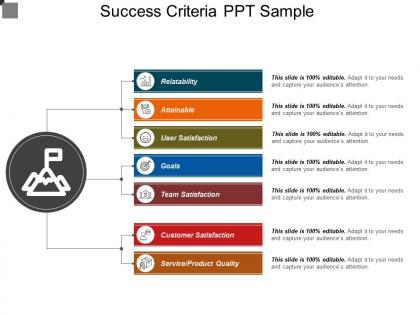
Grab your audience’s attention by uniquely displaying success criteria and models of excellence for your business. Use our one of the most wonderful success criteria PPT sample design to do the same. For any small or large business firm to be successful, employees must know when they have succeeded and why they should learn it. You can use this learning targets and success criteria PPT to define various parameters on which business success criteria should be identified. Different factors e.g. reliability, attainable, user satisfaction, goals, team satisfaction, customer satisfaction, product or service quality can easily be understood with this powerful PPT diagram. PPT design has numerous applications these days as by identifying learning intentions and success criteria for business, you can set future business goals and prepare plans accordingly. The design layout is simple and attractive enough to hold your audience interest until the end of the presentation. So, download this brilliantly designed PPT template and highlight learning outcomes and success criteria in the most comprehensive manner. Our Success Criteria Ppt Sample are good for any encounter. They will get you brimming with confidence.
People who downloaded this PowerPoint presentation also viewed the following :
Success criteria ppt sample with all 5 slides:
Your influence has an effect due to our Success Criteria Ppt Sample. Folks feel driven to consider your ideas.


FAQs for Success
Okay so first thing - get super specific with numbers. Like "boost engagement 15%" not just "make it better." Set real deadlines too, none of that vague timeline stuff. Figure out who's doing what upfront because that always becomes a mess later if you don't. Oh and define what "good quality" actually means before you start - I learned this the hard way when my team spent weeks arguing about whether something was "done" or not. Get everyone to agree on paper (or Slack, whatever). Bottom line: a random person should be able to look at your results and instantly know if you crushed it or flopped.
Honestly, you've gotta speak their language. Executives only care about ROI and timelines - they don't want technical details. Your dev team? Complete opposite. They want performance metrics and how stuff actually works. End users just want to know if it'll make their day less painful. I learned this the hard way when I kept talking about "user engagement" to our finance people who literally only cared about dollars saved. Different groups stress about completely different things. Ask yourself what would make each audience think "yes, this was worth it" - then build your success metrics around that specific fear or goal.
SMART criteria are honestly a lifesaver for writing success criteria that don't suck. You want specific and measurable stuff so everyone knows what "done" actually looks like - no more arguing about vague goals later. The achievable and relevant bits keep you realistic (learned this the hard way). Time-bound adds that push you need, otherwise projects just... drift forever. I swear, half the failed projects I've seen had success criteria that were basically meaningless fluff. Just run yours through the SMART checklist before you finalize anything. Trust me on this one.
Look, success criteria are honestly game-changers for presentation templates. They force you to build slides with actual purpose instead of just throwing together something that looks decent. Write down what winning looks like first - budget approval, team buy-in, whatever. Your template will naturally structure itself around those goals. I've wasted so much time on pretty slides that accomplished absolutely nothing because I skipped this step. Every slide should push you toward your specific outcome. Seriously, figure out your success metrics before you even touch PowerPoint. You'll save yourself hours of redoing everything later when you realize it's not hitting the mark.
Make your success criteria super specific so feedback actually means something. Like instead of "engage the audience," go for "75% rate clarity as good or excellent" or "get at least 3 real questions during Q&A." Honestly, I hate vague stuff like "compelling delivery" - that tells you nothing useful. You want numbers that people can actually measure when they give feedback. Surveys work great for this, or just casual conversations after. That way you're not randomly guessing if you did well. Oh and peer evaluations too if that's an option.
So it really depends on what you're trying to accomplish. With corporate stuff, you're tracking hard metrics - leads generated, deals closed, whether the C-suite actually bought into your proposal. Educational presentations are different though. You care more about whether people actually learned something - did they participate, can they demonstrate the skill, do they get it? Executives want to see dollar signs and business impact. Students and teachers? They want proof of understanding and retention. Honestly, I've seen too many people use the wrong metrics for their audience. Figure out what success looks like before you even open PowerPoint.
Look for audience engagement and whether people actually remember your stuff. Track participation during Q&A, follow-up questions, and if they can recall your main points days later. Applause feels good but doesn't mean much honestly. What counts is action - did they implement what you suggested or have those lightbulb moments? I always forget this part, but send a quick survey within 24 hours while everything's still fresh in their minds. That's where you'll get the real feedback that matters, not just polite clapping.
Match your visuals to whatever you're actually trying to accomplish with each slide. Clean layouts with white space work best for clear communication. Want engagement? Add clickable stuff or progress bars. Charts help with data (but seriously, not everything needs to be a pie chart). Color coding's great for grouping info or highlighting key points. Don't just make things pretty for the sake of it - every visual should help your audience either understand something better or know what to do next. I always do this quick test: would this element actually help someone following along, or am I just decorating?
Don't make your success criteria super vague - stuff like "engage the audience" tells you nothing useful. You need actual measurable things you can check off later. Here's what most people miss: real success often happens *after* your presentation ends. Follow-up meetings, decisions getting made, that kind of thing. Also think about what success looks like from your audience's angle, not just yours. I'd say pick 2-3 concrete goals you can actually evaluate, like "get approval for the next phase" or "audience asks at least 3 good questions." Way more helpful than fuzzy feel-good metrics.
Honestly, check your success criteria every month or whenever you hit a big milestone. I know it feels tedious but your metrics will shift as you figure out what actually matters to stakeholders. Don't be like me last year - waited until the end only to realize we'd been tracking completely useless stuff. Quick 15-minute monthly check with your team works great. Just ask if you're still measuring the right things. Also helps catch problems early instead of scrambling later. Update what needs updating and move on.
Regular check-ins are your best friend here. Break down those big success goals into smaller milestones that people can actually relate to their daily tasks. I know, I know - another meeting suggestion, but weekly alignment sessions really do catch problems before they snowball. Set up shared dashboards so everyone sees how their work connects to the bigger picture. The trick is making those criteria feel real, not like some corporate buzzword document gathering dust. When people understand how their piece matters, alignment happens naturally. Trust me on this one.
Oh man, this is so true! Success metrics totally depend on your audience's culture. Americans want clear ROI and personal wins. But in places like Japan? Group harmony matters way more than individual achievement. Some cultures expect quick results while others are all about building relationships over time. I bombed hard once doing my usual direct German-style presentation in Tokyo - learned that lesson fast! You really need to research what your specific audience considers a "win" first. Then adjust everything from your messaging to how you measure success. Cultural mismatch = presentation disaster, trust me.
Honestly, start with whatever you're already using for project stuff - Asana, Monday, Jira, whatever. Those all let you set actual measurable goals and see progress happening. OKRs are having a moment right now (the whole Objectives and Key Results thing), and tools like Lattice make them way less painful to set up. But real talk? A basic spreadsheet works fine when you're figuring things out. I mean, I still use Google Sheets for half my tracking because it's simple. The main thing is picking something everyone will actually use consistently instead of abandoning after two weeks.
Dude, you've gotta start telling stories with your success metrics. People's eyes glaze over at spreadsheets, but wrap those numbers in a narrative? Game changer. Show them the customer's journey - the struggle, then boom, your solution saves the day. I watched a colleague completely bomb a presentation until he started with "Picture Sarah, our typical user..." Suddenly everyone cared about the conversion rates. It's weird how our brains work, but we need that emotional hook to actually absorb data. Next time, try the whole "here's what sucked before, here's what's awesome now" approach.
Look, engagement beats vanity metrics every single time. Those million views? Completely useless if everyone clicked away after two seconds. What actually matters is when people stick around, share your stuff, or leave real comments - that's how you know you're connecting. Track the engagement that ties to your actual goals though. Want brand awareness? Watch your shares and mentions. Going for conversions? Focus on click-through rates and how long people hang out on your important pages. Raw reach numbers just make you feel good in reports, but they don't pay the bills.
-
Illustrative design with editable content. Exceptional value for money. Highly pleased with the product.
-
Very well designed and informative templates.