


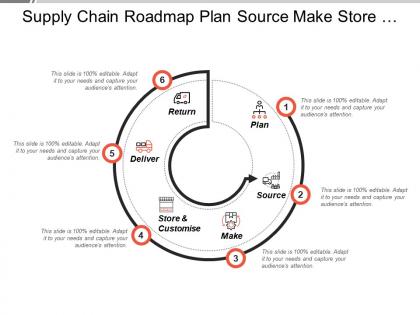
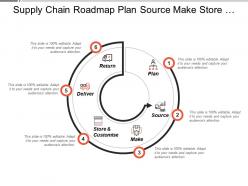
Supply chain roadmap plan source make store deliver and return




Try Before you Buy Download Free Sample Product
 Impress Your
 Audience
 100%
100% Editable
 Save Hours
 of Time


Find a dependable ally in our Supply Chain Roadmap Plan Source Make Store Deliver And Return. Get great assistance in your campaign.
People who downloaded this PowerPoint presentation also viewed the following :
Supply chain roadmap plan source make store deliver and return with all 5 slides:
Our Supply Chain Roadmap Plan Source Make Store Deliver And Return enhance your connectivity with clients. They broaden your access to them.



FAQs for Supply chain roadmap plan source make store
Key components include demand forecasting, supplier relationship management, inventory optimization, logistics coordination, and performance analytics. These elements work together by enhancing visibility across operations, reducing costs through strategic sourcing, and improving customer satisfaction, with many manufacturing and retail organizations finding that integrated approaches deliver competitive advantage and operational resilience.
AI and IoT enhance supply chain efficiency by enabling real-time tracking, predictive analytics, automated inventory management, and demand forecasting. These technologies streamline operations through smart sensors monitoring shipments, AI algorithms optimizing routes and predicting disruptions, ultimately delivering reduced costs, faster deliveries, and improved visibility across the entire supply chain.
Global supply chain management faces challenges including demand volatility, supplier reliability issues, regulatory compliance across regions, transportation disruptions, and inventory optimization complexities. These obstacles are compounded by geopolitical tensions, currency fluctuations, and coordination difficulties, with many multinational organizations finding that strategic technology integration and diversified supplier networks help streamline operations while enhancing resilience and competitive advantage.
Sustainable practices enhance supply chain operations by reducing waste, optimizing resource usage, and improving operational efficiency while strengthening brand reputation. Companies like Walmart and Unilever streamline logistics, minimize environmental impact, and lower costs through green sourcing and circular economy approaches, ultimately delivering competitive advantage and meeting increasingly conscious consumer demands.
Data analytics enables supply chain decision-making by providing real-time visibility, predictive insights, demand forecasting, risk assessment, and performance optimization across operations. Through advanced analytics platforms, organizations streamline inventory management, enhance supplier relationships, and minimize disruptions, with many manufacturing and retail companies finding that data-driven approaches ultimately deliver faster responses and significant cost reductions.
Businesses mitigate supply chain risks through diversifying suppliers, implementing real-time monitoring systems, maintaining strategic inventory buffers, and developing contingency plans for disruptions. These approaches enable organizations to enhance operational resilience by reducing dependency, improving visibility, and ensuring continuity, with many companies finding that proactive risk management ultimately delivers competitive advantage and sustainable growth.
Companies should measure supply chain performance using order fulfillment rates, inventory turnover, cost per shipment, supplier delivery performance, and cash-to-cash cycle time. These metrics enable organizations to streamline operations, reduce costs, and enhance customer satisfaction, with many manufacturing and retail companies finding that comprehensive performance tracking delivers competitive advantage and operational efficiency.
Collaboration improves through integrated digital platforms, real-time data sharing, joint forecasting systems, transparent communication protocols, and shared performance metrics. These approaches streamline coordination by enabling synchronized production schedules, reducing inventory costs, and accelerating response times, with manufacturers in automotive and electronics finding that strategic partnerships ultimately deliver enhanced efficiency and competitive advantage.
Key trends shaping supply chain management include artificial intelligence, blockchain technology, sustainability initiatives, autonomous vehicles, and predictive analytics. These innovations streamline operations by enhancing transparency, reducing costs, and improving demand forecasting, with many manufacturing and retail organizations finding that strategic adoption delivers competitive advantages and resilient supply networks.
E-commerce transforms traditional supply chain models by requiring faster fulfillment, direct-to-consumer distribution, and real-time inventory visibility across multiple channels. This shift enables retailers to streamline warehouse operations, enhance customer experiences through faster delivery, and optimize inventory allocation, with many companies finding that omnichannel approaches deliver significant competitive advantages.
Inventory management is crucial for supply chains because it balances supply and demand, minimizes carrying costs, and prevents stockouts or overstock situations. Effective inventory control enables organizations to reduce storage expenses, improve cash flow, and enhance customer satisfaction through consistent product availability, with many retailers and manufacturers finding that optimized inventory levels ultimately deliver competitive advantage and operational efficiency.
Businesses can adapt their supply chains by implementing demand forecasting analytics, diversifying supplier networks, enhancing inventory flexibility, and leveraging digital integration platforms. Through real-time data monitoring and agile logistics partnerships, companies in retail, automotive, and consumer goods streamline operations while reducing costs, ultimately delivering faster response times and improved customer satisfaction in an increasingly dynamic market environment.
Logistics serves as the operational backbone of supply chain strategy, encompassing transportation, warehousing, inventory management, and distribution coordination to ensure seamless product flow. Through strategic logistics planning, organizations streamline costs, enhance delivery speed, and improve customer satisfaction, with many retailers and manufacturers finding that optimized logistics networks ultimately deliver competitive advantage and operational efficiency.
Organizations ensure supply chain compliance through comprehensive supplier audits, third-party certifications, clear ethical standards, regular monitoring systems, and transparent reporting mechanisms. These practices enable companies to identify risks, verify labor conditions, and maintain sustainability standards across global networks, with many manufacturing and retail organizations finding that proactive compliance programs ultimately deliver reduced operational risks, enhanced brand reputation, and stronger stakeholder trust in increasingly regulated markets.
Adopting a circular supply chain model delivers significant waste reduction, enhanced resource efficiency, cost savings through material reuse, improved sustainability credentials, and strengthened supplier relationships. These approaches streamline operations by minimizing raw material dependency, creating new revenue streams from waste products, and reducing disposal costs, with many manufacturing and retail organizations finding that circular models ultimately enhance competitive advantage while meeting increasingly stringent environmental regulations.
-
Innovative and attractive designs.
-
Helpful product design for delivering presentation.