


Traditional Currency Vs Cryptocurrency Training Ppt




Try Before you Buy Download Free Sample Product
 Impress Your
 Audience
 100%
100% Editable
 Save Hours
 of Time


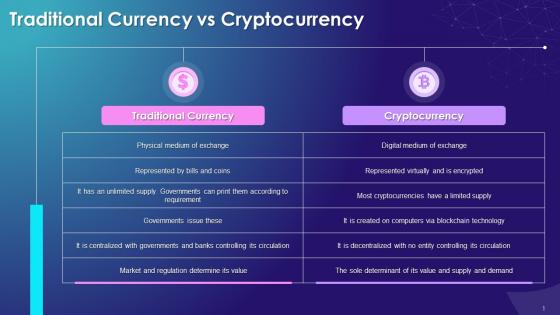
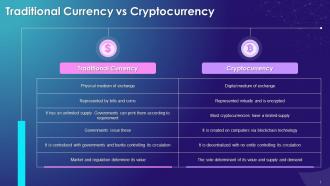
This slide draws a comparison between traditional currency and cryptocurrency. Traditional currencies are tangible, represented by bills and coins, have an unlimited supply, are issued by governments, are centralized, and their value is driven by market and regulation. Cryptocurrencies, on the other hand, are intangible. These digital currencies, have a limited supply, are created on computers, are decentralized, and demand and supply determine how much value these store.
People who downloaded this PowerPoint presentation also viewed the following :
Traditional Currency Vs Cryptocurrency Training Ppt with all 16 slides:
Use our Traditional Currency Vs Cryptocurrency Training Ppt to effectively help you save your valuable time. They are readymade to fit into any presentation structure.















FAQs for Traditional Currency Vs
So crypto uses blockchain encryption while regular money depends on banks and governments for security. Here's the thing though - with crypto you're basically your own bank, which is great until you forget your password and lose everything lol. Banks give you fraud protection, FDIC insurance, and actual people to call when stuff goes wrong. Crypto? Once it's gone, it's gone. No take-backs. Honestly the whole space is still pretty wild west with regulations. If you want to try it, don't go crazy - maybe start with like $100 and get a hardware wallet.
Dude, the crazy price swings are what kill crypto for daily stuff. Bitcoin could tank 20% before you finish your morning coffee - who wants that stress? Your paycheck buys the same groceries each month because regular money stays pretty stable. Most merchants who take crypto immediately flip it to dollars anyway since they can't handle that kind of volatility. It's just too unpredictable for everyday transactions. Though honestly, stablecoins are way better for this since they don't bounce around like a pinball machine. That's probably your best bet if you really wanna use crypto.
Honestly, it depends what you're comparing. Bank transfers are painfully slow - like 1-5 days, especially international stuff. Credit cards seem instant but they're actually settling for 24-48 hours in the background. Crypto's weird though. Bitcoin takes forever (10 minutes per confirmation), Ethereum's around 15 seconds. But then you've got newer ones like Solana that'll do it in under a second. There's always some tradeoff between speed, security, and how decentralized it is. If you need something fast, don't just assume all crypto sucks - check out payment processors or the newer blockchain networks instead.
So here's the deal - central banks basically run everything when it comes to regular money. They set interest rates, control how much cash is floating around, whatever they want really. Crypto's totally different though. Bitcoin and stuff like that are built to be decentralized, so the Fed can't just mess with them directly. They can only go after exchanges and crypto businesses, not the actual currencies. It's pretty crazy when you think about it. I mean, they're still trying to figure out how to regulate it all. Regular banking? They're the boss. Crypto? It's this whole gray area where they don't have nearly as much control.
Okay so here's the deal - regular money stays stable because governments back it up. Central banks can print more, mess with interest rates, whatever they need to do. Crypto though? Total Wild West situation. Bitcoin can drop 20% just because some CEO posted something dumb on Twitter (looking at you, Elon). There's nobody controlling the supply or stepping in when things get crazy. You're basically betting that other people will keep believing it's valuable. Which honestly might work out, but just know you're riding pure hype and market emotions.
So decentralization means no banks or governments calling the shots with crypto, which could totally shake up how money works globally. Cross-border payments get way faster without all those middlemen taking their cut. Traditional banks might actually be screwed if this takes off big time. But honestly, the volatility is insane and the energy usage is pretty brutal. Regulatory stuff is still a mess too - like, nobody really knows what rules are coming next. If this is for work though, definitely watch how governments respond since that'll basically decide if crypto goes mainstream or stays niche.
Banks are pretty straightforward with their fees - like $15-30 for wire transfers and those annoying $3-5 ATM charges. Crypto's totally different though. Bitcoin fees can swing from $1 to $50 depending on how busy the network is, which honestly gets frustrating during those crazy market days. Newer stuff like Solana costs basically nothing. The main difference? Bank fees don't change, but crypto fees bounce around constantly based on demand. I always check a fee estimator first before sending anything - learned that the hard way lol.
Honestly, smart contracts are the big game-changer here. They handle loans, insurance, payments - all without banks getting their cut. DeFi platforms already let people lend and trade directly with each other. Cross-border stuff is so much faster now too (thank god, because wire transfers are painfully slow). Stablecoins might replace those banking networks entirely. But here's what's wild - programmable money could auto-split your paycheck into savings, bills, whatever, bypassing banks completely. I'm curious which banks will actually adapt vs just complain about regulations.
Honestly, I still use regular money for most stuff. Rent, groceries, anything government-related - my landlord would probably laugh if I offered Bitcoin. Cash and cards don't randomly lose 20% of their value while I'm sleeping, which is nice. Plus banks actually protect you if someone steals your info or a purchase goes wrong. Emergency situations too - like when your car dies and you need gas at some sketchy station in the middle of nowhere. They're definitely not taking crypto. For daily spending, old-school money just works better right now.
Yeah, Bitcoin is pretty energy-hungry - like 700 kWh per transaction vs maybe 1-4 kWh for bank transfers. Thing is, banks have tons of hidden energy costs we don't think about. All those branches, ATMs, servers, people driving to work... it adds up fast. Bitcoin's just more obvious about it since it's all computational power. Honestly though, if energy use bugs you, check out proof-of-stake coins like newer Ethereum - they cut energy use by like 99%. Way better than Bitcoin's setup.
Honestly, crypto's biggest mess is that nobody knows what the hell to call it legally. Currency? Property? Security? Each country basically makes up their own rules as they go. Tax stuff gets super confusing, money laundering laws are all over the place, and some governments just said "nope" and banned it entirely. Meanwhile regular money doesn't deal with this chaos since central banks actually control it. Before you jump into crypto investments or start taking payments, definitely look up your local laws first - they change like every other week it feels like.
Honestly, people trust regular money way more right now. Like, nobody questions if their credit card will work at Starbucks, you know? Crypto's totally different though - half the people think it's the future, the other half think it's basically gambling. Can't blame them with how much Bitcoin swings around lol. Most folks still want that boring predictability for buying groceries and stuff. They'll maybe throw some money at crypto as an investment, but that's about it. If you're launching something, stick with traditional payments. Way less friction with customers.
So with regular banks, you've got all that fraud protection built in - they're constantly monitoring for weird transactions and can reverse stuff if something goes wrong. Crypto's totally different though. Once you send it, it's gone forever, which honestly freaks me out sometimes. But the blockchain tech does prevent people from spending the same coins twice, and most legit exchanges now require ID verification. Some platforms offer insurance, but it's hit or miss. Banks fix fraud after it happens. Crypto tries to stop it beforehand. Just use reputable exchanges and triple-check those wallet addresses!
Yeah so basically traditional banks are super slow because they bounce your money through like 3 different banks before it gets there. That's why you're waiting days and paying $25-50 just to send money overseas - it's honestly ridiculous. Bitcoin or stablecoins go straight through in minutes for under $5. Only downside is whoever you're sending to needs to actually know how to use a crypto wallet and cash it out. USDC is pretty solid if you do this regularly - way better than getting ripped off by wire fees every time.
Yeah, crypto's pretty appealing for privacy stuff. Banks track literally everything - your transfers, card purchases, all tied to your name. Bitcoin lets you use wallet addresses instead, which is why privacy people and folks in sketchy countries love it. But here's the thing - it's not actually that anonymous since blockchain records are public (kinda ironic, right?). If privacy's your main goal, you'll want to look into which cryptos are actually good at it first. Some are way better than others at keeping things private.
-
Keep doing the good work guys. Surpass the needs and expectations always!!
-
Time saving slide with creative ideas. Help a lot in quick presentations..