


Talent Development Powerpoint Presentation Slides





Try Before you Buy Download Free Sample Product
 Impress Your
 Audience
 100%
100% Editable
 Save Hours
 of Time


Having a strategic talent management gives organizations the opportunity to attract the most talented and skilled employees available. So, utilize our talent development PPT slideshow and attract top talent in your organization. Talent development and management is an organization's commitment to recruit, hire, retain, and develop the most talented and superior employees available in the job market. Our talent development Presentation slides helps you to motivate your employees and allowing them to work in the direction of the company’s business goals, which in turn, increases client satisfaction and business performance. Having a strategic talent management helps organizations keep their employees motivated which creates more reasons for them to stay in the company and do their tasks. Our talent development PPT deck does give managers a significant role and responsibility in the recruitment process and in the ongoing development of and retention of superior employees. Showcase your aspects with this ready-to-use talent development PowerPoint template. Fulfill customer aspirations with our Talent Development Powerpoint Presentation Slides. Cater for their growing demands.
People who downloaded this PowerPoint presentation also viewed the following :
Content of this Powerpoint Presentation
Slide 1: This slide shows Talent Development with magnifying glass imagery. Add your company name and proceed.
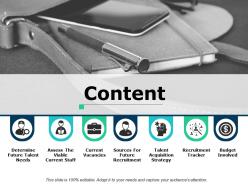
Slide 2: This slide shows Content. Its constituents are- Assess The Viable Current Staff, Current Vacancies, Sources For Future Recruitment, Talent Acquisition Strategy, Recruitment Tracker, Budget Involved, Determine Future Talent Needs.
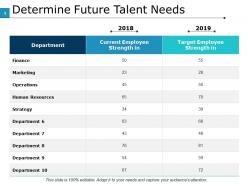
Slide 3: This slide shows a table which you can use to Determine Future Talent Needs. Add two-year data in this table and use it accordingly.
Slide 4: This slide is titled Assess the Viable Current Staff with imagery.
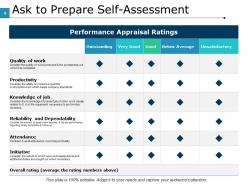
Slide 5: This is Ask to Prepare Self-Assessment slide showing Performance Appraisal Ratings.
Slide 6: This slide shows a table titled Get Feedback from the Teams in which you can add criteria, score and comments.
Slide 7: This is Ask for Clients’ Feedback slide showing Matrix in terms of excellent, very good and good.
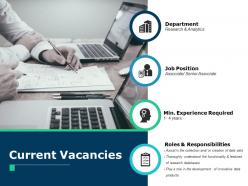
Slide 8: This slide shows Current Vacancies in the organization. You can add your own vacancies if any.
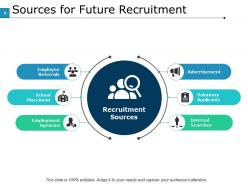
Slide 9: This slide shows Sources for Future Recruitment like Advertisement, Voluntary Applicants, Internal Searches, School Placement, Employee Referrals, Employment Agencies.
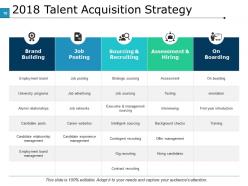
Slide 10: This slide shows 2018 Talent Acquisition Strategy table with the following sub headings- Brand Building, Job Posting, Sourcing & Recruiting, Assessment & Hiring, On Boarding.
Slide 11: This slide shows Recruitment Tracker. You can add the data for the requirement or hiring processes.
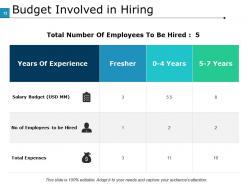
Slide 12: This slide shows the Budget Involved in Hiring which you can alter as per need.
Slide 13: This is Talent Development Icons Slide with various icons. Alter them as per your need.
Slide 14: This slide is titled Additional Slides to move forward. You can change the slide content as per need.
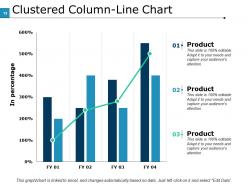
Slide 15: This is a Clustered Column - Line Chart slide to present product/ entity comparison, specifications etc.
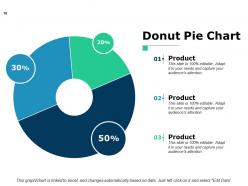
Slide 16: This is a Donut Pie Chart slide to present product or entity comparison, information etc.
Slide 17: This slide represents Our Mission. State your mission, goals etc.
Slide 18: This slide showcases Our Team with Name and Designation to fill.
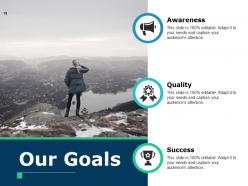
Slide 19: This is Our Goal slide. State your goals here.
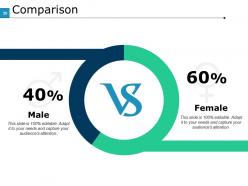
Slide 20: This slide displays Comparison on the basis of gender. It shows male and female image compared in terms of percentages.
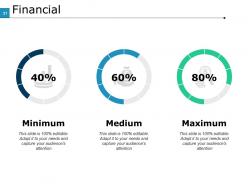
Slide 21: This is a Financial score slide. State financial aspects, information etc. here.
Slide 22: This is a Bulb & Idea image slide to show ideas, innovative information etc.
Slide 23: This is a Mind Map image slide to show information, specifications etc.
Slide 24: This is a Thank You slide with Address, Email Address, and Contact Number.
Talent Development Powerpoint Presentation Slides with all 24 slides:
Experience elation with our Talent Development Powerpoint Presentation Slides. They create an extraordinary feeling.






FAQs for Talent Development
Start by figuring out what skills you'll actually need in 2-3 years, then build backwards from there. Clear career paths are huge - people want to see where they're going. Regular skill check-ins help too, plus mentoring programs (though finding good mentors is always tricky). Give folks stretch assignments that actually push them. Leadership has to be on board or the whole thing flops. Oh, and feedback loops - can't stress this enough. People get frustrated when they don't know how they're doing. Track everything with real goals you can measure.
Honestly, look for three things: performance, potential, and what they actually want career-wise. Start with your solid performers, but then dig deeper - who's curious, adapts fast, takes on stuff outside their job? Don't just ask managers for names though. That's how you miss people. Mix performance data with 360 feedback and real conversations about where they want to go. The magic happens when someone's already killing it AND actively wants more growth. Oh, and set up those talent review meetings where you play "what if" games with everyone's future.
Dude, get yourself a mentor if you don't have one already. They'll spot your blind spots way better than any training program ever could. Having someone who actually gives a damn about your career is game-changing - especially when you're stuck on tough decisions or weird workplace drama. The trick is finding someone who'll push you, not just tell you you're awesome all the time. Coffee chats are perfect for this, by the way. Look for people whose careers you'd want to steal (in a good way) and just ask. Most people are surprisingly willing to help if you're genuine about it.
Track the obvious stuff first - promotion rates, retention, performance scores comparing people who did your programs vs those who didn't. But honestly, the softer metrics matter just as much. Are folks actually moving into different roles after training? That's where you see real impact. Employee engagement surveys and 360 feedback will show if people are growing in the right areas. I'd throw in some quick pulse surveys too - confidence levels, job satisfaction, that kind of thing. Set your benchmarks upfront though, or you'll be scrambling later trying to prove ROI. Don't get caught up in just completion rates... focus on actual behavior changes.
So honestly, the biggest thing I'm seeing is AI-powered personalized learning taking over everything. Companies are finally dropping the whole "must have a degree" thing for skills-based hiring instead. Micro-learning is huge now too - like bite-sized training that actually fits into your day instead of those awful 8-hour seminars we used to sit through. Remote work basically forced everyone into virtual mentorship, which is actually pretty great. Oh and forget one-time training sessions - it's all about continuous upskilling now. You should probably start figuring out where your team's skill gaps are because the companies using adaptive learning platforms are crushing it right now.
Honestly, tech can totally transform how you develop talent. AI helps spot skill gaps and builds custom learning paths for each person. Real-time tracking shows you what's actually moving the needle. VR training is surprisingly effective for hands-on stuff - beats death by PowerPoint any day! Your team can learn on mobile whenever they want, which is huge. Analytics cut through the BS to show what training actually works versus what just burns budget. Oh, and definitely audit your current tools first - automate the boring administrative stuff so you can focus on the bigger picture strategy.
First, actually talk to them about what they want career-wise and where they're struggling. Don't make it some formal HR thing - just figure out what gets them excited. Then connect their goals to real stuff they can work on with deadlines that make sense. Generic leadership courses are honestly pretty useless most of the time. Mix it up instead: give them challenging projects, pair them with a good mentor, maybe some formal training if it fits. The whole thing should feel like you're building it together, not like you're assigning homework. Check in regularly because people's interests change. Oh, and don't let it become one of those plans that just sits in a drawer gathering dust.
Performance reviews are honestly such wasted potential at most places. You've got this perfect chance to actually develop people, but companies just focus on the rating part. What you want to do is dig into the specifics - what are they crushing at? Where do they need help? Then turn that into real action. Like if someone's great at presenting but weak on data analysis, get them proper training. The key is actually following up on those development goals every few months, not waiting a whole year. Most managers just check the box and move on, which is why these things feel pointless to employees.
Ugh, honestly the budget thing is always brutal - leadership acts like they want talent development until they see the price tag. Getting people to actually show up is rough too since everyone's drowning in work. Plus you'll deal with managers who get weird about "losing" their star players to other teams (so annoying). Here's what I'd do: pilot something small first. Track the boring stuff like promotion rates and who sticks around - numbers don't lie and that's how you prove it works. Oh, and good luck figuring out who actually has potential versus who just interviews well!
Honestly, most companies just dump random training on people and wonder why it doesn't work. Figure out what specific skills are actually blocking your big goals first. Then build programs around those exact gaps - not some cookie-cutter course catalog. Your company culture matters too. Like if everyone's super collaborative, don't do boring solo e-learning modules. Make it team-based instead. The trick is getting leadership excited by showing them how the skills you're building will directly impact results. Otherwise you'll just be another training program that gets ignored.
Dude, you're spot on about learning opportunities. People bail when they feel stuck - it's that simple. Investing in their skills shows you actually see them having a future there, which builds real loyalty. I've seen this firsthand at my old job actually. Nobody wants to feel like they're just spinning their wheels in some dead-end position. When employees can develop new abilities, they'll look for growth internally instead of jumping ship. Honestly? Just ask your team what they want to learn. Half the battle is showing you care enough to ask.
Dude, start by showing curiosity yourself and don't freak out when things go wrong. Ask "what'd we learn?" instead of playing blame games. I used to be awful at this - I just wanted results, you know? But celebrating the effort actually works better. Share your own screw-ups with the team so they see it's normal. Give people challenging projects that'll stretch them, then coach through the struggle rather than jumping in to save the day. Oh, and switch your language from "you suck at this" to "you're not there yet." That little word makes a huge difference.
Honestly, cross-functional training is a game changer. Your employees pick up different skills and suddenly they're way more flexible when stuff hits the fan. No more panic when someone calls in sick or you get slammed with orders. It also fixes that annoying thing where departments act like they're on different planets - seriously, why do teams always work in bubbles? People stay more interested in their jobs too since they're not stuck doing the exact same tasks forever. I'd start with some job shadowing or maybe rotate people for short stints. See what works.
Check out stuff like Coursera or LinkedIn Learning first - they're pretty solid for filling gaps your team can't handle internally. Sometimes bringing in outside people is honestly the best move when everyone's stuck. Local universities might do custom training programs, or you could find industry experts for workshops. Oh, and mentorship programs with seasoned pros work really well too. The trick is figuring out exactly what skills you're missing before you go shopping around. I'd start with a talent audit - sounds boring but it'll save you from wasting money on random training that doesn't actually help.
Honestly, forget trying to match everyone's "learning style" - that whole theory's kinda bogus anyway. Mix it up instead! Throw in visual stuff, hands-on activities, group discussions, solo reflection time. Yeah, people have preferences, but everyone does better with variety. What works is rotating through different approaches within each session. Do a quick presentation, then breakout groups, then have them apply it to real scenarios. That way you're hitting different angles while the concepts actually stick. I mean, nobody wants to sit through a 2-hour lecture, right? Keep switching it up and you'll see way better results.
No Reviews