

Talent Management System for Effective Hiring Process Talent Acquisition Analytics Framework




Try Before you Buy Download Free Sample Product
 Impress Your
 Audience
 100%
100% Editable
 Save Hours
 of Time


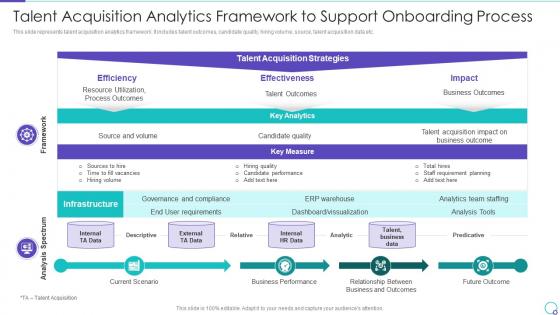
This slide represents talent acquisition analytics framework. It includes talent outcomes, candidate quality, hiring volume, source, talent acquisition data etc.
People who downloaded this PowerPoint presentation also viewed the following :
Talent Management System for Effective Hiring Process Talent Acquisition Analytics Framework with all 6 slides:
Use our Talent Management System for Effective Hiring Process Talent Acquisition Analytics Framework to effectively help you save your valuable time. They are readymade to fit into any presentation structure.





FAQs for Talent Management System for Effective Hiring Process Talent
Key components include talent acquisition platforms, performance management tools, learning and development systems, succession planning modules, and compensation management features. These integrated technologies streamline recruitment processes, enhance employee development tracking, and optimize workforce planning, with many organizations finding that comprehensive TMS implementations deliver improved retention rates and accelerated leadership development.
A Talent Management System improves employee engagement and retention by providing clear career development pathways, personalized learning opportunities, and transparent performance feedback mechanisms. Through automated succession planning and skills tracking, organizations like banks and healthcare institutions enhance employee satisfaction, reduce turnover costs, and build stronger internal talent pipelines, ultimately delivering improved workforce stability and competitive advantage.
A TMS aligns with business strategy by supporting workforce planning, identifying skill gaps for strategic initiatives, automating succession planning, and linking performance metrics to organizational objectives. Through strategic talent mapping and competency frameworks, organizations streamline resource allocation, enhance leadership development, and accelerate goal achievement, ultimately delivering competitive advantage and sustainable growth.
Data analytics enhances talent management systems by identifying skill gaps, predicting employee turnover, measuring performance trends, and optimizing recruitment strategies. Through predictive modeling and real-time insights, organizations streamline hiring processes, improve retention rates, and align talent development with business objectives, ultimately delivering competitive advantage and strategic workforce planning.
A TMS identifies high-potential employees through performance analytics, competency assessments, 360-degree feedback, and predictive modeling that analyzes career trajectories and skill development patterns. These systems streamline talent development by creating personalized learning paths, succession planning frameworks, and mentorship matching, with many organizations finding that strategic talent identification ultimately delivers stronger leadership pipelines and competitive advantage.
A TMS significantly enhances recruitment processes by automating candidate sourcing, streamlining interview scheduling, centralizing communication, and providing real-time analytics on hiring metrics. This technology delivers faster time-to-hire, improved candidate engagement through seamless application tracking, and enhanced recruiter productivity, with many organizations finding that candidates appreciate the transparent, efficient experience while hiring teams achieve better quality matches.
Technology integration enhances Talent Management Systems by automating recruitment processes, enabling data-driven decision making, and streamlining employee development workflows through AI-powered analytics and cloud-based platforms. These technologies deliver faster candidate screening, predictive talent insights, and seamless performance tracking, with organizations finding significantly improved hiring efficiency and strategic workforce planning capabilities.
Organizations face challenges including data migration complexities, employee resistance to new processes, integration difficulties with existing HR systems, insufficient training resources, and budget constraints during TMS implementation. While these obstacles can initially slow adoption, many companies find that addressing change management early, investing in comprehensive training, and phasing rollouts strategically ultimately delivers improved efficiency and stronger talent retention.
A TMS supports diversity and inclusion initiatives by enabling bias-free recruitment through standardized screening processes, tracking diversity metrics across hiring and promotion pipelines, and ensuring equitable access to development opportunities. These systems help organizations identify gaps in representation, monitor progress toward inclusion goals, and create transparent pathways for advancement, ultimately delivering more diverse workforces and improved employee engagement across all organizational levels.
Cloud-based Talent Management Systems should include applicant tracking, performance management, learning and development modules, succession planning, and analytics dashboards. These integrated features streamline HR operations by automating recruitment workflows, tracking employee progress, and providing real-time insights, with many organizations finding that comprehensive platforms ultimately enhance talent retention and accelerate strategic workforce planning.
Employee feedback can be effectively incorporated through continuous pulse surveys, 360-degree evaluations, real-time performance discussions, peer review modules, and automated feedback collection tools. These systems streamline data aggregation and analysis, enabling organizations to identify talent gaps, enhance professional development programs, and improve retention strategies, with many companies finding that integrated feedback loops ultimately deliver more engaged workforces and strategic talent decisions.
Essential metrics for measuring Talent Management System success include employee retention rates, time-to-fill positions, internal promotion percentages, performance improvement scores, and employee engagement levels. These metrics enable organizations to track recruitment efficiency, career development effectiveness, and overall workforce satisfaction, with many companies finding that comprehensive measurement ultimately delivers enhanced talent retention and improved organizational performance.
A TMS facilitates succession planning by identifying high-potential employees, tracking their development progress, and mapping critical roles with suitable internal candidates. Through automated assessments and performance analytics, organizations can proactively develop talent pipelines, reduce leadership gaps, and ensure business continuity, with many companies finding that strategic succession planning significantly minimizes recruitment costs while accelerating leadership transitions.
Performance management serves as the central engine of talent management systems, driving employee development through continuous feedback, goal alignment, objective assessments, and structured career planning initiatives. These integrated processes enable organizations to identify high performers, address skill gaps, and optimize workforce productivity, with many companies finding that strategic performance management ultimately delivers improved retention rates and enhanced organizational capabilities.
Small businesses can leverage Talent Management Systems to compete by streamlining recruitment processes, identifying high-potential employees, and creating structured career development paths that retain top talent. These systems enable smaller organizations to automate HR workflows, deliver personalized employee experiences, and make data-driven decisions about talent allocation, ultimately helping them attract skilled professionals who might otherwise choose larger competitors with more resources.
-
This visual representation is stunning and easy to understand. I like how organized it is and informative it is.
-
I loved the hassle-free signup process. A few minutes and, I had this giant collection of beautiful designs.