


Tech Stack Overview Of Spotify App Tech Stack SS




Try Before you Buy Download Free Sample Product
 Impress Your
 Audience
 100%
100% Editable
 Save Hours
 of Time


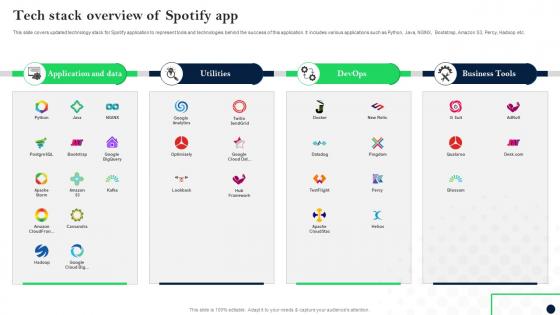
This slide covers updated technology stack for Spotify application to represent tools and technologies behind the success of this application. It includes various applications such as Python, Java, NGINX, Bootstrap, Amazon S3, Percy, Hadoop etc.
People who downloaded this PowerPoint presentation also viewed the following :
Tech Stack Overview Of Spotify App Tech Stack SS with all 9 slides:
Use our Tech Stack Overview Of Spotify App Tech Stack SS to effectively help you save your valuable time. They are readymade to fit into any presentation structure.








FAQs for Tech Stack Overview Of Spotify App
Spotify's backend services primarily utilize Java, Python, Scala, and Go, with Java serving as the foundational language for most core services and microservices architecture. These languages enable Spotify to handle massive data processing, real-time streaming, and personalized recommendation algorithms across millions of users, while Python supports machine learning initiatives and Go delivers high-performance concurrent operations, ultimately ensuring seamless music delivery and user experiences at global scale.
Spotify utilizes microservices architecture by breaking its platform into independent, loosely-coupled services that handle specific functions like user authentication, music streaming, playlist management, and recommendation algorithms. This approach enables rapid feature deployment, allows teams to scale individual components based on demand, and facilitates continuous integration, ultimately delivering seamless user experiences across millions of concurrent users while maintaining system reliability and performance optimization.
Machine learning powers Spotify's recommendation algorithms through collaborative filtering, natural language processing, audio analysis, deep neural networks, and reinforcement learning techniques. These technologies analyze user behavior patterns, song characteristics, and listening contexts to deliver personalized playlists and discover features, with many streaming platforms finding that ML-driven recommendations significantly increase user engagement and retention rates.
Spotify ensures data security and privacy through multi-layered encryption, secure data centers, strict access controls, regular security audits, and compliance with GDPR and other privacy regulations. These comprehensive security measures work by protecting user data both in transit and at rest, implementing role-based permissions, and conducting continuous monitoring, ultimately delivering trustworthy streaming experiences while maintaining competitive advantage in user retention.
Spotify employs PostgreSQL for transactional data, Cassandra for scalable music metadata storage, BigQuery for analytics, and Redis for caching frequently accessed tracks and playlists. These database technologies streamline music discovery by enabling instant search capabilities, personalized recommendations, and seamless streaming across millions of songs, ultimately delivering faster load times and enhanced user experiences for subscribers worldwide.
Spotify implements real-time data processing through Apache Kafka for event streaming, Apache Storm for real-time analytics, and machine learning pipelines that analyze listening patterns, skip rates, and user interactions. These technologies enable instant playlist updates by processing millions of data points simultaneously, delivering personalized recommendations within seconds and enhancing user engagement across their global platform.
Spotify primarily uses Kubernetes for container orchestration, along with Docker for containerization and their internally developed tools like Helios for deployment management. Through Kubernetes, Spotify streamlines application deployment, enables auto-scaling across their global infrastructure, and maintains high availability for millions of users, while their custom tooling delivers enhanced operational efficiency and faster release cycles.
Spotify leverages cloud services through Amazon Web Services and Google Cloud Platform to deliver seamless music streaming across 180+ markets, utilizing content delivery networks, auto-scaling infrastructure, and distributed data storage. This multi-cloud approach enables rapid geographic expansion, reduces latency for users worldwide, and ensures 99.9% uptime, ultimately delivering consistent experiences while supporting millions of concurrent streams across diverse global markets.
Spotify applies adaptive bitrate streaming, content delivery network optimization, edge caching, predictive buffering, and network condition monitoring for streaming quality. These technologies enhance user experience by automatically adjusting audio quality based on connection speed, reducing latency through global server distribution, and minimizing interruptions, with many streaming services finding that strategic infrastructure investment ultimately delivers consistent playback and competitive advantage.
Spotify manages user-generated content through distributed microservices architecture, real-time processing pipelines, and automated metadata extraction systems. The platform leverages Apache Kafka for streaming data ingestion, machine learning algorithms for content categorization, and cloud-based storage solutions, enabling seamless playlist creation, podcast uploads, and music discovery while maintaining scalability across millions of daily uploads.
Spotify's monitoring and logging solutions include Prometheus for metrics collection, Grafana for visualization, ELK Stack (Elasticsearch, Logstash, Kibana) for log management, Jaeger for distributed tracing, and custom alerting systems. These technologies streamline performance tracking, incident response, and system optimization by delivering real-time insights, automated error detection, and comprehensive observability, ultimately enabling faster issue resolution and enhanced user experience reliability.
Spotify's API architecture facilitates third-party integrations by providing RESTful endpoints, OAuth authentication, and comprehensive developer tools that enable seamless access to music data, playlists, and user preferences. Through standardized protocols and extensive documentation, developers across gaming, fitness, and social media platforms can integrate Spotify's streaming capabilities, ultimately delivering enhanced user experiences while expanding Spotify's ecosystem reach.
Spotify has faced challenges with microservices complexity, data synchronization across distributed systems, handling massive concurrent user loads, and maintaining seamless music streaming during peak usage periods. Through strategic infrastructure investments, automated failover systems, and robust monitoring tools, they've achieved impressive uptime while scaling globally, with many streaming platforms finding that proactive architecture planning ultimately delivers competitive advantage in user retention.
Spotify continuously evolves its tech stack through real-time data analytics, machine learning algorithms, and microservices architecture to respond to changing listening behaviors, streaming preferences, and content discovery patterns. These technologies enable personalized recommendations, seamless cross-platform experiences, and scalable content delivery, with many streaming platforms finding that adaptive infrastructure ultimately delivers enhanced user engagement and competitive advantage in an increasingly dynamic entertainment landscape.
Spotify employs sophisticated A/B testing strategies including feature flagging, gradual rollouts, multi-variant testing, cohort analysis, and real-time metrics monitoring across different user segments. These methodologies enable data-driven decisions by comparing user engagement, retention rates, and listening behaviors, with many streaming platforms finding that systematic testing ultimately delivers enhanced user experiences and reduced deployment risks.
-
Great templates that you can use in your next keynote or conference. They are perfect for quick and visually-engaging delivery.
-
Thanks to SlideTeam, we have an ideal template to present all the info we need to cover. Their slides give our numbers and projections a more clear and enchanting look.