


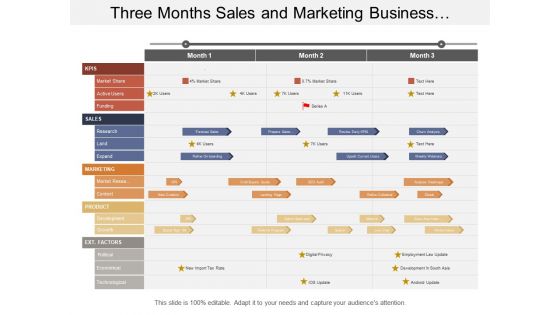
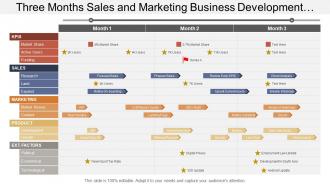
Three months sales and marketing business development timeline





Try Before you Buy Download Free Sample Product
 Impress Your
 Audience
 100%
100% Editable
 Save Hours
 of Time


Are you looking to represent three months sales and business plan of your firm? Checkout our predesigned three months sales and marketing business development timeline presentation design template to do this efficiently. The PPT design will allow you to incorporate each aspect of your business strategic operations in sales, marketing, business development etc. This is one of the best among all the business development PPT templates available, if you are planning to represent company’s overall strategy, sales action plan in front of stakeholders and investors. The marketing and business development PPT template will let you set the strategic plans, priorities and provide a clear picture of goals. This sales and marketing plan timeline is mainly used by sales leaders, marketing professionals and account executives who want to present their business plans to sales teams and management. Our business proposal PPT template is available with compatible, high quality graphics and icons which enable you to just download and insert it in your presentation. Ensure it becomes bright and clear again with our Three Months Sales And Marketing Business Development Timeline. It helps dispel the clouds.
People who downloaded this PowerPoint presentation also viewed the following :
Three months sales and marketing business development timeline with all 5 slides:
Demonstrate your capacity for dynamic action with our Three Months Sales And Marketing Business Development Timeline. Bring your desire for growth to the fore.

FAQs for Three months sales and marketing
So there's basically four phases you'll go through. Research and planning comes first - figure out who you're targeting, set your goals, map everything out. Launch phase is next where you're pushing content and running ads to get initial buzz going. Then lead nurturing (honestly this is where most people mess up) - you're qualifying prospects and moving them through your funnel. Conversion and retention wraps it up. Close those deals and keep customers happy. Oh, and definitely build in some buffer time between each stage because things always take longer than you think they will.
So basically, sales cycles are way shorter - we're talking weeks to months depending on your deal size. Marketing though? That's the long game. You're building awareness and nurturing leads for months, sometimes years before they're ready to buy. Here's how I think about it: marketing plants the seeds way before sales even gets to talk to someone. Your marketing team is creating content and running campaigns to warm people up first. Then sales jumps in when prospects are actually ready (or close to it). Bottom line - you need to plan your marketing stuff well ahead of when you need those leads flowing to sales.
Honestly, you've got tons of options here. Gantt chart tools are perfect for this - Asana and Monday.com let your whole team jump in and update stuff in real-time, which is clutch. Trello works too but it's a bit more basic. For something that looks really polished in presentations, Canva has some nice timeline templates. Adobe Creative Suite too, obviously, but that's probably overkill unless you're already using it. Here's the thing though - sometimes a solid Excel spreadsheet gets the job done just fine. Not sexy, but it works. My advice? Start with whatever tool your team's already comfortable with. The fanciest timeline in the world is useless if nobody maintains it.
So basically you want different metrics for each stage. Top of funnel - track website traffic, social stuff, lead gen. Middle's where you measure engagement like email opens, downloads, demo requests. Here's the thing though - most people get totally distracted by vanity metrics that look good but don't actually mean anything. Bottom funnel's your conversion rates, how fast deals close, acquisition costs. Pick maybe 2-3 key ones per stage max. I swear, teams that try tracking everything just end up paralyzed and can't tell what's actually working.
So your sales targets are basically running the show here. Got aggressive quarterly numbers? You'll be cramming 6-month campaigns into like 2-3 months - it's brutal but doable. Short-term revenue means direct response stuff and quick turnarounds. Long-term goals though? That's where you can actually invest in brand building (takes forever but pays off big). Here's what I'd do: map your sales milestones first, then figure out backwards when everything needs to launch. The timing has to match when sales actually needs those leads coming in. Makes the whole planning process way cleaner.
Dude, feedback is literally your sanity check. Collect it after demos, surveys, sales calls - all that stuff. I've watched so many teams ignore customers who are basically yelling that the messaging sucks or timing's wrong. Don't be those people. When you get feedback saying they need more time to warm up? Extend that phase. Messaging feels off? Pivot it. Oh and actually set up regular reviews to go through what you're learning - otherwise you'll just collect feedback and let it sit there doing nothing.
Check it monthly at least, but honestly every 2-3 weeks is better if stuff's moving quickly. Markets shift so fast now - what seemed realistic in January could be completely wrong by March. Your team's bandwidth changes too with new people, folks leaving, random priorities that come up. Oh and definitely build in some buffer time when you update things. Don't make your timeline so tight that one delayed campaign screws everything else up. I just set a recurring reminder and treat it like any other meeting I can't skip.
Ugh, timeline planning - everyone's worst nightmare but mine's probably procrastination lol. But seriously, the biggest mistake is being crazy optimistic about how long stuff takes. Content creation always drags on forever, then you've got approval rounds that somehow multiply. Plus nobody thinks about optimization time after launch. Oh, and coordinate with other teams early! I learned this the hard way when we launched during a product update. Total disaster. Always pad your timeline with like 30% extra time minimum. Trust me, revisions will happen and you'll be scrambling otherwise. Buffer time saves your sanity.
Honestly, joint timeline planning is a game changer for getting sales and marketing to stop stepping on each other's toes. Map out when marketing will deliver leads and content so sales actually knows what's coming down the pipeline. I can't tell you how many times I've seen marketing celebrating campaign "success" while sales is panicking about empty funnels - it's painful to watch! Build in some buffer time because things always take longer than you think. The key though? Both teams need to create the timeline together instead of one side just dumping requirements on the other. Schedule that joint planning session ASAP.
Oh man, seasonality will absolutely mess with your timelines if you don't see it coming. B2B basically goes into hibernation between Thanksgiving and New Year's - I learned that one the hard way my first year in sales. Meanwhile retail's going absolutely crazy during that same stretch. Your lead times get weird during slow periods too. Decision-making either speeds up or crawls to a halt depending on what's happening. Budget cycles are another thing that'll trip you up. Best thing you can do is bake these patterns right into your annual planning so you're not panicking when November hits and nobody's answering emails.
Honestly, automation tools are a lifesaver for sales and marketing stuff. Start with email sequences and lead scoring - that alone will save you tons of manual work. The best part? Your marketing leads flow straight into sales without someone having to copy-paste everything (which always gets messy anyway). You'll actually see where prospects are stuck in real-time instead of guessing. I'd say tackle lead nurturing first since it's pretty straightforward, then you can get fancy with the complex workflows later. Oh, and follow-up reminders are clutch - nothing worse than losing a hot lead because you forgot to circle back.
So HubSpot's famous case study is actually pretty genius - they spent 6 months building their whole funnel. First 3 months was just content marketing to get people's attention, then they added email sequences and sales calls in months 4-6. Dollar Shave Club crushed the same process in 90 days, but honestly they had crazy money to throw at it. Dropbox went totally different with their referral thing over 8 months, focusing on letting the product sell itself. Here's what you should copy though: they all worked backwards from their revenue target and gave themselves extra time to test stuff that didn't work.
Honestly, think of your social posts like steps in your sales process. Post awareness stuff first to get people interested. Then hit them with engagement content that keeps them thinking about you during the consideration phase. So many teams just throw random content out there without connecting it to sales - huge mistake. Your product demos and testimonials need to drop when people are actually ready to buy, not whenever. Whatever your sales team is focusing on that month? Your social content should back that up. I mean, social media IS part of your revenue strategy, not some side thing marketing does.
Look, it really depends on who you're selling to. Enterprise deals? Those drag on forever because you've got like 5 people who need to sign off. B2C stuff moves way faster. Price matters too - nobody's gonna drop $50K without thinking it through. Timing's weird though. December is basically a dead zone for sales, which is annoying but predictable. Your team's experience makes a huge difference, and honestly, how good you are at following up with leads. I'd start tracking how long each stage actually takes so you can get better at predicting this stuff.
Match your content to where people are in your buying process. Educational stuff first - blog posts, videos, whatever. Case studies hit around the middle. Save ROI calculators and demos for when they're actually ready to buy. If your sales cycle runs 6 months, drop the teaching content early, proof points around month 3, then decision tools near the end. Most marketing teams just throw content out randomly and can't figure out why sales gets annoyed with them. Oh, and definitely loop your sales team into your content calendar. They'll actually know what prospects have seen and can bring it up naturally.
-
Informative presentations that are easily editable.
-
Awesome use of colors and designs in product templates.