


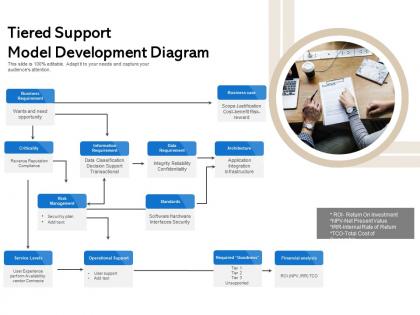
Tiered support model development diagram




Try Before you Buy Download Free Sample Product
 Impress Your
 Audience
 100%
100% Editable
 Save Hours
 of Time


Our Tiered Support Model Development Diagram have all the correct cards. They allow you to control the game.
People who downloaded this PowerPoint presentation also viewed the following :
Tiered support model development diagram with all 2 slides:
Our Tiered Support Model Development Diagram allow you to control the game. They have all the correct cards.
FAQs for Tiered support
Educational tiered support models include universal instruction, targeted interventions, intensive individualized support, ongoing assessment systems, and collaborative team structures. These components interact through continuous data collection and analysis, with educators using assessment results to move students between tiers, adjust intervention intensity, and coordinate resources, ultimately delivering personalized learning experiences and improved academic outcomes.
Schools can effectively implement a tiered support model by establishing universal interventions for all students, targeted support for at-risk groups, and intensive individualized assistance for struggling learners. Through systematic data collection and regular progress monitoring, educational institutions streamline resource allocation, enhance student outcomes, and deliver personalized learning experiences, with many districts finding that this strategic approach ultimately reduces achievement gaps while maximizing instructional efficiency.
Data serves as the foundation for tiered support by analyzing ticket complexity, resolution times, customer profiles, and historical patterns to route inquiries appropriately. Through predictive analytics and automated classification systems, organizations can streamline support workflows, reduce escalation delays, and optimize resource allocation across tiers, ultimately delivering faster resolutions and enhanced customer experiences.
Educators can ensure evidence-based interventions by selecting research-validated programs, conducting regular progress monitoring through data collection and assessment, and implementing fidelity checks to maintain program integrity. Through systematic evaluation protocols, schools track student outcomes across all tiers, adjust interventions based on measurable results, and collaborate with specialists to optimize effectiveness, ultimately delivering improved academic outcomes and strategic resource allocation.
Training strategies for tiered support models include role-specific workshops, cross-tier shadowing programs, standardized escalation protocols, regular scenario-based simulations, and comprehensive knowledge base development. These approaches streamline service delivery by ensuring consistent problem resolution, reducing response times, and improving customer satisfaction, with many organizations finding that structured training ultimately delivers enhanced operational efficiency and better customer experiences.
Elementary settings emphasize foundational skills through visual aids, hands-on activities, and immediate interventions, while secondary applications focus on academic rigor, career preparation, and independent learning strategies. These differentiated approaches enable schools to address developmental needs effectively, with elementary institutions finding success through play-based Tier 1 interventions and secondary schools leveraging data-driven academic support systems.
Common challenges include staff training requirements, resource allocation complexities, data management systems, resistance to change, and consistent implementation across classrooms. Schools can overcome these by providing comprehensive professional development, establishing clear intervention protocols, investing in user-friendly tracking systems, and creating collaborative leadership teams that support gradual implementation, ultimately delivering improved student outcomes and streamlined support services.
Technology integration in tiered support models enhances student engagement through adaptive learning platforms, real-time progress monitoring systems, interactive assessment tools, personalized feedback mechanisms, and collaborative digital environments. These technologies streamline intervention delivery by automating tier identification, customizing content difficulty, and facilitating seamless communication between educators, with many schools finding that students show improved participation rates and academic outcomes across all support levels.
**INPUT**: What metrics should be used to evaluate the success of interventions at different tiers? **OUTPUT**: Success metrics for tiered interventions include response time reduction, escalation rates, first-contact resolution, customer satisfaction scores, and cost-per-incident tracking across each support level. These measurements enable organizations to streamline resource allocation, enhance service delivery, and optimize operational efficiency, with many companies finding that systematic tier-based analytics ultimately delivers improved customer experiences and significant cost reductions. [Word count: 58 words]
Parental involvement can be encouraged through regular communication channels, collaborative goal-setting sessions, home-based intervention strategies, and structured feedback loops at each tier. Educational institutions implementing tiered frameworks find that parent training workshops, progress monitoring tools, and clear role definitions enhance student outcomes significantly, while strengthening family-school partnerships and ultimately improving intervention effectiveness across all support levels.
A tiered support model requires strategic resource allocation across prevention, targeted intervention, and intensive support levels, with schools redistributing staff time, specialized personnel, and instructional materials accordingly. This approach enables more efficient scheduling through data-driven placement decisions, streamlined intervention delivery, and optimized staffing ratios, ultimately delivering improved student outcomes and enhanced operational efficiency.
Tiered support models foster collaboration through structured team meetings, shared data analysis protocols, cross-disciplinary planning sessions, and regular case consultation processes. These frameworks enable teachers, counselors, administrators, and specialists to coordinate interventions seamlessly, share expertise across tiers, and monitor student progress collectively, ultimately delivering more comprehensive support and improved educational outcomes.
Cultural responsiveness in tiered support models requires implementing multilingual capabilities, cultural competency training for staff, flexible communication preferences, and region-specific escalation protocols. Organizations should establish diverse support teams at each tier, incorporate cultural context into knowledge bases, and regularly assess cultural satisfaction metrics, with many global companies finding that culturally-aware support significantly enhances customer retention and experience quality.
A tiered support model for students with disabilities involves customizing intervention levels through individualized accommodations, assistive technologies, specialized instructional methods, and collaborative support teams. Schools successfully implement this by providing universal design learning at Tier 1, targeted skill-building interventions at Tier 2, and intensive one-on-one support at Tier 3, ultimately delivering personalized educational pathways that enhance academic outcomes and promote inclusive learning environments.
Continuous professional development ensures each tier maintains relevant skills, adapts to evolving technologies, and delivers consistent service quality across escalation levels. Through regular training, certification programs, and knowledge sharing sessions, support teams enhance technical competencies, improve customer interaction skills, and stay current with best practices, ultimately delivering faster resolution times and higher customer satisfaction rates.
No Reviews