


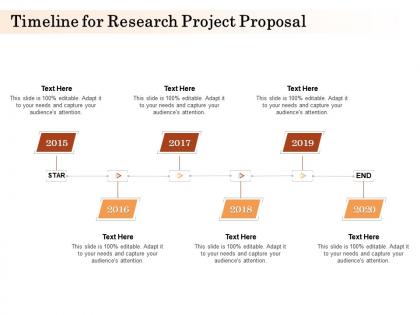
Timeline for research project proposal ppt powerpoint presentation demonstration




Try Before you Buy Download Free Sample Product
 Impress Your
 Audience
 100%
100% Editable
 Save Hours
 of Time


Our Timeline For Research Project Proposal Ppt Powerpoint Presentation Demonstration are topically designed to provide an attractive backdrop to any subject. Use them to look like a presentation pro.
People who downloaded this PowerPoint presentation also viewed the following :
Timeline for research project proposal ppt powerpoint presentation demonstration with all 2 slides:
Use our Timeline For Research Project Proposal Ppt Powerpoint Presentation Demonstration to effectively help you save your valuable time. They are readymade to fit into any presentation structure.
FAQs for Timeline for research project proposal ppt
Key components of a successful research project proposal timeline include literature review phases, methodology development, data collection periods, analysis timeframes, and milestone checkpoints. These elements streamline project management by establishing clear deadlines, allocating adequate resources for each phase, and enabling stakeholder tracking, with many research institutions finding that structured timelines ultimately deliver better outcomes and enhanced project completion rates.
A Gantt chart enhances research proposal timeline visualization by displaying project phases, task dependencies, resource allocation, and milestone tracking in a comprehensive visual format. This structured approach enables researchers to identify potential bottlenecks, optimize workflow sequences, and communicate project scope effectively to stakeholders, ultimately delivering clearer project management and enhanced collaboration throughout the research process.
Common pitfalls include underestimating research phases, failing to account for data collection delays, inadequate buffer time for revisions, and overlooking stakeholder approval cycles. These oversights often derail academic and corporate research projects by creating unrealistic expectations, resource conflicts, and missed deadlines, ultimately compromising project quality and strategic outcomes for organizations.
Deadlines should be determined by working backwards from the final submission date, allocating time based on task complexity, resource availability, and potential dependencies between phases. Each phase requires buffer time for revisions, data collection delays, and stakeholder feedback, with many research organizations finding that realistic timeline planning ultimately enhances project quality and reduces last-minute pressures.
Stakeholder feedback significantly influences research project timelines by determining project scope, methodology adjustments, resource allocation, and milestone priorities through iterative review cycles. This collaborative approach enables organizations to align research objectives with business needs, anticipate implementation challenges, and secure necessary approvals, ultimately delivering more strategic outcomes while many institutions finding that early stakeholder engagement streamlines project execution.
Time management tools help streamline research proposal processes by automating task scheduling, tracking milestone deadlines, and coordinating team collaboration across multiple project phases. These platforms enable researchers to allocate resources more efficiently, minimize administrative overhead, and maintain consistent progress monitoring, with many academic institutions finding that structured timeline management ultimately delivers faster proposal completion and higher submission success rates.
**INPUT**: What factors should be considered when estimating the duration of each project phase? **OUTPUT**: Duration estimation should consider resource availability, task complexity, stakeholder review cycles, data collection requirements, and potential bottlenecks or dependencies between phases. These factors enable project managers to create realistic timelines by accounting for team capacity, approval processes, and research methodologies, with many organizations finding that incorporating buffer time ultimately delivers more accurate scheduling and successful project outcomes. [Word count: 58 words]
Research project timelines should be reviewed monthly during active phases and at every major milestone, with updates made whenever scope changes, unexpected delays occur, or new requirements emerge. This regular monitoring enables research teams to maintain realistic expectations, reallocate resources strategically, and communicate progress transparently to stakeholders, ultimately delivering more accurate projections and successful project outcomes.
Research timeline strategies include building buffer periods, establishing milestone checkpoints, maintaining flexible resource allocation, creating contingency protocols, and implementing regular progress reviews. These approaches enable researchers to absorb unexpected delays through strategic time padding, alternative methodologies, and adaptive scheduling, while many academic institutions find that proactive risk assessment ultimately delivers more realistic project completion rates and better research outcomes.
Project milestones can be effectively communicated through visual timeline dashboards, regular milestone review meetings, automated progress alerts, clear deliverable specifications, and milestone-linked accountability systems. These communication strategies streamline project coordination by establishing transparent expectations, enabling proactive timeline adjustments, and maintaining team alignment, with many research organizations finding that structured milestone communication ultimately delivers faster project completion and enhanced collaborative efficiency.
Aligning research timelines with funding agency deadlines ensures adequate preparation time, comprehensive proposal development, and competitive positioning against other applicants. This strategic synchronization enables researchers to conduct thorough literature reviews, secure institutional approvals, and refine methodologies, with many academic institutions finding that well-timed submissions significantly increase funding success rates.
Different research methodologies significantly impact project timelines, with qualitative approaches like interviews and ethnographies typically requiring longer data collection periods, while quantitative surveys and experiments can accelerate timelines through structured data gathering. These methodological choices ultimately determine resource allocation, analysis complexity, and deliverable schedules, with many research teams finding that mixed-method approaches balance depth with efficiency for comprehensive insights.
Best practices for coordinating with collaborators include conducting initial planning sessions, establishing clear communication protocols, defining individual responsibilities and deadlines, implementing regular check-ins, and using shared project management tools. These collaborative approaches streamline coordination by ensuring transparency, accountability, and real-time updates, with many research teams finding that structured communication and centralized tracking ultimately deliver more efficient project execution and stronger outcomes.
Digital tools enhance research timeline collaboration by enabling real-time document sharing, synchronized scheduling, automated progress tracking, and instant communication across distributed teams. Through cloud-based platforms and project management software, research institutions streamline coordination, minimize revision conflicts, and accelerate decision-making processes, with many academic organizations finding that these technologies ultimately deliver faster project completion and improved research outcomes.
Key metrics include milestone completion rates, resource utilization efficiency, stakeholder feedback scores, budget adherence percentages, and deliverable quality assessments. These evaluation criteria enable project managers to track progress systematically, identify potential bottlenecks early, and make data-driven adjustments, with many research organizations finding that comprehensive timeline metrics ultimately deliver improved project outcomes and enhanced strategic planning capabilities.
-
Unique design & color.
-
Attractive design and informative presentation.
-
Content of slide is easy to understand and edit.
-
Enough space for editing and adding your own content.