


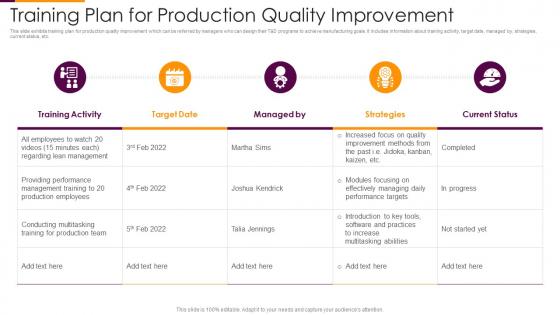
Training Plan For Production Quality Improvement




Try Before you Buy Download Free Sample Product
 Impress Your
 Audience
 100%
100% Editable
 Save Hours
 of Time


This slide exhibits training plan for production quality improvement which can be referred by managers who can design their T and D programs to achieve manufacturing goals. It includes information about training activity, target date, managed by, strategies, current status, etc.
People who downloaded this PowerPoint presentation also viewed the following :
Training Plan For Production Quality Improvement with all 6 slides:
Use our Training Plan For Production Quality Improvement to effectively help you save your valuable time. They are readymade to fit into any presentation structure.





FAQs for Training Plan For
Track your defect rates and first-pass yield - those are the big ones. Customer complaints too, obviously. Scrap and rework costs will kill your margins faster than anything else, trust me on that. On-time delivery matters since quality problems always seem to cause delays. Don't forget process capability indices (Cpk) to see if you're actually hitting spec limits. Oh, and supplier quality metrics are huge because bad incoming materials screw up everything downstream. Honestly, start with these basics first. You can get fancy with more metrics later once you figure out where you're bleeding the most.
So here's what's worked for me - start by mapping out where quality issues usually pop up in your process. That becomes your game plan. Get your team to actually stop production when they catch defects (sounds scary but it's worth it). Visual management systems help too - makes problems super obvious right away. Look for anything that doesn't add real value and cut it out. The whole kaizen thing is just making small tweaks consistently rather than some massive overhaul. Oh, and poka-yoke is basically idiot-proofing your process so mistakes can't happen. Honestly, the "pursue perfection" mindset gets results if you don't overthink it.
Dude, training your people is huge for quality - probably the biggest impact you can have. Your team will catch problems early when they actually know what to look for. Confidence goes up too, which honestly makes such a difference in how much care they put into their work. I've watched companies try to cut corners on training... always backfires with complaints and wasted material. You should start with whatever's causing your biggest headaches right now and train specifically around those issues. Way more effective than generic stuff.
Start with the 5 Whys - just keep asking "why" until you get past the obvious stuff. Fishbone diagrams help map out causes across people, processes, materials, equipment. Do a Pareto analysis because honestly, the defects costing you the most aren't usually the ones you'd expect. Get everyone doing gemba walks on the production floor. Oh, and check your data first - I've seen so many "defects" that were actually just crappy measurements. Your team will catch things you miss when they're actually watching the process happen. Short walks beat long meetings every time.
Honestly, automation is a game-changer for quality control. Machines don't have Monday morning brain fog or get distracted by office drama - they just do the same thing perfectly every time. Your defect rates will drop big time because there's no human inconsistency. The data you get is actually reliable too, which helps catch problems early before they cost you money. Temperature, pressure, timing - all that stuff gets monitored way more precisely than any person could do. Oh, and start with whatever process gives you the most headaches. That's where you'll notice the difference immediately.
Dude, supplier quality can totally destroy your whole operation if you're not careful. Bad materials = bad final products, period. I learned this the hard way at my last job - we had this one supplier who kept sending us garbage components and it screwed up everything downstream. You'll end up with way more defects, angry customers, the whole mess. Honestly, I'd rather deal with a slightly more expensive supplier who's reliable than chase after the cheapest option. Set your standards early and actually check up on them. Don't just hope they'll figure it out.
Really depends on what kind of business you're running and how much risk you can handle. Manufacturing places swear by SPC and Six Sigma - old school but they work. Food and pharma have to use HACCP systems since nobody wants to poison customers, obviously. Tech companies do agile testing with continuous integration. Service businesses? Customer feedback and mystery shoppers are your best bet. Don't try to do everything at once though - pick like 2 or 3 methods that actually make sense for your situation. Focus on whatever's causing you the biggest headaches first.
So basically you want data flowing back to your production team constantly - not just when stuff breaks. Automated alerts are clutch when quality starts drifting. Your floor operators need an easy way to flag problems they're seeing, and honestly, customer complaints are pure gold for spotting what you're missing. Weekly cross-team reviews help catch trends before they explode. Don't try building everything overnight though - pick one solid feedback loop first, then add more. Oh, and make sure it's actually systematic, not just random conversations when fires need putting out.
Think of SOPs as your backup plan when things get crazy. You don't want to rely on everyone remembering stuff perfectly - we both know how that usually goes! Document the steps that actually work, especially for your most important processes. Training new people becomes so much simpler when everything's written down. Plus, when something goes sideways (and it will), you can trace back through the process to figure out what happened. Honestly, I've seen too many businesses wing it and then wonder why their quality is all over the place. Start small with your critical stuff first.
Cross-functional teams are honestly game-changers for quality stuff. You get manufacturing spotting a defect, engineering explaining why it keeps happening, and QA realizing there's a testing gap. Sales can jump in with customer complaints before they blow up too. Different perspectives on the same problem just work better than having departments stuck in their own bubbles. The trick is actually getting everyone in a room regularly to share what they're seeing. Sometimes those meetings drag on forever though - but when they click, you catch issues way faster than going through normal channels.
Honestly, customer feedback is like a reality check for your quality standards. It'll show you what specs you obsessed over that nobody actually cares about. Plus it catches quality problems you totally missed during testing. The annoying thing is you hear from the complainers first - not your average customer. But once you start seeing patterns in what people love or hate, that's pure gold for tweaking your benchmarks. I'd set up regular feedback loops and track which quality stuff actually matches customer satisfaction. Trust me, the data tells a story.
So Six Sigma is basically this methodical way to find and fix defects using data - which sounds boring but actually works really well. There's this DMAIC thing (Define, Measure, Analyze, Improve, Control) that walks you through each step. First you define what's broken, measure how bad it is, figure out why it's happening, fix it, then make sure it stays fixed. The statistical tools can be a bit much at first, honestly. But once your team gets trained up and starts spotting waste everywhere, it's pretty cool. Just pick one process to start with - don't go crazy and try everything.
Honestly, it's mostly about everything breaking down at once. Your quality teams can't keep up anymore, new people haven't learned the ropes yet, and everyone's just scrambling to meet demand instead of doing things right. Equipment starts wearing out faster, supply chains get messy, departments stop talking to each other properly. I learned this the hard way - you really want those scalable systems in place way before you actually need them. Like, way before. Trying to fix quality issues while you're already in crazy growth mode? That's a nightmare you don't want.
So product design is like the foundation for everything quality-wise. Bad design upfront? You're gonna have a nightmare later. When you think about manufacturability and tolerances from day one, production just flows better. I've watched teams burn months fixing issues that good design choices would've prevented entirely. Your workers can build more consistently, defects drop, and catching problems gets way easier. Here's what really works though - get your production people in those design reviews super early. They'll catch the expensive screwups before they happen.
Get everyone involved in quality, not just the QC folks. Celebrate when people spot mistakes or suggest fixes - most companies only highlight screw-ups which is backwards honestly. Train your team properly and trust them to make calls. Those regular team huddles? They crush top-down rules every time. Focus on preventing problems instead of constantly putting out fires. Oh, and fix your reward system - recognize quality wins, not just who works fastest. Your people will actually care about doing things right if you show them it matters more than just cranking out volume.
-
Loved the collection. Editing the presentation was seamless with their templates.
-
Enough space for editing and adding your own content.