

Training proposal template powerpoint presentation slides





Try Before you Buy Download Free Sample Product
 Impress Your
 Audience
 100%
100% Editable
 Save Hours
 of Time


Training is an essential process to equip employees with the right skill set to do their jobs as competently as possible. Outline here training procedures and goals for your employees with the help of our professionally designed Training Proposal PPT template. Quote your services to provide professional development and corporate training with a comprehensive proposal. Present all the goals and steps needed to be completed within the training period. Assign and display the roles of the groups and individuals who will assist in the training process. With a training proposal template set a clear direction, communicate a compelling vision along with preventing employee disengagement. Include prerequisites for attending the training, the proposed length of the training, the learning objectives, agenda, and a preliminary budget. Offer a visually appealing yet well-structured layout like this to explain your process in a comprehensive and easy to understand way. Get the necessary approvals and funding required for the training's development with a compelling proposal. Share the guidelines that are essential to appeal to your funders. Identify and focus on the areas you intend to cover in your proposed management training program. Enable employees to recognize their roles and responsibilities as well as manage different types of reporting structures. With this professionally designed training proposal, guide and make employees competent to function effectively and manage the tasks efficiently. High quality and well-researched graphics used in this PPT template will help make the required impact on your funders. Immediately download this proposal template to prepare an appealing travel proposal.
People who downloaded this PowerPoint presentation also viewed the following :
Content of this Powerpoint Presentation
Here’re some facts about corporate training based on the studies by Associated for Talent Development (ATD), Linkedin, and Gallup:
-
Did you know that companies with a formalized training program have a 24% higher profit margin overall?
-
94% of employees would stay in their roles if offered development opportunities.
-
Companies that invest in employee training programs are 17% more productive.
These numbers prove that employee training programs are essential for a company’s growth. Besides, they also help improve employee satisfaction and retention. Well-trained employees can be a company’s competitive asset in the market. Thus, businesses actively pursue corporate trainers.
If you offer corporate training and development courses, be rest assured the market is here to stay. Our training proposal template is designed to help such businesses.
For example, you can use our well-structured proposal template to present your training programs to companies. You can highlight topics like your process, training type, and budget. Our customizable PPT Presentation can help you convince the company leadership and get their approval.
Training Proposal Template PPT
‘How can we train employees better?’ This is the question companies are asking.
As a training provider, you must answer this question in a clear and engaging manner. It is your chance to offer a tailored solution and also advertise your training services. Our training proposal template helps you do precisely that.
Are you looking to onboard clients for your professional development workshops? Use our workshop training proposal template to present your programs. The bundle includes additional slides with timeline flows that you can customize to your needs.
Let us go through some of the high-impact slides in our proposal template.
Template 1: Project Context
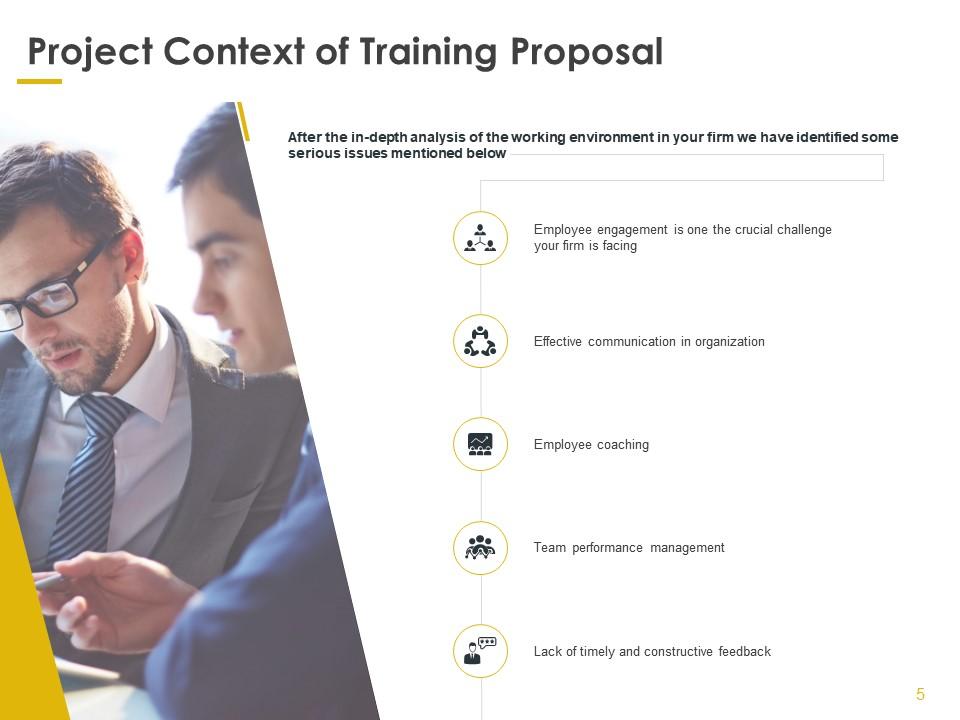
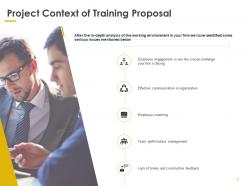
Why does the company want to hire a training expert? What are the top employee training and development challenges? The project context PPT Slide is where you will cover the answer to these questions. This is where you define the scope of the training project. For example, we have added challenges like employee engagement and team performance.
The presentation template uses a vertical list design with descriptive icons for the issues. Its design gives the presentation slide a clutter-free look while driving attention to the text. You can change the icons and font style to match the context.
Template 2: Project Objectives
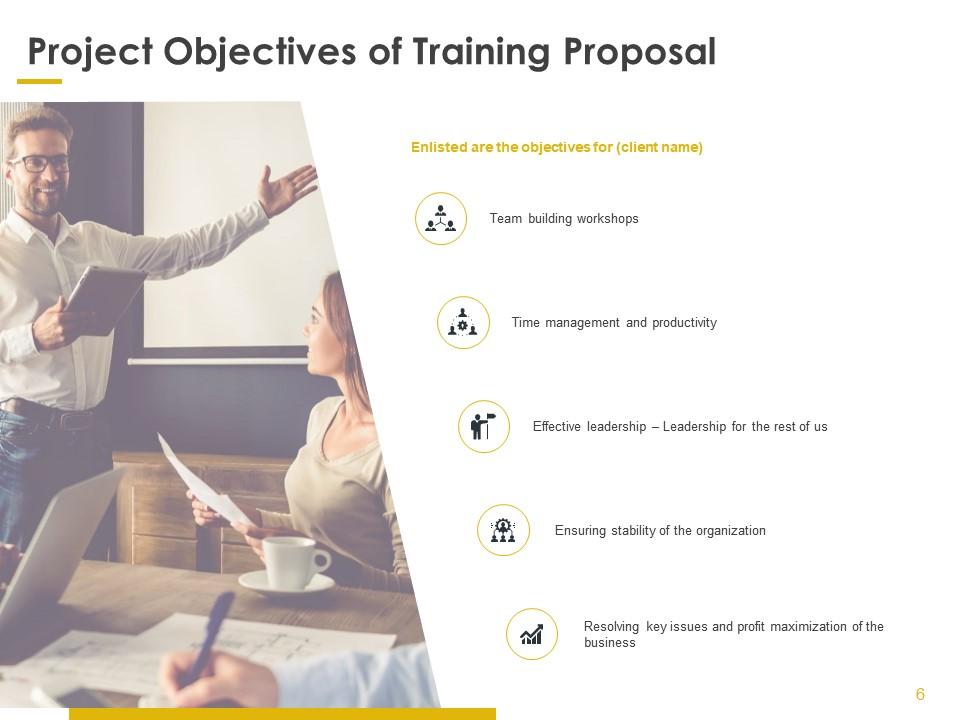
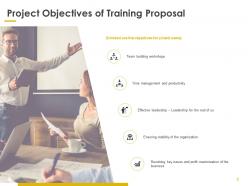
What are the expected outcomes of the training project? This is where you will mention the objectives that will be measured after the course is completed. For example, we have included objectives like productivity and profit maximization.
The PPT Slide again uses a vertical list design with icons for the objectives. The design is reused across the PPT Template for its effectiveness. For example, readers are more likely to pay attention to a neatly organized list. It is also easier to refer back to during the course of the training.
Template 3: Our Process
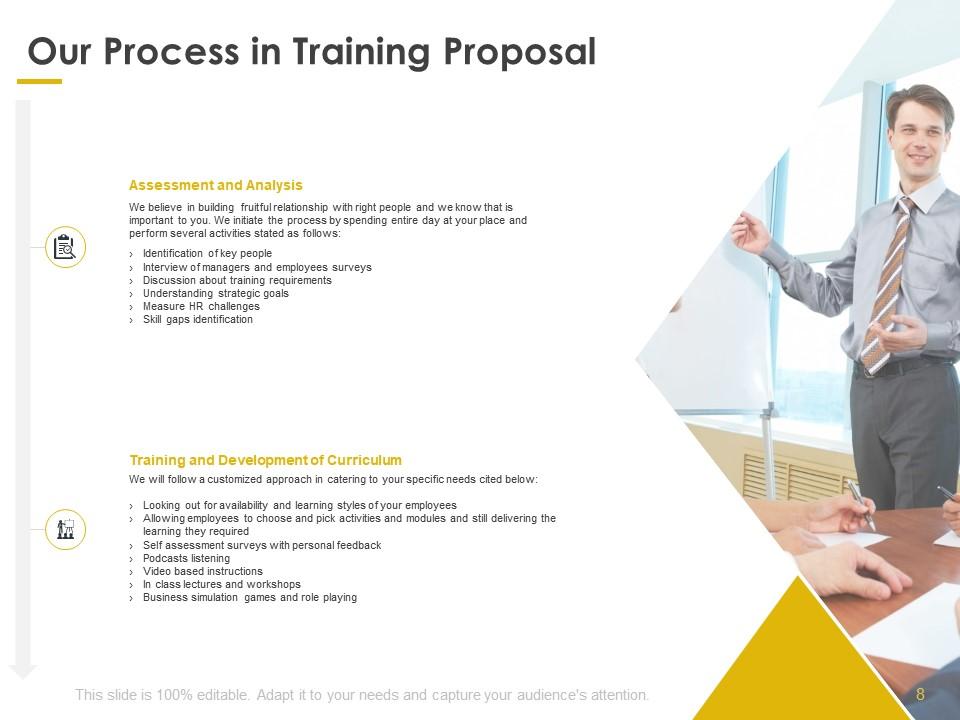
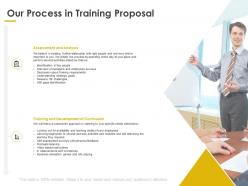
With the above PPT Slides, you have defined the training scope and objectives. How do you plan to meet the goals? You can use our process slides to explain your strategy. The process presentation design includes a lot of information; it is text-heavy. Thus, the design is kept minimal. We have used headings, lists, and icons for the steps. The two steps covered in this presentation design are analysis and curriculum development. Researched content is available under both headings. You can use them as-is or as inspiration. You can customize it or add new content altogether.
Template 4: Our Process
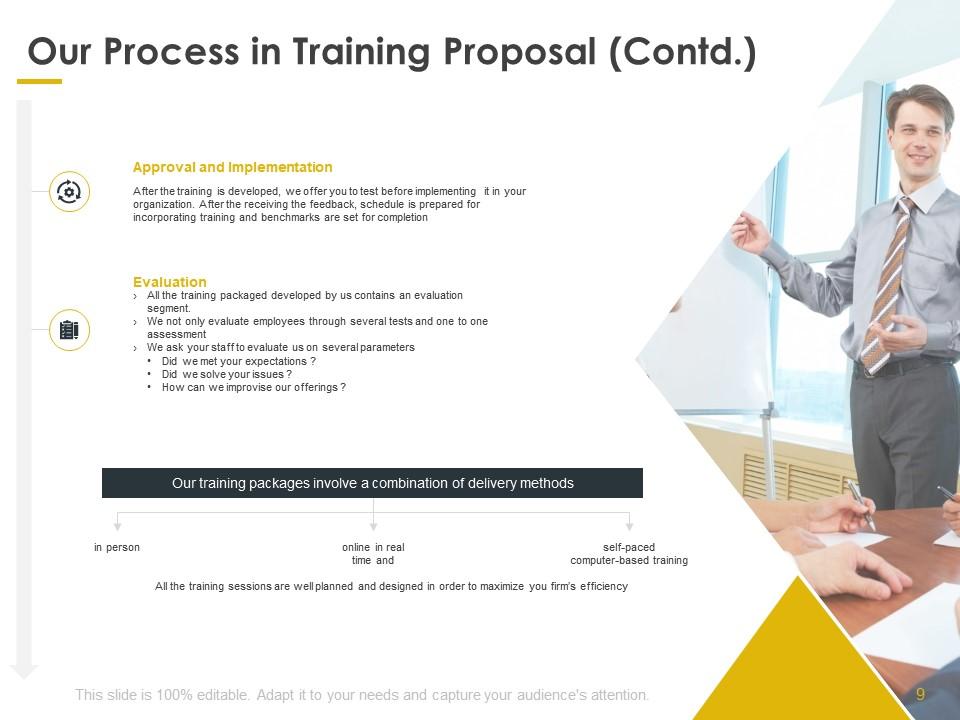
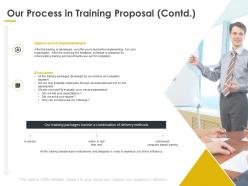
This is a continuation of the process slide. The remaining two steps included in the PPT Design are ‘approval and implementation’ and ‘evaluation’. The lists and icons design is carried over to maintain consistency. The one addition to the PPT Design is the training delivery methods graphic at the bottom. The methods are represented by a vertical tree. On the branches, you have methods like in-person, online, and self-paced. The two content-ready process presentation slides together thus explain how you will achieve objectives with detailed steps and training methods.
Template 5: Investment with Training Options
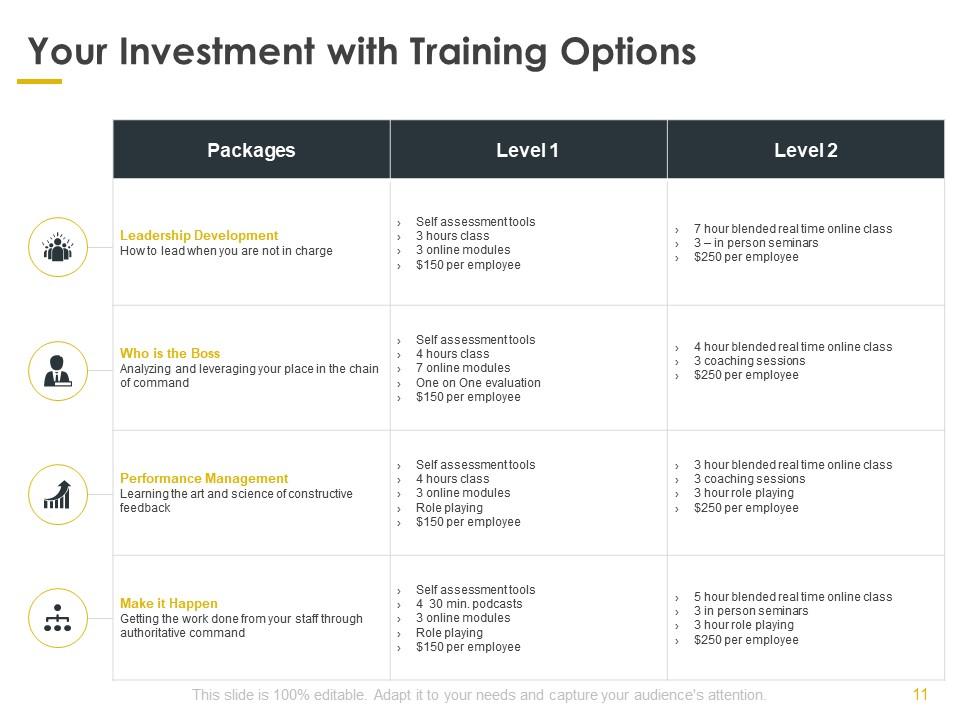
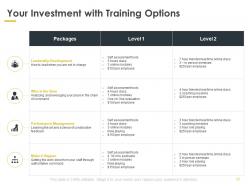
What type of training packages do you offer? What services do each of these packages include? How much do these training cost? You can use the ‘investment with training options’ PPT Layout to answer these questions. You can present the packages and levels of training with a table. You can provide details about the training type, timeline, and cost with a bulleted list. The table format makes it easier to compare the different training levels. It also helps provide a comprehensive view of your services at one glance.
Template 6: About Us
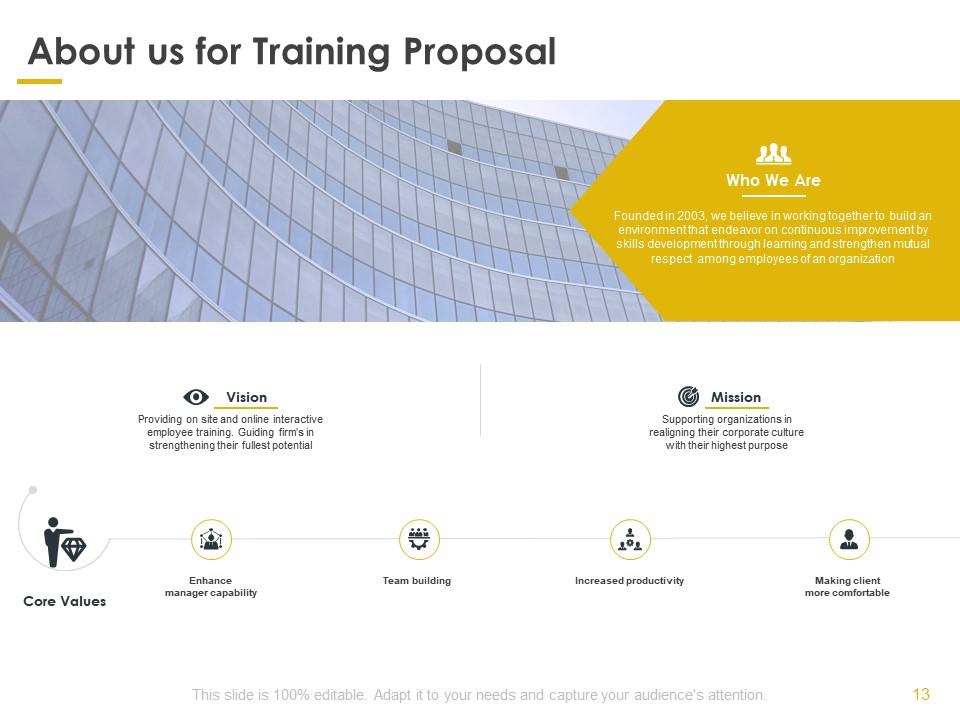
Who are you? Why should companies work with you? You can use the About Us slide to give a background of your company.
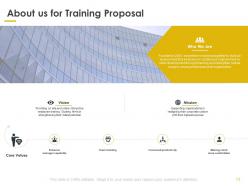
The PPT Preset has a creative design as there is comparatively less content to present. The presentation preset has a banner at the top where you can write about when the company was established and what you do. The mid-section is dedicated to vision and mission. A divider line separates the two into neat sections. At the bottom we have used a graphic of a linear flow with icons for the core values. The design of the three sections complements each other with their style, spacing, and graphics.
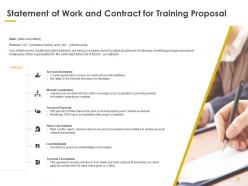
Template 7: Statement of Work and Contract
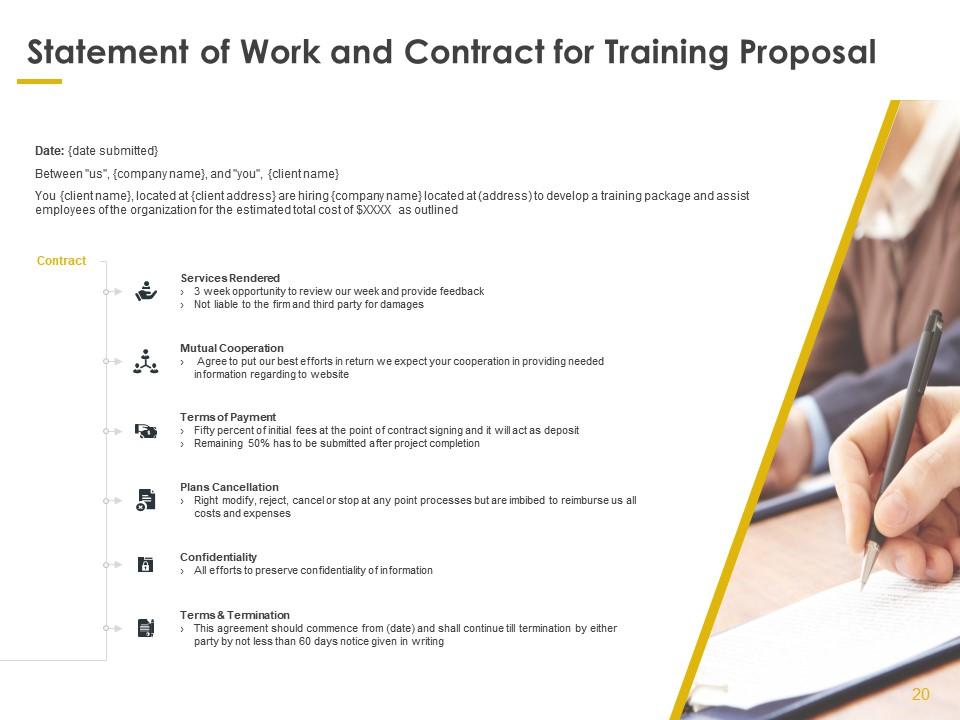
Statement of Work is an important presentation design as it helps set the expectations before you start the training project. Here, you can mention your services, payment terms, confidentiality, and other conditions. The terms can be mentioned with the help of a vertical list and icons. You can explain each list heading further with a sublist as required. The PowerPoint Layout already includes content for typical contract clauses, such as services, terms of payment, and plan cancellation. However, you can always modify the content or add your own clauses as required.
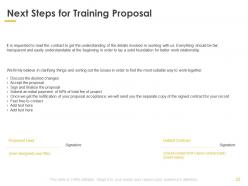
Template 8: Next Steps
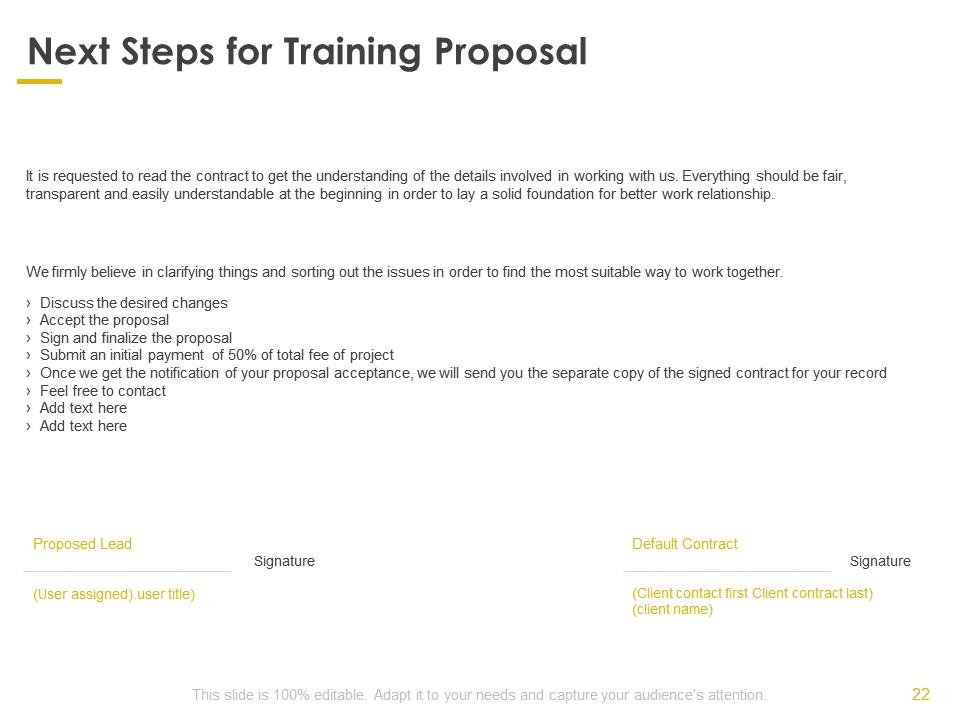
The ‘Next Steps’ slide acts as an agreement between the client and your business. Here you can reiterate the important terms and conditions. You can let the client know the next steps from their end and when the project will start. Two signature sections are available at the bottom. The space for the signature and name is well-defined. Once the stakeholders are in agreement, you and the client can formalize the training project with your signatures. This PPT Design is minimalistic, as the content needs the reader’s undivided attention.
Empower Companies with your Training Offerings
Our training proposal template can help you win over clients. The pre-designed slides also include well-researched content. It helps you set the narrative with a problem statement and solution flow.
Design elements like simple lists, icons, and linear flows dominate the proposal PPT Template. This is done to ensure the client gets the most out of the PPT Presentation while not being overwhelmed with the amount of data.
All the PPT Slides are customizable and even minute changes or redesign will align with your requirement of offering training services.
PS: Do you offer training programs for new joiners? Use our company staff training proposal PPT to make your case. The 100% editable slides are content-ready and cover topics from objectives to contracts.
Training proposal template powerpoint presentation slides with all 29 slides:
Use our Training Proposal Template Powerpoint Presentation Slides to effectively help you save your valuable time. They are readymade to fit into any presentation structure.
FAQs for Training proposal template
Hey! So for your training proposal, you'll want clear learning objectives and who exactly you're targeting. Content outline is huge - plus delivery method and timeline. Budget breakdown too, obviously. The business case is honestly the most important part - like what problems does this actually solve? I always throw in success metrics because managers eat that stuff up. Oh and don't forget resources you'll need - materials, space, tech whatever. Be specific enough that they won't come back with a million questions. Grab a template and just tweak it each time.
Look, it really comes down to knowing your audience. Corporate folks want to hear about ROI and how training boosts productivity - basically, show me the money. Schools? They're way more interested in student outcomes and whether it fits their curriculum. Same basic structure works for both, but ditch terms like "stakeholders" when talking to educators (sounds so stiff). Timeline expectations are totally different too. Companies want tight deadlines and clear metrics they can track. Educational clients are cool with longer-term goals since learning takes time. Honestly, just do your homework on what's bugging them first - makes everything else way simpler.
Keep it clean and professional - lots of white space, consistent fonts, bullet points to break up chunks of text. Charts showing ROI or timelines are gold for executives. Company branding should be there but don't go overboard with it. Icons for different training modules look nice too. Good contrast on headers makes everything easier to navigate. Honestly, PowerPoint works fine for this stuff - you don't need anything fancy. Just make it polished without being too flashy. Create a template you can reuse later. The whole point is making it scannable so busy people can actually digest your proposal quickly.
Use action verbs when you write objectives - stuff like "analyze," "demonstrate," or "create." Way better than fuzzy words like "understand." Make them specific enough that you can actually tell if the training worked. Here's how I think about it: participants should be able to clearly explain what they can do now that they couldn't before. Each outcome needs to tie back to a real business problem or skill gap. Otherwise you're just doing training because someone said you should, which honestly happens way too often. Keep it measurable and connected to actual needs.
Honestly, I'd go with a mix of hard numbers and softer stuff. Completion rates and test scores are obvious ones. But the real magic happens when you see if people actually use this stuff back at work - that's where manager check-ins and employee surveys come in handy. Business metrics matter too, like did productivity go up or errors go down? Whatever your boss cares about most. Set your baseline before you start so you can show the difference. Oh, and don't go crazy - pick maybe 3-5 things to track or you'll spend forever collecting data instead of actually training people.
Okay so basically - do your needs assessment first, then build everything else around it. Like, don't even touch the template until you know what skill gaps you're dealing with. Once you've got that data, you can actually justify why you're asking for specific training methods or budget amounts. Makes your whole proposal way more targeted instead of just throwing random stuff at the wall. I mean, nobody wants to read generic training fluff, right? It's honestly like the difference between a custom solution and some cookie-cutter program. Your objectives, timeline, resources - they'll all make way more sense when they're tied to actual identified needs.
Definitely collect feedback after every session - that's where the real insights are. I used to just toss those forms in a folder (terrible mistake!). Look for patterns in what bombed or what people loved. Consistent complaints about pacing? Fix your template timing. Everyone wants more interaction? Build that in permanently. Facilitator notes about logistics are super helpful too. The whole point is making each session better than the last one. Oh, and don't ignore the small stuff - sometimes tiny tweaks make huge differences in how smoothly things run.
Break your budget into specific chunks - instructor fees, materials, venue, participant time. People hate vague "miscellaneous" line items (learned that the hard way). Simple table format works best. Show both per-person costs and total project costs so everyone can see the value immediately. Oh, and definitely pad it with 5-10% extra because something random always pops up. Maybe the projector dies or you need last-minute printing. The whole thing should look thought-out but not overwhelming. Honestly, if stakeholders can't quickly scan it and get it, you'll lose them.
Definitely add a "Risk Assessment" section to your proposal - it's honestly one of those things that makes you look super prepared. I'd think through the obvious stuff first: what if nobody shows up, tech crashes, or your budget gets slashed? Also consider skill gaps between participants since that always creates headaches. Write down your backup plan for each scenario. Maybe you need virtual options, extra facilitators, whatever. It shows you're not just throwing together a training and hoping for the best. Trust me, when things go sideways (and they will), you'll be glad you mapped this out beforehand.
Hey! So training proposals need a few key things that regular ones don't. First off, nail down your learning objectives - what can people actually DO after your training? Curriculum breakdown is crucial too, showing modules and timelines. Honestly, trainer qualifications matter way more here than in other proposals - like, people really scrutinize that stuff. You also gotta explain how you'll assess if it worked (did they learn anything?). Oh and don't skip post-training support because nobody retains everything from one session. Focus on measurable skills over flashy features and you're golden.
Honestly, try Typeform or Google Forms first - way easier than wrestling with static PDFs. Notion's pretty sweet for this too since you can throw in videos and budget calculators that actually work. Been using Canva's presentation mode lately and it's shockingly decent for proposals. Oh, and here's the cool part - set up branching scenarios so different client needs automatically show different template sections. Makes the whole thing feel like you're having a real conversation instead of just dumping info on them. I'd start small with one interactive piece and see how it goes!
Check out ATD's website first - they've got real proposal examples from companies that actually won contracts. Dale Carnegie and FranklinCovey publish some solid case studies too, though you have to dig a bit. LinkedIn Learning has surprisingly good B2B proposals if you can find them. Look for ones that break everything into clear sections: needs assessment, learning objectives, your approach, and ROI stuff. The good templates use visuals like timelines instead of just boring text blocks. Honestly, that makes such a difference with clients. Find one that fits how you actually train, then just adapt it from there. Way easier than starting from scratch.
Make your template super modular from the start - different sections for virtual vs in-person delivery, materials lists, all that stuff. I'd throw in checkboxes for learning styles too: visual people, hands-on learners, discussion lovers, whatever. Trust me, the more flexible you build it now, the less you'll hate yourself later when you're scrambling to adapt it. Dropdowns work great for training formats so you can just click and go. Map out maybe 3 scenarios you deal with most. Then create sections that work across all of them. Way easier than rebuilding every single time.
Look, you definitely need timelines in that proposal. People want to know when they'll actually see results, not just throw money at some vague training idea. Break it down into phases with real dates and deliverables - like "module 1 done by March 15th" or whatever makes sense. Honestly, it's one of those things that separates the pros from people who are just winging it. Without clear milestones, stakeholders can't track progress or plan their budgets. Plus it shows you've thought through the actual work involved instead of just promising the moon. Make it specific so everyone knows what's happening when.
Honestly, just bake flexibility into your template from day one. I keep this random notes doc where I dump new methods I stumble across - super nerdy but has literally saved my ass multiple times lol. Make modular sections you can swap around for different industries. Short bursts work better than long blocks anyway. Also throw in placeholder spots for "emerging tools" or whatever so you're not rebuilding the whole thing when some shiny new trend pops up. Think of it more like a living doc that grows with you rather than something static you set up once and ignore.
-
Colors used are bright and distinctive.
-
Very unique and reliable designs.
-
Appreciate the research and its presentable format.
-
Easy to edit slides with easy to understand instructions.