

USA Map Split Into Census Regions With Northeast Division





Try Before you Buy Download Free Sample Product
 Impress Your
Audience
 100%
Editable
 Save Hours
of Time


Our USA Map Split Into Census Regions With Northeast Division are topically designed to provide an attractive backdrop to any subject. Use them to look like a presentation pro.
People who downloaded this PowerPoint presentation also viewed the following :
USA Map Split Into Census Regions With Northeast Division with all 6 slides:
Use our USA Map Split Into Census Regions With Northeast Division to effectively help you save your valuable time. They are readymade to fit into any presentation structure.
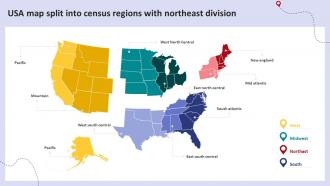





FAQs for USA Map Split Into Census Regions
The four main U.S. Census regions are the Northeast, Midwest, South, and West, each encompassing multiple states with distinct geographic, economic, and demographic characteristics. These regional classifications enable businesses, researchers, and policymakers to analyze market trends, demographic patterns, and economic opportunities across different areas, ultimately delivering strategic insights for targeted marketing, resource allocation, and regional expansion planning.
Census region classification significantly impacts federal funding distribution by determining allocation formulas for programs like Medicaid, transportation infrastructure, and education grants, with funding often calculated based on regional population densities, economic indicators, and demographic characteristics. This systematic approach enables equitable resource distribution across diverse geographic areas, ensuring states within similar regions receive proportional support while accounting for regional cost variations and specific economic needs.
Demographic trends vary significantly across U.S. census regions, with the South experiencing rapid population growth and increasing diversity, the West seeing substantial Hispanic population increases, the Northeast facing slower growth and aging populations, and the Midwest encountering population decline in rural areas. These regional patterns create distinct opportunities for businesses, with many companies finding that tailored strategies addressing specific demographic shifts—such as bilingual services in the West or senior-focused offerings in the Northeast—deliver competitive advantages and enhanced market penetration.
Census regions influence political representation through population-based congressional apportionment, redistricting processes, and Electoral College allocation, directly affecting federal funding distribution and legislative priorities. Regional demographic patterns, economic interests, and voting behaviors create distinct political landscapes, with states like Texas and California gaining representation while Rust Belt regions face declining influence, ultimately reshaping national electoral strategies and policy outcomes.
The Northeast emphasizes finance, technology, and manufacturing with higher costs but greater income density, while the Southwest focuses on energy, agriculture, and tourism with lower operational costs and rapid population growth. Through strategic resource allocation, businesses find the Northeast delivers established infrastructure and skilled workforce access, whereas the Southwest enables cost-effective expansion and emerging market opportunities, ultimately offering distinct competitive advantages.
Cultural aspects vary significantly across U.S. census regions through distinct traditions, languages, cuisines, and social practices shaped by historical migration patterns, geographic influences, and economic development. The Northeast emphasizes education and urban sophistication, the South celebrates hospitality and traditional values, the Midwest prioritizes community and work ethic, while the West embraces innovation and diversity, ultimately creating distinct regional identities that influence consumer behavior, business practices, and market strategies.
Migration significantly reshapes census region demographics by altering age structures, ethnic compositions, educational levels, and economic profiles through interstate and international population movements. The South experiences substantial growth from retirees and job seekers, while the Northeast faces outmigration challenges, with these patterns ultimately transforming regional political representation, workforce characteristics, and economic development strategies.
The U.S. Census Bureau gathers regional data through the decennial census, American Community Survey, economic censuses, and ongoing demographic surveys, combining traditional mail-in forms with digital collection methods and statistical sampling techniques. This comprehensive approach enables federal agencies, businesses, and researchers to track population shifts, economic trends, and resource allocation needs across the four major census regions, ultimately delivering critical insights for policy planning and strategic business decisions.
The establishment of current census regions reflects westward expansion, economic development patterns, geographic boundaries, and administrative efficiency needs from the 1800s onward. These regions evolved through territorial acquisitions, industrialization phases, and transportation networks, with many federal agencies finding that regional organization streamlines data collection, policy implementation, and resource allocation across diverse state groupings, ultimately delivering standardized statistical analysis.
Geographic features significantly shape each census region's development through natural resources, climate patterns, transportation networks, and economic opportunities. The Northeast's coastal access enabled early trade and finance centers, the South's fertile plains supported agriculture, the Midwest's Great Lakes facilitated manufacturing, and the West's diverse terrain created mining, agriculture, and technology hubs, ultimately delivering distinct regional economies and settlement patterns.
Census regions enable businesses to segment markets by analyzing demographic patterns, consumer behaviors, economic conditions, and regional preferences across standardized geographic boundaries. Companies leverage this data for targeted marketing campaigns, product development strategies, and expansion decisions, with retail chains finding optimal store locations and financial services tailoring offerings to regional economic profiles, ultimately delivering competitive advantages through data-driven market insights.
Educational attainment levels vary significantly across U.S. census regions, with the Northeast and West typically showing higher percentages of bachelor's and advanced degrees, while the South and Midwest present more diverse patterns. These regional differences reflect varying economic structures, industry concentrations, and historical investment in higher education infrastructure, with states like Massachusetts, Colorado, and Maryland consistently ranking highest in educational achievement.
Urban areas across census regions face housing affordability, traffic congestion, and infrastructure strain, while rural areas encounter limited broadband access, healthcare shortages, and economic diversification challenges. These disparities create strategic opportunities for targeted investment and policy solutions, with many regional development agencies finding that hybrid urban-rural partnerships enhance resource allocation, service delivery, and ultimately competitive regional advantage.
Understanding census regions enables policymakers to identify distinct economic, demographic, and social patterns across the Northeast, Midwest, South, and West, facilitating targeted resource allocation and strategic policy development. This regional framework streamlines infrastructure planning, healthcare distribution, and economic development initiatives, with many federal agencies finding that region-specific approaches deliver more effective outcomes and enhanced constituent services.
Recent trends show the South and West experiencing robust population growth, while the Northeast and Midwest face slower growth or decline, driven by job opportunities, lower costs, and favorable climates. These demographic shifts create strategic advantages for businesses relocating to high-growth regions, with companies in technology, healthcare, and manufacturing finding expanded talent pools and market opportunities in Sun Belt states.
-
The templates are the best in class. Very clear and innovative graphics! I am excited to explore and download more presentations.
-
Thank you SlideTeam for such an excellent service.