


Value Proposition Canvas For Hyperlocal Delivery Brand




Try Before you Buy Download Free Sample Product
 Impress Your
 Audience
 100%
100% Editable
 Save Hours
 of Time


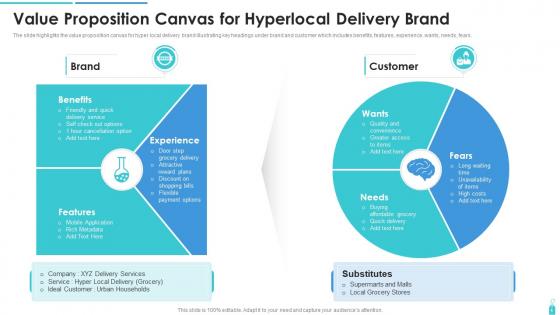
The slide highlights the value proposition canvas for hyper local delivery brand illustrating key headings under brand and customer which includes benefits, features, experience, wants, needs, fears.
People who downloaded this PowerPoint presentation also viewed the following :
Value Proposition Canvas For Hyperlocal Delivery Brand with all 6 slides:
Use our Value Proposition Canvas For Hyperlocal Delivery Brand to effectively help you save your valuable time. They are readymade to fit into any presentation structure.






FAQs for Value Proposition Canvas For
So the Value Proposition Canvas has two sides - Customer Profile and Value Map. Customer side covers their jobs (what they're doing), pains (what sucks), and gains (what they want). Your side shows products, pain relievers, and gain creators. Here's the thing though - everyone rushes the customer part, which is honestly backwards. You need "fit" where your stuff actually solves their problems and gives them what they want. Oh, and definitely do customer interviews first before you even think about your value side. That's where you'll find the good stuff. Makes way more sense that way.
Dude, you should totally try the Value Proposition Canvas! It's wild how much it shows you about what customers actually want versus what we think they want. One side maps out their real jobs, pains, and wins. The other side? Your products and services. Then you just... connect the dots, I guess. What's crazy is how fast you'll spot the gaps - like when you're building features nobody even cares about. I did this for our main customer group last month and honestly felt kinda stupid about some assumptions I'd made. Just pick your biggest segment and fill one out this week.
So the Value Proposition Canvas is basically zooming into one part of your Business Model Canvas - the value prop and customer segments boxes. Map out customer jobs, pains, and gains on the right side. Then figure out your products, pain relievers, and gain creators on the left. I swear it sounds so simple but nobody thinks to do it systematically until they try it. Once both sides click together, take those insights back to your BMC. Honestly? Fill out the VPC first, then update your business model canvas. Your value prop will actually make sense instead of being some vague marketing fluff.
So basically map out what your customers actually need vs what you're giving them right now. Fill out their real jobs, pains, and wins first. Then be brutally honest about your value prop. The mismatches? That's where it gets interesting. I've watched companies spend months on features literally nobody wanted - kinda painful to see. Look for those empty spots where customer problems exist but you have zero solutions. Maybe you're fixing stuff they don't care about while ignoring their actual headaches. Those gaps are where you'll find your next big wins.
Dude, seriously - get out there and talk to real people. Customer interviews are where you'll find the good stuff, way better than surveys honestly. I'd start with some quick landing page tests or basic prototypes to see if anyone actually cares about your idea. Face-to-face convos are gold for those lightbulb moments you can't get from data alone. A/B test your messaging too. Here's the thing though - only test one assumption at a time or you'll have no clue what's actually moving the needle. Behavioral data helps, but nothing beats hearing someone get excited about what you're building.
Here's the thing - you really can't wing it with one blanket value prop and expect it to work. Different customer segments have totally different problems and priorities. Enterprise clients? They're obsessed with security and whether your stuff scales. SMBs just want something cheap and dead simple to use. I'd start with maybe 2-3 solid segments, then create separate Value Prop Canvases for each one. It's way more work upfront but honestly saves you from that awkward "why isn't anyone buying?" conversation later. Each group needs their own tailored approach.
Honestly, most teams just guess what customers want instead of actually asking them - huge mistake. You'll end up building these elaborate canvases based on complete fiction. Don't try to appeal to everyone either; "business owners" isn't a real target segment, it's way too broad. Focus on outcomes, not just features. Like, how will this actually make their life better? The emotional stuff matters more than you'd think. Oh, and validate everything with real interviews. Internal brainstorming sessions are basically echo chambers.
Yeah, the Value Proposition Canvas totally works for any industry - just different pain points matter. Tech customers are dealing with integration nightmares and scaling problems. Hospitality? They want comfort and those "wow" moments. Same framework though, which is honestly genius. Map out what jobs your customers are actually trying to do, what frustrates them, what they're hoping for. Then match your stuff to that. API reliability for developers, cozy vibes for hotel guests - you get it. I'd start by talking to people in your space first. They'll tell you what actually keeps them up at night.
For your Value Proposition Canvas, Miro and Mural are solid choices - your team can all jump in and edit together. Canva's got some nice templates if you want it looking professional. But honestly? PowerPoint works fine, or even sticky notes on a wall (old school but effective). XMind's pretty good too if you're into the mind-mapping thing. Don't overthink the tool choice though. Pick whatever everyone can actually use without getting frustrated. I've seen teams waste hours debating software when they could've been mapping insights. Start with what you know.
Map the feedback straight onto both sides of your canvas. Customer jobs, pains, and gains go on the profile side. Their thoughts about your actual product update the value map. I always sort feedback into these buckets first - otherwise you'll end up with a mess of random comments (learned that the hard way). Multiple customers mentioning the same issues? That's gold. Update your pain relievers and gain creators based on what's really working, not what you thought would work. Oh, and treat this feedback like actual data to validate your ideas. Sometimes you'll need to pivot entirely.
Honestly, just track what actually matters - does anyone care about your product? Customer acquisition cost and conversion rates are your best friends here. Lifetime value shows if they stick around. I'd throw in NPS too since it tells you if you're solving real problems or just think you are. Feature adoption is clutch - shows what people actually use vs. what you think is important. Revenue per customer matters too, obviously. The key is picking like 3-5 metrics that match what you promised customers and watching them religiously. Don't get caught up tracking everything under the sun.
Honestly, just treat that canvas like it's constantly changing - because it should be. Test your assumptions with real customers first, then tweak based on what they actually tell you. I've watched so many teams fall in love with their first draft and refuse to budge (big mistake). Run little experiments to figure out their real pain points, then update everything accordingly. Make it a habit: guess, test, learn, repeat. Oh and schedule monthly reviews with your team - sounds boring but it keeps everyone focused on what customers actually want instead of what you think they want.
Look, competitive analysis is super important for your Value Prop Canvas - it shows what's already out there and helps you stand out. Most people totally skip this step and just wing it, which is honestly such a waste. You can see what pain points competitors are addressing (or completely missing) and how they position their solutions. Once you map out competitor value props, you'll spot market gaps and chances to solve customer problems way better. Your canvas gets so much sharper when you actually understand the landscape. Oh, and start with like 3-5 direct competitors - don't go crazy analyzing everyone.
So instead of just having boring bullet points on your canvas, you can turn those pain points into actual stories about real customers. Like mini-movies showing someone struggling with a problem, then boom – your solution saves the day. Way more engaging than dry frameworks, honestly. Stories help people visualize the customer journey and remember your pitch better. Plus they make abstract benefits feel concrete. I'd probably start with 2-3 short customer narratives using your canvas insights as the foundation. It's kind of like turning data into something people actually care about.
Look at Netflix - they saw people hating late fees and driving to Blockbuster, so they built around unlimited streaming and those scary-good recommendations. Uber tackled the whole "where's my taxi?" nightmare with real-time tracking and no cash fumbling. Then there's Airbnb connecting travelers wanting authentic spots with homeowners needing extra cash. Honestly, the pattern's pretty clear - you've got to get obsessed with what's actually making your customers miserable. Not what you assume they want, but their real daily frustrations. That's where the magic happens.
-
Wonderful templates design to use in business meetings.
-
They guys always go the extra mile to meet the expectations of their customers. Almost a year has been associated with them.