


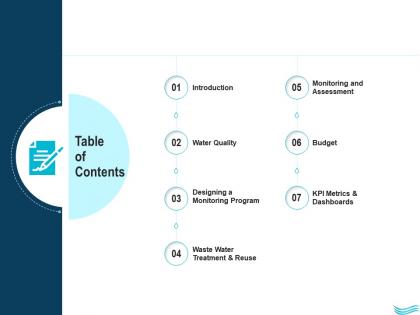
Water management table of contents ppt introduction




Try Before you Buy Download Free Sample Product
 Impress Your
 Audience
 100%
100% Editable
 Save Hours
 of Time


Our Water Management Table Of Contents Ppt Introduction are topically designed to provide an attractive backdrop to any subject. Use them to look like a presentation pro.
People who downloaded this PowerPoint presentation also viewed the following :
Water management table of contents ppt introduction with all 2 slides:
Use our Water Management Table Of Contents Ppt Introduction to effectively help you save your valuable time. They are readymade to fit into any presentation structure.

FAQs for Water management table of
Check out rainwater harvesting first - that's where I'd start. Smart meters and greywater systems are total game changers too. Permeable surfaces help with runoff, plus bioswales look pretty decent if your city cares about aesthetics. The leak detection stuff nowadays is honestly insane, saves crazy money. Oh, and tiered pricing? Works like magic to get people to stop wasting water. Before you do anything major though, audit what you've got. Sometimes there's obvious fixes staring you right in the face.
Honestly, the tech for cutting water waste is getting pretty impressive. Soil moisture sensors are a game-changer - they'll tell you exactly when to water instead of just winging it. Drip irrigation is way better than sprinklers since it goes straight to the roots. Those GPS systems can map your whole field and adjust watering for different zones, which is kind of wild if you think about it. Weather integration means you won't accidentally irrigate right before it rains (been there). I'd start with sensors in just one section to test it out first.
Honestly, water pricing is the best way to get people to actually change how much they use. Make heavy users pay way more per gallon - it's brutal but it works. Think of it like surge pricing for Uber, except you're trying to save water instead of making more money during rush hour. You'd set up these block rates where your first 100 gallons might be cheap, but once you hit 500+ gallons you're paying through the nose. People hate expensive water bills, so they'll fix those leaky sprinklers real quick. Plus all that extra money from the heavy users can go toward fixing pipes and funding conservation programs. Pretty smart system if you ask me.
Look, your community needs to hit three main things: get different water sources, fix the crappy infrastructure, and actually change how people use water. Rainwater harvesting is huge - so is greywater recycling and better groundwater storage. We waste an insane amount of water daily, which sounds bad but honestly means there's tons of room to improve. Those old pipes? Yeah, they're bleeding water everywhere. And start doing tiered pricing now, plus require water-smart landscaping before things get desperate. My neighbor's city waited too long and they're scrambling. The places that get ahead of this won't be panicking later.
Oh man, industrial wastewater is awful for local water. Chemical contamination, nutrient overload, temperature spikes - it all adds up fast. Fish die off, algae takes over everything, whole ecosystems get thrown out of whack. The really messed up part? Heavy metals and toxins build up in fish over time, so it climbs the food chain. Even pH changes can kill off species that can't adapt. Honestly, some companies are just careless about treatment standards. If there's industrial discharge near you, I'd definitely look up their permits and see if they're actually following regulations. Worth checking out.
Honestly, just start with your roof - that's where you'll get the most bang for your buck in the city. Get some gutters running into storage tanks or maybe an underground cistern if you're feeling fancy. A tiny roof can pull in thousands of gallons per year, which is pretty wild when you think about it. You'll need basic filtration obviously, but nothing crazy expensive. Green roofs look cool but they're kinda overrated cost-wise. Use that collected water for your garden, toilets, cooling stuff - cuts your water bill like crazy. Do the math on your roof size first though, the numbers might surprise you.
There's some really promising stuff happening with desalination tech right now. Forward osmosis and solar-powered systems are cutting energy costs way down compared to old-school reverse osmosis. Graphene filtration is still pretty experimental but honestly looks amazing. Energy recovery devices can grab like 98% of pressure energy now - that's a game changer for operating costs. Scale matters a ton though. Bigger plants get way better cost per gallon. Energy prices will make or break you too. Oh and don't just look at upfront costs - maintenance and energy will eat your budget alive over time, so factor that in from the start.
Dude, water rights are all over the map depending where you're working. The US does state-by-state stuff - East Coast has riparian rights, but western states? Total free-for-all with their "first come, first served" mentality. Europe mostly keeps water public but regulates who gets access. Chile's pretty unique - they actually let people buy and sell water like stocks or whatever. Australia does cap-and-trade systems. A ton of developing countries are still trying to figure out what works. Honestly, just research the local laws before you start any project there. I've seen people get completely screwed assuming water rules work the same everywhere.
You'll want to check pH, dissolved oxygen, and bacterial stuff like E. coli for sure. Temperature and turbidity too - that's just how cloudy it looks, which is honestly the easiest thing to spot right away. If you're near factories or whatever, throw in heavy metals and nitrates. For drinking water specifically, test chlorine levels and total dissolved solids. Oh and phosphates - forgot those. Set up regular testing instead of random checks because water quality changes super fast with weather. Murky water is basically your "something's wrong" signal, so that's always my go-to first indicator.
Honestly, awareness campaigns can completely change how people use water daily. Communities start taking shorter showers, actually fix those annoying leaks, and switch to plants that don't need constant watering. Some of the best campaigns I've seen make conservation feel cool instead of like a chore - social media's great for that. The trick is connecting water issues to stuff people already care about in their everyday lives. Oh, and you'll build support for bigger changes too, like water restrictions or new infrastructure. Figure out what your community's struggling with first, then craft messages that actually resonate with what matters to them most.
Honestly, watersheds are like the skeleton of any ecosystem - everything depends on how water moves through a region. You'll see it affect soil quality, where animals can live, all that stuff. Good management prevents erosion and keeps water clean for both land and aquatic life. Think of it as conducting nature's symphony, but less cheesy than that sounds lol. Screw up the watershed and you get floods, droughts, destroyed habitats. The damage cascades through entire food webs. Pro tip: if you're doing any conservation work, figure out the watershed first. Trust me on this one.
Yeah, cultural stuff totally matters for water conservation. People won't care about saving it if they think water's endless or dirt cheap. Some cultures actually see water as sacred though, which is perfect for conservation messaging. Others just view it like electricity or whatever. Older generations are usually better at conserving since they remember when water was actually scarce. My grandma still turns off the tap while brushing her teeth religiously. The trick is figuring out how your specific community thinks about water first, then designing programs that actually connect with those beliefs instead of fighting against them.
Honestly, it mostly comes down to money and crappy old pipes - countries just don't have cash for decent treatment plants. Rural areas get screwed over the most since they're expensive to reach. Plus you've got all these government departments that refuse to talk to each other, which is super annoying. Climate change isn't helping either - water sources keep shifting around unpredictably. Oh, and don't get me started on corruption eating up budgets. The technical skills just aren't there in a lot of places to actually run this stuff properly. If you're getting into this work, I'd say train local people first. That's usually where everything falls apart.
Honestly, data analytics is a total game-changer for water management - turns all that guesswork into actual smart decisions. You'll spot leaks way before they blow up into expensive disasters, and predicting demand becomes so much easier. The cool part? It catches patterns you'd never see otherwise, like weird seasonal spikes or when your infrastructure's starting to wear out. Before dropping serious cash on new pipes or whatever, you can actually model different scenarios first. My advice though - start small with something like leak detection, prove it works, then expand from there. No point overwhelming yourself right away.
Dude, graywater recycling is actually pretty sweet - cuts water bills by like 30-50%. Basically you're taking water from your sinks, showers, washing machine and using it for watering plants or flushing toilets instead of just wasting it. Super helpful if you're dealing with those annoying water restrictions or crazy high bills. My neighbor installed one last year and says it'll pay for itself in about 3-5 years, which isn't bad. Oh and obviously it helps the environment too. I'd just get some quotes from local contractors who do residential systems - they can tell you what actually makes sense for your place.
-
Unique design & color.
-
Really like the color and design of the presentation.