


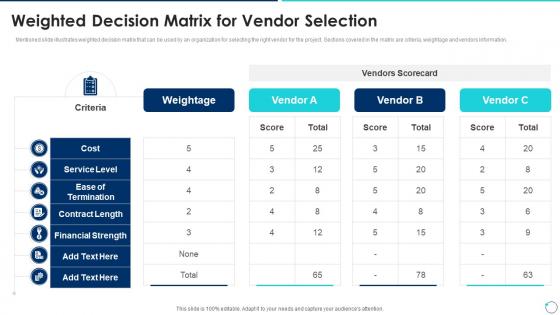
Matriz de decisión ponderada para la selección de proveedores Colección de plantillas de control de calidad Reglas de PPT




Try Before you Buy Download Free Sample Product
 Impress Your
 Audience
 100%
100% Editable
 Save Hours
 of Time


Secciones cubiertas en la matriz son criterios, ponderación e información de proveedores.
People who downloaded this PowerPoint presentation also viewed the following :
Matriz de decisión ponderada para la selección de proveedores Colección de plantillas de control de calidad PPT Reglas con las 6 diapositivas
Utilice nuestra Matriz de Decisión Ponderada para la Selección de Proveedores Colección de Plantillas de Control de Calidad Ppt Reglas para ayudarlo a ahorrar su valioso tiempo de manera efectiva. Están listos para adaptarse a cualquier estructura de presentación.





FAQs for Weighted Decision Matrix For Vendor Selection Collection Of Quality Control
Honestly, check their track record first - ask for examples of similar work they've done. I made the mistake once of hiring someone who literally ghosted me for three weeks! Pricing should be crystal clear upfront too, none of that "oh btw here's an extra fee" nonsense later. Communication is huge - if they're slow to respond during the pitch phase, that's probably how they'll be as partners. Oh and make a simple scorecard to compare them, otherwise you'll just go with whoever seems nicest. Trust me on this one.
First thing - get their last 2-3 years of financial statements if they'll share them. Audited ones are best. Check for steady revenue growth, decent cash flow, debt that isn't crazy high. D&B credit reports help too for payment history stuff. One thing I always watch for is if they're too dependent on just a few big clients - that's sketchy for obvious reasons. Also ask about insurance and bonding capacity. Oh, and if they get weird about sharing financials? That's your answer right there.
Honestly, vendor reputation is everything - it's your safety net when deals look perfect on paper. Always check references and read reviews to see how they handle problems, because that's way more telling than their fancy sales pitch. I've watched companies go with the cheapest option and get completely screwed when vendors vanished mid-project or delivered total crap. You want someone with a solid track record in your space and clients who've stuck around. Ask for three recent references minimum and actually call them - those website testimonials are usually cherry-picked nonsense anyway.
Track the obvious stuff first - delivery times, quality scores, costs, and whether they're hitting their SLAs. Honestly, a basic spreadsheet works fine for this. Don't overthink it. Also measure the relationship side though - how fast they respond to emails, whether they actually solve problems, and how they react when everything's on fire. The trick is measuring the same things for everyone so you can actually compare them. I learned this the hard way after trying to compare vendors using totally different metrics. Review everything monthly or quarterly to catch issues before they blow up.
Definitely ask for real examples of similar projects they've done - like actual details about problems they hit, not just the glossy case studies. Find out who you'd be working with day-to-day too. Some companies just send their A-team for the pitch then stick you with junior people. Timeline stuff matters. So does training and what their support looks like when things inevitably break. Oh, and here's something that works well - ask what questions their best clients usually ask. You'd be surprised how much that tells you about whether they actually know what they're doing.
Oh man, cultural fit is honestly huge. I've watched great vendors bomb because they just couldn't vibe with how the team worked. When styles click though? Game changer. You get way better communication, faster turnarounds, and they actually *get* what you're going for instead of just doing the bare minimum. During evals, watch how they handle meetings - do they feel awkward or natural to work with? Sometimes the less polished vendor who meshes well beats the fancy one who doesn't. Trust your instincts on this stuff.
Honestly, scorecards are a game changer for vendor selection. Instead of falling for whoever sounds the most convincing in meetings, you're actually comparing apples to apples. Weight the stuff that really matters to your project - maybe cost is everything, or maybe you need rock-solid support. The whole thing becomes way more transparent when you have to defend your choice later. Oh, and you'll definitely spot red flags you'd miss otherwise when juggling multiple vendors. Just make sure you build the template first before talking to anyone - keeps you from moving the goalposts mid-process.
Keep your team small - like 5-7 people tops. Any bigger and you'll be stuck in meetings forever trying to agree on anything. Grab someone from procurement, the actual users (they're honestly the most important since they're stuck with whatever you pick), IT for tech stuff, finance for budget, and a project lead. Oh, and make sure that project lead can make final calls when everyone's arguing in circles. Before you even start looking at vendors, get everyone on the same page about what you're actually evaluating. Trust me, defining roles upfront saves so much headache later.
Oh man, don't just go with the cheapest option - that's mistake
-
Illustrative design with editable content. Exceptional value for money. Highly pleased with the product.
-
Qualitative and comprehensive slides.