


Work experience template for visual resume powerpoint ideas





Try Before you Buy Download Free Sample Product
 Impress Your
 Audience
 100%
100% Editable
 Save Hours
 of Time


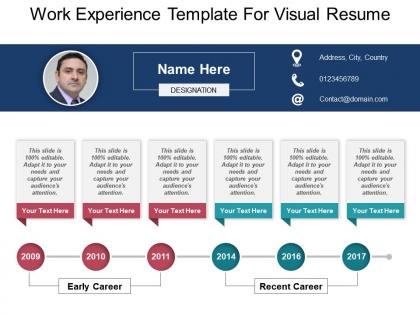
Use this work experience template for visual resume PowerPoint ideas and showcase the basic details about yourself in a very professional way. Our business experts have especially for business professionals like you who do not have enough time to sketch the slides yourself designed this work experience PowerPoint presentation. This career progression business slides have been used to design high resolution and premium quality slides which will raise the standard of your work. Our self-introduction PPT template will let you display personal details like your name, your picture, your address, email ID, contact details, early career, recent career, designation, etc. We assure you that if you download and use this visual resume PowerPoint ideas you will be able to win everyone’s attention as the slides are very eye catchy. If you use this about yourself slides you will save a lot of your precious time and will also get rid of all the workload as the slides are predesigned. So simply hit the download button and make most of this opportunity. Get your colleagues interested in coming on board with our Work Experience Template For Visual Resume Powerpoint Ideas. Involve them in your effort.
People who downloaded this PowerPoint presentation also viewed the following :
Work experience template for visual resume powerpoint ideas with all 5 slides:
Gain access to far flung areas with our Work Experience Template For Visual Resume Powerpoint Ideas. It helps bridge huge distances.
FAQs for Work experience template for visual
So for each job, put the title, company name, dates, and location (city/state). Then do 3-4 bullet points about what you actually accomplished - not just your boring daily tasks. Start each bullet with an action verb and throw in numbers whenever you can. Like "increased sales by 30%" hits way harder than just "responsible for sales." Keep bullets short, maybe two lines tops so people can actually scan it quickly. Oh and once you nail the format for one job, you can just copy it for the others. Makes life easier.
Okay so basically you keep the same template structure but tweak the language for each industry. Tech companies want to see your coding projects and problem-solving skills. Healthcare? Focus on patient care and certifications. Sales is all about those numbers - how much you sold, targets you crushed. Finance roles care about analytical thinking and compliance stuff. Creative fields are more into collaboration and innovative projects you've worked on. It's kinda like using the same recipe but switching up the spices, you know? Just swap out the buzzwords and metrics that actually matter to whatever field you're targeting.
Honestly, the worst thing you can do is be super vague - like saying you "managed projects" without any details. Numbers are your friend here! Also, resist cramming every tiny task you've ever done into one bullet point. Nobody wants to read War and Peace about your daily routine. Put your biggest wins first, and make sure there aren't random gaps in your timeline that make HR wonder what you were doing for six months. Oh, and definitely customize it for whatever field you're targeting - accounting managers care about totally different stuff than marketing people. Clean formatting matters too, but that's obvious.
Oh absolutely, your resume design totally matters before anyone even reads what you wrote. Clean formatting shows you're professional and detail-oriented. Messy or super outdated templates? They'll think you don't care or you're stuck in the past. I've literally watched hiring managers toss resumes that looked ancient - it's brutal but true. Modern fonts and good spacing make a huge difference. Your template should match your industry's style, and definitely make sure it works with those applicant tracking systems or you're screwed from the start.
Dude, turn your resume bullets into actual stories! Like instead of "managed social media accounts," say something like "took over a dead Instagram with 200 followers and grew it to 2,000 through user-generated campaigns." Way more interesting, right? Think of it as explaining what you actually did at work to a friend - just keep it professional. Mini-narratives show how you solved problems and got results. Honestly, most people just list boring duties, so stories make you stand out. Hiring managers will remember the person who painted a picture vs someone who just rattled off responsibilities.
Oh definitely use bullet points - way easier to read than those giant paragraph blocks. Start with action words like "managed" or "developed," but mix it up so you're not repeating the same verbs. Numbers are your friend here - "boosted sales by 25%" sounds so much better than just saying you improved things. I usually stick to 3-5 bullets per job... more than that and people's eyes glaze over, you know? Each one should be short but actually say something meaningful about what you did. Honestly, read them out loud because if they sound boring to you, they'll definitely bore whoever's reading your resume.
So you want it professional but not like you're writing a legal brief or something. Use action words - "managed," "developed," "implemented" - instead of boring passive stuff. Honestly, most resume templates are painfully robotic. Focus on what you actually accomplished, not just your job duties. Skip the jargon unless it's standard in your field and everyone gets it. The goal is clear and direct writing that doesn't put people to sleep. I always read mine out loud - if it sounds like a robot, tone it down. You want someone to actually want to keep reading about you.
Look, you've gotta focus on what you actually achieved, not just what you did day-to-day. Like instead of "managed social media," write "boosted engagement 40% through content strategy" - shows you can analyze AND communicate. Use strong action words with real numbers that work anywhere. Honestly, most hiring managers scan these things pretty quickly anyway. Structure each job with 2-3 bullets highlighting stuff like leadership or problem-solving. Your barista gig? That's customer service mastery and juggling multiple tasks - perfect for office work. It's all about reframing what you've already done.
Stick to 2-4 bullet points per job, one sentence each. Recruiters scan super fast so you don't want to overwhelm them with walls of text. I'd shoot for 50-80 words total per position. Focus on actual achievements with numbers if you can - way better than boring generic duties everyone lists. When you're editing, ask yourself "does this make me sound hireable?" If it's just taking up space, cut it. Oh and don't start every bullet the same way, it looks weird. Quality beats quantity every time.
Oh totally! Icons for different sections work great, and I'm obsessed with timeline graphics - makes your career path way easier to scan. Color-coded headers are solid too. Company logos next to each role look pretty professional. You could try those progress bar things for skills, though honestly I'm kinda mixed on those. Just start small though - like pick one or two visual elements first. I went crazy with design once and it looked like a rainbow exploded on my resume lol. See what works before you go full Pinterest mode with it.
So here's the thing - you don't need tons of work experience yet. Hiring managers totally get that you're new to this. Put your internships, volunteer stuff, even part-time jobs front and center. Technical skills matter a lot, and honestly customer service experience is gold since it applies everywhere. Leadership roles from college? Definitely include those. Oh, and make sure you've got room for a solid summary at the top that's more about your potential than just listing what you did. That's usually what catches their attention first.
Honestly, I'd say every 3-6 months or right after finishing something big at work. Trust me, hiring managers can tell when your resume is ancient - they've seen it all. Your skills and accomplishments change way faster than you think, and industry buzzwords shift constantly too. The worst part? Trying to remember what you actually did on that project from 2022... good luck with that lol. Way better to jot things down while they're still fresh. Oh, and definitely set a phone reminder or you'll totally forget like I always do.
Your resume template can totally screw you over with ATS systems. They can't read tables, text boxes, or fancy graphics at all. Just use clean, simple formatting with normal fonts and clear headers. Trust me, I made this mistake - spent hours on this gorgeous design and got crickets back from employers. Bullet points work great, just don't go crazy with them. Honestly, most recruiters are scanning these things in like 10 seconds anyway. You want something that's easy for both robots and humans to read quickly. Save the creative stuff for your portfolio or something.
Honestly, get some people to look over your template - it's such a huge help. Other folks will catch stuff you totally missed, like confusing parts or skills you forgot to mention. They're way better at seeing how to make your accomplishments sound more impressive too. My friend Sarah actually helped me realize I was underselling my project management experience by like... a lot. Ask maybe 2-3 people you work with to give you real feedback on what's unclear or what you're missing. Trust me, the difference is pretty crazy.
Dude, personalization is what stops your resume from looking like everyone else's. Don't just swap company names - that's lazy and recruiters can tell. Actually tailor the language and examples to match what they're asking for. Use their industry buzzwords, highlight relevant experience, and throw in numbers that'll matter to them. I made this mistake early on tbh - sent the same generic template everywhere and got crickets. Make each one feel like you wrote it specifically for that role. Trust me, cookie-cutter resumes get trashed immediately.
-
Great designs, Easily Editable.
-
Very well designed and informative templates.