


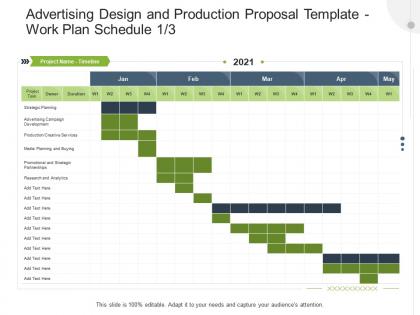
Work plan schedule analytics advertising design and production proposal template ppt model




Try Before you Buy Download Free Sample Product
 Impress Your
 Audience
 100%
100% Editable
 Save Hours
 of Time


Our Work Plan Schedule Analytics Advertising Design And Production Proposal Template Ppt Model are topically designed to provide an attractive backdrop to any subject. Use them to look like a presentation pro.
People who downloaded this PowerPoint presentation also viewed the following :
Work plan schedule analytics advertising design and production proposal template ppt model with all 2 slides:
Use our Work Plan Schedule Analytics Advertising Design And Production Proposal Template Ppt Model to effectively help you save your valuable time. They are readymade to fit into any presentation structure.
FAQs for Work plan schedule analytics advertising design and production proposal
Honestly, start with a headline that actually makes people stop scrolling - most are boring as hell. Then you need visuals that actually relate to what you're selling (shocking concept, right?). Your value prop has to answer "what's in it for me" super clearly. Don't make people guess what to do next either - tell them exactly. Oh, and know your audience's pain points inside out so you can speak their language. Test different versions too since what works for one crowd might flop with another.
Honestly, digital advertising is a game changer - you can actually target the exact people who'd want your stuff instead of just throwing ads at everyone. The best part? You finally know what's working. No more wondering if that campaign did anything. You can tweak budgets on the fly, test different versions instantly, and see exactly how someone goes from clicking your ad to buying. Old school marketing was basically throwing darts blindfolded, but now you can be super precise with your spending. My advice: start small, figure out what clicks, then double down on those winners.
Dude, you absolutely can't write good copy for "everyone" - that's how you end up with boring ads nobody cares about. Segmentation changes everything: your tone, where you advertise, what problems you focus on. I always tell people to pick their top 2-3 audience types first. Then write totally different messages for each group. A luxury car ad targeting millennials? Completely different vibe than one for boomers. Makes sense, right? You're basically speaking different languages to different people based on their demographics, behaviors, or what motivates them. Way more effective than trying to please everyone at once.
Oh man, cultural stuff will make or break your ads globally. Like white means purity here but mourning in parts of Asia - who knew? Germans want direct, no-BS messaging while Japanese audiences prefer subtle, relationship-focused approaches. Humor's tricky too since what's hilarious in one place falls completely flat elsewhere. Honestly, I'd skip trying to translate existing campaigns and just work with local teams instead. They actually get the nuances you'll miss. Way less headache than learning these lessons the expensive way!
Look, it really comes down to what you're trying to achieve, but focus on CTR first - shows if your ads actually grab attention. Then track your cost per acquisition and return on ad spend, that's where the real money story is. Conversion rate matters way more than how many people saw your ad (I swear everyone gets caught up in impressions). Oh and don't sleep on lifetime customer value - tells you if you're attracting the right people. Honestly? Pick like 3-4 metrics that actually move your business forward and stick to those.
Honestly, stories just stick in people's heads way better than boring feature lists. Your customers don't really care about specs - they want to know how your product changes their life. Look at Nike - they're not selling sneakers, they're selling that whole "become a champion" vibe. Pretty genius if you think about it. When you tell a story instead of just pushing "buy now" messages, you actually give people a reason to remember you. Plus it helps you stand out since most brands are still doing the same old sales pitch thing. Figure out what transformation your product creates, then build your story around that customer experience.
Honestly, just stick to three basics: be truthful, show respect, and own your choices. Never promise stuff you can't deliver. Stay transparent about sponsorships and data - people hate feeling tricked. Don't target vulnerable groups unfairly either, that's just gross. I've watched so many campaigns totally bomb because they crossed ethical lines. Cultural sensitivity matters too. Your audience gives you their time and trust, so don't screw that up. Here's my test: would you feel okay if everyone knew exactly why you made this content? If yes, you're probably good.
Honestly, social media ads are pretty wild with how precise you can get. Facebook and Instagram have the best targeting - you can narrow down by demographics, interests, what people bought recently, all that stuff. LinkedIn's solid too if you're going B2B. What I'd do is upload your email list to create custom audiences, then make lookalike audiences from those. Start super narrow though - like, way more specific than you think. Test small budgets on different segments first. Once you see what's actually working, then throw more money at it. Trust me, I learned this the hard way by going too broad initially.
Dude, interactive ads are a game changer. People actually click on them way more than boring banner ads - like, who even notices those anymore? You'll get better brand recall too since users are actually doing stuff instead of just scrolling past. The cool part is all the data you collect about what people actually want. Plus they remember the experience way longer. Oh, and you can tweak campaigns in real-time based on how people interact with them rather than just throwing stuff at the wall and hoping it sticks.
Dude, AI and VR are totally changing the advertising game right now. You've got these crazy personalized ads that shift based on what people are actually doing, plus VR experiences where customers can literally walk around and test stuff out. My friend works at an agency and says AI already beats humans at optimizing ad budgets - which is kinda scary but also cool? The whole "try before you buy" thing used to be pure fantasy. These aren't just shiny new tools either, they're actually changing what's possible. I'd start simple though - maybe test some AI audience targeting or basic AR filters first.
Honestly, color psychology is huge for getting people to actually buy your stuff. Red makes everything feel urgent - that's why every sale tag uses it. Blue screams trustworthy (Facebook, LinkedIn, you know the drill). Green says healthy or money-related, which is pretty obvious when you think about it. Orange is tricky though - energizing but kinda cheap if you mess it up. You gotta match your colors to what vibe you're going for AND what you want people to do. Seriously, just switching button colors can bump your conversions 10-20%. Test different combos - it's worth it.
Skip the mega-influencers and find people who actually use your stuff already. Seriously, fake excitement is so cringe and everyone can tell. I'd look for creators who naturally talk about your industry or have audiences that match yours. Give them freedom to do their thing instead of micromanaging every post - their voice is why people follow them anyway. Oh, and make sure they disclose properly because trust matters. Start by stalking their content first (in a non-creepy way lol) to see if it's actually a good fit before sliding into their DMs.
Oof, when ads go sideways you gotta move quick. Own up to it publicly - no hiding or weird excuses. Then shift your messaging back to what you actually stand for and show how you're fixing things. Here's where most companies totally blow it though - they disappear completely. Actually you want to stay out there posting good stuff. Get back into real conversations with people and tell authentic stories to earn trust again. Honestly the hardest part is sticking with it long-term because one sorry-we-messed-up post isn't gonna cut it.
Mobile ads are totally different - you've got like 3 seconds max before someone swipes away. Keep headlines super short and make buttons huge since people are tapping with their thumbs. Honestly, I see so many brands mess this up by cramming desktop copy onto mobile. Vertical formats work way better than square ones. Location targeting is your friend here - you can hit people when they're actually near your store. One clear action per ad, that's it. Oh and definitely test on your actual phone first, not just the preview tool. Trust me on that one.
Don't be vague - that's death for ads. Focus on benefits, not just what your product does. Oh and stop making everything about YOUR company... people care what's in it for them. I swear, brands use way too much jargon that nobody understands. Lead with clear headlines that matter to customers. Always throw in a solid call-to-action too. Here's the thing - cramming everything into one ad never works. Pick your main message and run with it. Test different versions because honestly? You'll be surprised what actually clicks with people.
-
Great quality product.
-
Presentation Design is very nice, good work with the content as well.