


Workforce Upskilling Training Plan Strawman Project Plan




Try Before you Buy Download Free Sample Product
 Impress Your
 Audience
 100%
100% Editable
 Save Hours
 of Time


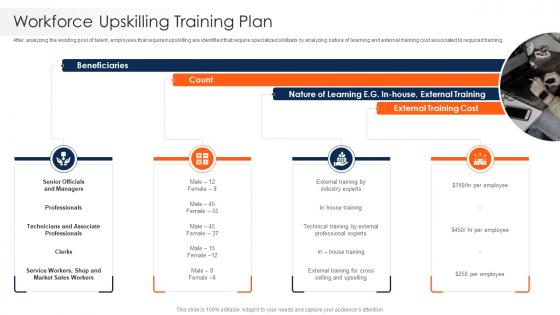
After analyzing the existing pool of talent, employees that required upskilling are identified that require specialized skillsets by analyzing nature of learning and external training cost associated to required training.
People who downloaded this PowerPoint presentation also viewed the following :
Workforce Upskilling Training Plan Strawman Project Plan with all 6 slides:
Use our Workforce Upskilling Training Plan Strawman Project Plan to effectively help you save your valuable time. They are readymade to fit into any presentation structure.





FAQs for Workforce Upskilling Training Plan
The most in-demand skills include data analysis, digital marketing, cloud computing, artificial intelligence, cybersecurity, and project management. These capabilities enable organizations to streamline operations, enhance customer experiences, and maintain competitive advantage, with industries like healthcare, finance, and manufacturing finding that professionals with these skills drive innovation, reduce costs, and accelerate business transformation.
Upskilling enhances tech career progression by expanding technical competencies, increasing market value, and enabling transitions into emerging roles like AI engineering, cloud architecture, and cybersecurity. Through continuous learning in areas such as machine learning, DevOps, and data analytics, professionals position themselves for leadership opportunities, salary advancement, and greater job security in an increasingly competitive landscape.
Emotional intelligence enhances upskilling effectiveness by improving self-awareness, managing learning anxieties, and facilitating better communication during training processes. Through emotional regulation and empathy, professionals navigate skill transitions more successfully, build stronger mentor relationships, and adapt to new technologies with greater resilience, ultimately delivering improved performance and career advancement in increasingly complex work environments.
Organizations create a continuous learning culture by establishing mentorship programs, providing regular training opportunities, rewarding skill development, encouraging knowledge sharing, and allocating dedicated time for learning activities. Through these initiatives, companies like Google and Microsoft enhance employee engagement, improve retention rates, and maintain competitive advantage, with many finding that investing in upskilling ultimately delivers higher productivity and innovation.
Effective self-directed upskilling practices include setting specific learning goals, creating structured schedules, leveraging online platforms, seeking mentorship, and applying skills through real projects. These approaches enhance professional development by building relevant competencies, expanding career opportunities, and maintaining market relevance, with many professionals finding that consistent, targeted learning ultimately delivers competitive advantage and increased earning potential.
Companies effectively measure upskilling impact through performance metrics, skill assessments, productivity indicators, employee retention rates, and internal promotion tracking. These measurement approaches enable organizations to quantify ROI by monitoring career advancement, reduced recruitment costs, and enhanced operational efficiency, with many finding that comprehensive evaluation frameworks ultimately deliver stronger workforce capabilities and competitive advantage.
Organizations face challenges including resistance to change, limited training budgets, identifying relevant skill gaps, time constraints for employee participation, and measuring training effectiveness. These obstacles often create tension between immediate operational needs and long-term workforce development, with many companies finding that strategic planning, phased implementation, and clear communication ultimately deliver better employee engagement and sustainable skill enhancement across departments.
Emerging technologies facilitate upskilling through AI-powered learning platforms, virtual reality simulations, personalized learning paths, microlearning modules, and data analytics that track progress. These technologies enable organizations to deliver customized training at scale, reduce learning time, and enhance skill retention, with companies like Amazon and IBM finding that tech-driven upskilling significantly improves employee productivity and competitive advantage.
Technology, manufacturing, finance, healthcare, and retail are experiencing rapid skills obsolescence due to automation, AI integration, and digital transformation demands. Strategic upskilling programs in these sectors focus on digital literacy, data analysis, and human-AI collaboration, enabling organizations to retain talent while building competitive advantages through enhanced productivity and innovation capabilities.
Mentorship programs enhance upskilling efforts by providing personalized guidance, accelerating knowledge transfer, and creating structured learning pathways within organizations. Through experienced mentors, employees receive targeted skill development, real-world application insights, and career progression support, while companies benefit from improved retention rates, faster competency building, and stronger internal talent pipelines, ultimately delivering enhanced organizational capability.
Effective upskilling strategies include microlearning sessions, skill-gap assessments, leveraging commute time, weekend intensive courses, and employer-sponsored programs. Busy professionals increasingly find success through bite-sized online modules, industry-specific certifications, and strategic focus on high-impact skills, ultimately delivering career advancement and competitive positioning while maintaining work-life balance.
Generational approaches to upskilling vary significantly, with Gen Z preferring digital microlearning and social platforms, Millennials favoring structured online courses and career-focused certifications, Gen X emphasizing practical skills for advancement, and Baby Boomers selecting face-to-face training for specific competencies. Organizations increasingly find that blended learning strategies accommodate these diverse preferences while delivering enhanced engagement, knowledge retention, and ultimately stronger workforce adaptability across all age groups.
Leading online platforms for skill development include Coursera, LinkedIn Learning, Udemy, Pluralsight, and edX, offering comprehensive courses across technical, business, and creative disciplines. These platforms enhance professional growth by providing industry-recognized certifications, flexible learning schedules, and expert-led content, with many organizations finding that structured online learning accelerates employee development while reducing traditional training costs.
Feedback loops enhance upskilling effectiveness by providing continuous performance insights, identifying skill gaps in real-time, and enabling personalized learning adjustments throughout the development process. Through regular assessments and manager input, organizations can refine training content, accelerate competency development, and measure ROI more accurately, with many companies finding that structured feedback systems ultimately deliver faster skill acquisition and improved employee retention.
Soft skills complement technical expertise by enhancing communication, leadership, and adaptability, which are essential for management roles and cross-functional collaboration. While technical skills demonstrate competency, soft skills enable professionals to lead teams, navigate organizational change, and build strategic relationships, with many companies finding that employees combining both skill sets advance faster and deliver greater business impact.
-
The templates are easy to get, and the chat customer support is excellent.
-
If you have visited their site and failed to find the products, try reaching the customer service because it will be the case that you didn't use the search bar well.