

World Cloud Kitchen Industry Analysis Powerpoint Presentation Slides





Try Before you Buy Download Free Sample Product
 Impress Your
Audience
 100%
Editable
 Save Hours
of Time


A cloud kitchen operates in a commercial kitchen to prepare foodstuffs for delivery or takeout, with no dine-in consumers. Grab our World Cloud Kitchen Industry Analysis template. It is insightfully designed to encourage restaurateurs to grow an existing restaurant or start a digital brand at a low cost. It begins with an industry overview of the cloud kitchen market, including statistical highlights, market size, and growth rate. Our Virtual Restaurant deck displays the market landscape showing market drivers, restraints, challenges, etc. The global cloud kitchen market is segmented by type, product, nature, and region. Additionally, it shows market dynamics displaying the impact of COVID-19 on the market, trending technologies, growth factors, and cloud kitchen and online food delivery growth rate. Our Ghost Kitchen PPT also highlights market analysis assessing the multiple market frameworks like SWOT analysis, Porters five forces analysis, etc. Further, our cloud kitchen module exhibits kitchen as a service model forecasted growth and adoption by restaurant size. Lastly, it outlines various dashboards for managing cloud kitchen operations, financials, and performance. Get access now.
People who downloaded this PowerPoint presentation also viewed the following :
Content of this Powerpoint Presentation
Slide 1: This slide introduces World Cloud Kitchen Industry Analysis. Commence by stating Your Company Name.
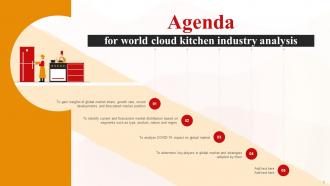
Slide 2: This slide depicts the Agenda of the presentation.
Slide 3: This slide incorporates the Table of contents.
Slide 4: This is yet another slide continuing the Table of contents.
Slide 5: This slide highlights the Title for the Topics to be discussed next.
Slide 6: This slide presents an overview of cloud kitchen market to gain valuable insights.
Slide 7: This slide reveals the statistics of global cloud kitchen market to gain valuable insights.
Slide 8: This slide focuses on Global cloud kitchen market size and growth.
Slide 9: This slide mentions the Heading for the Components to be covered further.
Slide 10: This slide shows the market drivers that helped in stimulating the growth of global cloud kitchen market.
Slide 11: This slide incorporates the Challenges of global cloud kitchen market.
Slide 12: This slide emphasizes on the Market opportunities in global cloud kitchen market.
Slide 13: The slide highlights the emerging trends in global cloud kitchen market for sustainable growth and development.
Slide 14: This slide mentions the Title for the Ideas to be discussed further.
Slide 15: The following slide showcases current and forecasted market distribution of cloud kitchen industry based on type.
Slide 16: This slide presents the Cloud kitchen market segmentation by product.
Slide 17: This slide focuses on the Cloud kitchen market segmentation by nature.
Slide 18: This slide reveals the Cloud kitchen market segmentation by region.
Slide 19: This slide incorporates the Heading for the Ideas to be covered in the forth-coming template.
Slide 20: The slide provides overview of impact of covid-19 on cloud kitchen market and food industry.
Slide 21: This slide shows various emerging technology trends in cloud kitchen market to automate workflow and gain operational efficiency.
Slide 22: This slide exhibits the Reasons of growth in cloud kitchen market.
Slide 23: The following slide illustrates growth in dark kitchen & online food delivery market with yearly highlights which displays new dark kitchen brands and new dark kitchen locations.
Slide 24: This slide mentions the Title for the Components to be discussed further.
Slide 25: The slide showcases porter five forces variable factors analysis to evaluate cloud kitchen market and forecast future growth strategy.
Slide 26: This slide gives a glimpse of the PESTLE analysis of global cloud kitchen market.
Slide 27: The following slide presents primary activities of value chain analysis framework of cloud kitchen model to understand relationship at different points.
Slide 28: This slide focuses on the McKinsey framework for cloud kitchen model.
Slide 29: This slide indicates the Heading for the Components to be covered in the next template.
Slide 30: The following slide highlights comparison of cloud kitchen and dine in restaurants based on business structure and profit margins.
Slide 31: The following slide represents the comparison of cloud kitchen and dine in restaurants based on gross food sales of previous years.
Slide 32: This slide elucidates the Title for the Topics to be discussed further.
Slide 33: This slide displays the Comparative analysis of major players in global cloud kitchen industry.
Slide 34: This slide continues the Comparative analysis of major players.
Slide 35: This slide portrays the Heading for the Contents to be covered in the forth-coming template.
Slide 36: This slide covers Cloud kitchen targets segment analysis with buyers persona.
Slide 37: This slide highlights customer journey mapping to track users' actions and key touch points across levels such as awareness, conversion, etc.
Slide 38: This slide incorporates the Title for the Ideas to be discussed next.
Slide 39: This slide emphasizes on the Cloud kitchen business models and workings.
Slide 40: This slide presents a business model canvas of ghost kitchen enterprise to define & communicate business idea.
Slide 41: This slide focuses on the Cloud kitchen operating model for food delivery.
Slide 42: This slide deals with the Cloud kitchen outlet business model.
Slide 43: This slide exhibits the Heading for the Ideas to be covered further.
Slide 44: This slide outlines various elements required to start a cloud kitchen business.
Slide 45: This slide presents financial analysis showing investment requirements to build a cloud kitchen business.
Slide 46: This slide reveals various platforms used globally for connecting and ordering food in cloud kitchen industry.
Slide 47: This slide highlights various promotional methods used by key operators in cloud kitchen market to increase business presence.
Slide 48: This slide displays the Title for the Topics to be covered next.
Slide 49: The following slide illustrates growth in of kitchen as a service model in dark kitchen.
Slide 50: This slide portrays the KaaS model adoption by restaurants size.
Slide 51: This slide indicates the Heading for the Components to be discussed in the upcoming template.
Slide 52: This slide presents a dashboard for tracking and managing business income and expenditure.
Slide 53: The below slide reveals a dashboard for tracking and managing status of food orders received by customers.
Slide 54: This slide talks about the Cloud kitchen business performance management dashboard.
Slide 55: This is the Icons slide containing all the Icons used in the plan.
Slide 56: This slide depicts Additional information.
Slide 57: This slide deals with the Market restraints of global cloud kitchen.
Slide 58: This slide focuses on the SWOT analysis of key players in industry.
Slide 59: This slide states the Types of cloud kitchen business models.
Slide 60: This slide reveals the Market highlights of global cloud kitchen industry.
Slide 61: This slide talks about the Economics of general cloud kitchen business.
Slide 62: This slide mentions about the Key elements of international cloud kitchen market.
Slide 63: This slide reveals the Clustered column.
Slide 64: This is the About us slide for stating the company-related information.
Slide 65: This is Our vision, mission & goal slide.
Slide 66: This is Meet our team slide for showcasing the information related to the team members.
Slide 67: This is the 30 60 90 Days plan slide for efficient planning.
Slide 68: This slide illustrates the SWOT analysis.
Slide 69: This is the Quotes slide for motivation.
Slide 70: This is the Idea generation slide ofr encouraging fresh ideas.
Slide 71: This slide elucidates the Company Roadmap.
Slide 72: This is the venn diagram slide with related imagery.
Slide 73: This slide contains the Posts it notes for reminders and deadlines.
Slide 74: This slide presents information related to the Financial topic.
Slide 75: This slide portrays the company Timeline.
Slide 76: This is the Target slide. State your organization's targets here.
Slide 77: This is the Thank You slide for acknowledgement.
World Cloud Kitchen Industry Analysis Powerpoint Presentation Slides with all 75 slides:
Use our World Cloud Kitchen Industry Analysis Powerpoint Presentation Slides to effectively help you save your valuable time. They are readymade to fit into any presentation structure.








FAQs for World Cloud Kitchen Industry Analysis
Honestly, location is everything - you want to be smack in the middle of your delivery zones to keep food hot and costs low. Get your kitchen layout super efficient for juggling multiple brands, and make sure your tech can handle orders from all the different platforms without you losing your mind. Partner with solid delivery services too. Menu-wise, stick to stuff that doesn't get soggy in transit and try to use the same ingredients across brands so you're not buying a million different things. Oh and seriously, master one virtual brand first before you go crazy with like five different concepts. I've seen people crash and burn trying to do too much at once.
Oh, cloud kitchens? They're just delivery-only spots - no dining room or anything, literally just a kitchen cranking out orders for DoorDash and whatever. You save tons on rent since you don't need some fancy location or servers. Actually, multiple brands can share the same kitchen space which is pretty smart. But here's the thing - you're basically married to those delivery apps and never see your customers face to face. Honestly feels kinda sterile to me? If you're thinking about it, nail your packaging first because that's literally your only brand touchpoint.
First thing - get a POS system that connects with DoorDash, Uber Eats, all that stuff. Trust me on this one. Kitchen display systems are a lifesaver for managing orders, otherwise you're basically flying blind. Also grab some inventory software so you can actually see what you're spending on food costs. Oh, and analytics tools help track how each delivery platform's doing. The trick is making sure everything syncs up automatically - nobody wants to input the same order three different places. Start with the POS integration though, that'll make the biggest difference right away.
Honestly, start small with this stuff or you'll go crazy looking at spreadsheets all day. Pick one thing - like tracking your peak hours so you're not scrambling when orders blow up at dinner time. Customer feedback is gold for figuring out what's actually broken (spoiler: it's usually delivery times). I'd focus on your bestsellers first - keep those dialed in and available. The fancy analytics can wait. Track what dishes people order when, which neighborhoods always get their food late, stuff like that. But seriously, don't try to measure everything at once.
Honestly, you gotta go all-in on digital since people aren't stumbling across you anymore. Instagram and TikTok are perfect for food pics - like, that's literally what people scroll through when they're hungry. Don't forget Facebook for targeting locals though. Obviously hit up all the delivery apps, but make sure your photos don't suck and write decent descriptions. Email marketing actually works way better than you'd think for getting people to order again. Oh, and definitely claim your Google My Business - helps with searches. Partner with local food bloggers if you can find good ones. Just be wherever people are when they're deciding what to eat.
Honestly, delivery can totally wreck your cloud kitchen if you're not careful. Those platforms like DoorDash hit you with 20-30% commissions - ouch. Plus your food has to actually survive the trip. Soggy fries? Yeah, that customer's gone forever. Location's huge too. Get too far from your customers and you're screwed - long delivery times kill your ratings fast. I'd stick within 3-4 miles max of where people actually order from. Oh, and invest in decent packaging that keeps everything hot. Great food means nothing if it shows up cold and gross.
Honestly, menu design can totally make or break a cloud kitchen. Your food needs to look amazing in photos since that's all customers see. Plus everything has to travel well - nobody wants soggy fries after a 20-minute ride. I'd keep it simple, maybe 8-12 items tops that your team can actually handle during busy times. Smart move is using ingredients that overlap across dishes to cut costs. Oh, and definitely test how your food looks after sitting in a delivery bag for 20 minutes before you go live. I've watched so many places crash because they tried doing too much at once.
Honestly, cloud kitchens are basically playing hot potato with food safety. Temperature control is everything - you need solid insulated containers and constant monitoring during prep and transport. Partner with delivery services that actually use thermal bags (some don't, weirdly). Sealed packaging prevents contamination, plus clear labeling with prep times helps. I'd set delivery radius limits too because long transit times kill you. The whole chain matters - kitchen to driver to doorstep. A tracking system lets you monitor temps throughout, which saves your butt when things go wrong.
Food safety licenses are gonna be your worst nightmare, plus all the zoning headaches. Most cities still don't really get the ghost kitchen thing, so you're stuck dealing with rules that were written for normal restaurants. Health department approvals take forever, and don't even get me started on fire safety codes - every city's different. You'll need commercial kitchen permits obviously. Some places want special delivery-only licenses too which is kinda ridiculous but whatever. Seriously though, hire a restaurant lawyer right away. Trust me, it's worth it to avoid months of regulatory BS.
Dude, pricing is literally like playing chess with your competitors. First thing - figure out your food costs and delivery zones, then bump prices during rush hours when everyone's ordering. I check competitor menus every week (yeah, it's tedious but whatever). Position yourself maybe 10-15% under the fancy places or match the cheap spots but with way better quality. Test different prices on your bestsellers to see what actually moves without screwing your profits. Honestly though, the biggest thing is staying flexible and using real numbers, not just winging it based on hunches.
First thing - get tight with DoorDash, Uber Eats, all those delivery apps since they're basically your only customers. Find food suppliers who won't flake on you when orders get crazy. The POS system stuff is boring but trust me, when it breaks you'll want to throw your phone out the window. Your commercial kitchen relationship matters way more than people think - a good landlord will work with you, a bad one will nickel and dime everything. Oh and start talking to suppliers like months ahead of time because the good ones are already booked up with other ghost kitchens.
Honestly, most people mess this up by trying to expand everywhere at once. Start with your delivery radius instead - cover more ground before opening new spots. Cut the menu items that aren't selling and focus on what's actually working. I'd probably test new markets using shared kitchen spaces first since the upfront costs are way lower. Get good kitchen management software early too, trust me on this one. Once you've got operations dialed in for one area, just copy that exact setup. Way less risky than throwing money at multiple locations right away.
Honestly, cloud kitchens can be way better for the environment than regular restaurants. No massive dining room means way less energy for lights and AC. Plus you can manage inventory better across different virtual brands from one spot, so less food gets tossed. But here's the thing - all that delivery packaging really adds up. And don't get me started on the constant stream of drivers burning gas. If you're thinking about it, definitely go for eco-friendly packaging. Partner with services using electric bikes when you can. It's not perfect but beats traditional restaurants overall.
Dude, your customers are literally telling you what to put on the menu through their orders. I'm always digging through my data to see what's flying off the virtual shelves and what's just sitting there. Peak times, popular combos, seasonal stuff - it all matters. If everyone's going crazy for spicy food, why fight it? Just lean in hard. The cool thing about cloud kitchens is you can switch things up super fast without worrying about some fancy restaurant aesthetic. Test new dishes, ditch the duds. Platform analytics are your best friend here - they'll show you patterns you'd never notice otherwise. Way easier than traditional restaurants, honestly.
AI demand forecasting is huge right now - helps predict what people will actually order. Automated cooking systems are handling multiple orders at once too. Real-time inventory tracking is pretty smart, tells you when you're about to run out of stuff before it happens. Robotic prep stations are everywhere now, though I still think robot-made food tastes weird sometimes. Shared kitchen spaces with modular setups are way more practical - you can test concepts without dropping crazy money upfront. My cousin tried one last year and loved it. Check out kitchen-as-a-service platforms first if you're thinking about jumping in.
-
SlideTeam, Please don’t stop sharing discount coupons! I love your occasional discounts and tend to buy your products around that corner.
-
It makes easy work of my work presentations. I’ve never had to be nervous about my presentations for meetings.