


10 new business challenges





Try Before you Buy Download Free Sample Product
 Impress Your
 Audience
 100%
100% Editable
 Save Hours
 of Time


Our 10 New Business Challenges enable convincing and flawless arguments. They help dismiss all dissent.
People who downloaded this PowerPoint presentation also viewed the following :
Content of this Powerpoint Presentation
Description:
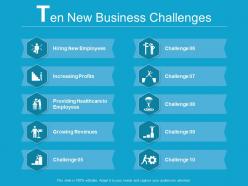
This image is a PowerPoint slide titled "Ten New Business Challenges," which outlines a list of common challenges that businesses face today. Four of these challenges are specified, each accompanied by an icon that illustrates the concept:
1. Hiring New Employees is represented by an icon depicting a person with a plus sign, suggesting the addition of new staff.
2. Increasing Profits has an upward trend graph icon, indicating a goal of financial growth.
3. Providing Healthcare to Employees is shown with two figures, one seemingly assisting the other, highlighting the importance of employee health benefits.
4. Growing Revenues uses a figure with arms raised, symbolizing success or improvement in revenue generation.
The other challenges numbered 5 to 10, are not specified and are represented by hexagonal shapes with placeholders for further customization. The slide emphasizes its adaptability to the presenter's needs with a note at the bottom stating, "This slide is 100% editable. Adapt it to your needs and capture your audience's attention." This indicates that the slide is a template meant for businesses to tailor according to their specific challenges and strategic focus areas. The use of a consistent color scheme and structured layout provides a professional and clear format for presentation purposes.
Use Cases:
Business challenge slides like these are valuable across sectors for strategic planning and problem-solving discussions.
1. Technology Startups:
Use: Strategy meetings and investor pitches
Presenter: Startup founders or managers
Audience: Investors or team members
2. Healthcare Providers:
Use: Addressing operational challenges in meetings
Presenter: Hospital administrators or department heads
Audience: Medical staff or board members
3. Retail Chains:
Use: Store performance and improvement strategies
Presenter: Retail managers or executives
Audience: Store managers or regional directors
4. Financial Services:
Use: Enhancing profitability and customer service
Presenter: Financial analysts or consultants
Audience: Bank staff or stakeholders
5. Manufacturing:
Use: Streamlining production and workforce management
Presenter: Plant managers or operations directors
Audience: Production team or executives
6. Educational Institutions:
Use: Faculty recruitment and budgeting workshops
Presenter: School principals or university deans
Audience: Educational staff or administrative personnel
7. Hospitality Management:
Use: Enhancing guest experiences and service quality
Presenter: Hotel managers or hospitality consultants
Audience: Hotel staff or management teams
10 new business challenges with all 5 slides:
Be criteria compliant with our 10 New Business Challenges. They ensure you adhere to every clause.



FAQs for 10
Common startup challenges include securing adequate funding, acquiring and retaining customers, building strong teams, navigating regulatory compliance, and establishing market differentiation in saturated sectors. These obstacles often interconnect, with many emerging companies finding that strategic planning, lean operational approaches, and adaptive business models help streamline growth while minimizing resource constraints, ultimately delivering sustainable competitive advantage.
Businesses can effectively adapt to rapid technological changes by investing in employee training, fostering a culture of continuous learning, partnering with technology vendors, and implementing phased adoption strategies. Through strategic workforce development and flexible infrastructure planning, organizations across sectors like retail and manufacturing streamline operations, enhance customer experiences, and maintain competitive advantage in an increasingly digital marketplace.
Employee engagement plays a crucial role in overcoming business challenges by fostering innovation, improving productivity, reducing turnover, and enhancing customer service quality. Engaged employees actively contribute solutions during crises, adapt more readily to organizational changes, and maintain higher performance standards, with many companies finding that strong engagement levels directly correlate with improved resilience and competitive advantage.
Companies improve supply chain resilience by diversifying suppliers, investing in predictive analytics, building strategic inventory buffers, establishing alternative logistics routes, and strengthening supplier relationships. These approaches enable organizations to maintain operations during disruptions, with many manufacturers and retailers finding that resilient supply chains ultimately deliver faster recovery times, reduced costs, and significant competitive advantage in increasingly volatile markets.
Small businesses can compete with larger corporations through agile decision-making, personalized customer service, niche market specialization, strategic partnerships, and leveraging technology for operational efficiency. These approaches enable smaller companies to deliver faster responses, build stronger customer relationships, and adapt quickly to market changes, with many finding that their flexibility and focused expertise ultimately create sustainable competitive advantages in increasingly dynamic markets.
Regulatory changes impact business operations by requiring compliance system updates, process modifications, and staff retraining, while creating new market opportunities and competitive landscapes. Companies in financial services, healthcare, and manufacturing often find that proactive regulatory adaptation streamlines operations, reduces long-term costs, and delivers strategic advantages over less agile competitors.
Effective financial management practices include cash flow forecasting, maintaining adequate reserves, implementing strict credit policies, negotiating favorable payment terms, and diversifying revenue streams. These strategies enable businesses to anticipate shortfalls, reduce collection periods, and maintain operational stability, with many organizations finding that proactive monitoring ultimately delivers improved liquidity and competitive advantage.
Businesses can effectively measure customer satisfaction through surveys, Net Promoter Scores, social media monitoring, customer feedback platforms, and analytics tools that track behavioral patterns. These methods enable organizations to identify pain points, optimize service delivery, and enhance customer experiences across touchpoints, with many companies finding that systematic satisfaction measurement drives retention rates and ultimately delivers competitive advantage in increasingly customer-centric markets.
**INPUT**: What are the key factors in successfully managing remote teams? **OUTPUT**: Key factors in successfully managing remote teams include clear communication protocols, regular check-ins, defined performance metrics, collaborative technology platforms, and flexible scheduling approaches. These management strategies streamline productivity by establishing accountability, maintaining team cohesion, and enabling seamless project coordination, with many organizations finding that structured remote frameworks ultimately deliver enhanced employee satisfaction and operational efficiency. [Word count: 55 words]
Companies leverage data analytics to identify business challenges by analyzing customer behavior patterns, operational inefficiencies, market trends, and financial performance metrics. Through predictive analytics and real-time dashboards, organizations streamline decision-making processes, reduce operational costs, and enhance customer experiences, with many retail and financial services companies finding that data-driven insights deliver significant competitive advantages.
Globalization presents both challenges and opportunities for local businesses, including increased competition, expanded market access, supply chain complexities, cultural adaptation requirements, and regulatory compliance issues. While local retailers and restaurants face pressure from international chains, many find competitive advantages through unique positioning, community connections, and specialized offerings, ultimately enabling strategic growth and enhanced customer experiences.
Organizations foster innovation by creating dedicated innovation labs, implementing cross-functional collaboration frameworks, establishing employee idea management systems, and investing in emerging technologies like AI and automation. These approaches streamline problem-solving by encouraging diverse perspectives, accelerating solution development, and enabling rapid prototyping, with many companies finding that structured innovation processes ultimately deliver operational efficiency and competitive advantage.
Business crisis management best practices include establishing clear communication protocols, forming dedicated response teams, conducting regular risk assessments, maintaining stakeholder transparency, and developing comprehensive contingency plans. These approaches enable organizations to respond swiftly during disruptions, minimize operational damage, and maintain customer confidence, with many companies finding that proactive crisis preparation ultimately delivers competitive resilience and faster recovery times.
Cultural differences impact international business operations by influencing communication styles, negotiation approaches, decision-making processes, and customer expectations across markets. These variations create both challenges and opportunities, with companies finding that adapting marketing strategies, management practices, and product offerings to local cultures enhances customer relationships, reduces operational friction, and ultimately delivers competitive advantage in diverse global markets.
Businesses can enhance sustainability while maintaining profitability through energy efficiency initiatives, waste reduction programs, sustainable supply chain partnerships, circular economy models, and green technology investments. These approaches streamline operations by reducing resource costs, improving operational efficiency, and attracting environmentally conscious consumers, with many companies finding that sustainable practices ultimately deliver competitive advantages and long-term cost savings.
No Reviews