


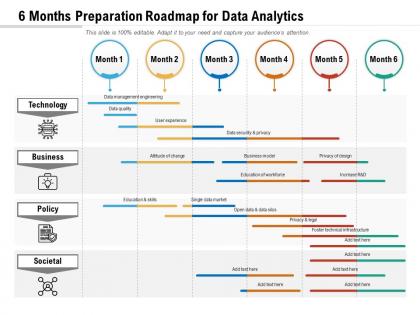
6 months preparation roadmap for data analytics




Try Before you Buy Download Free Sample Product
 Impress Your
 Audience
 100%
100% Editable
 Save Hours
 of Time


Anyone looking to embark on a data analytics journey needs to first understand all of the tasks that need to be completed before any action can take place. By understanding the different phases and corresponding tasks, you can create your own roadmap for data analytics success. If you're looking for a data-driven way to understand your business and how it can improve, then look no further. SlideTeam's amazing data analytics ppt templates will give you a roadmap for where to start and what to do 6 months before taking your data analytics strategy live. These templates are easy to use and customizable, so you'll be able to get the insights you need quickly and easily. Ready to get started? Then grab these data analytics ppt templates now.
People who downloaded this PowerPoint presentation also viewed the following :
6 months preparation roadmap for data analytics with all 2 slides:
Use our 6 Months Preparation Roadmap For Data Analytics to effectively help you save your valuable time. They are readymade to fit into any presentation structure.
FAQs for 6 months preparation roadmap
Key objectives include defining clear business goals, assessing current data infrastructure, identifying skill gaps, establishing governance frameworks, and creating implementation timelines. These strategic components work together to ensure organizations can effectively harness data assets, streamline analytics processes, and build sustainable competitive advantages, with many companies finding that structured preparation ultimately delivers faster insights and improved decision-making capabilities.
Organizations can assess their current data maturity by evaluating data quality, governance frameworks, infrastructure capabilities, analytical skills, and existing reporting processes. Through comprehensive audits, many companies discover gaps in data integration, staff expertise, or technology platforms, enabling them to prioritize investments in foundational elements before advancing to sophisticated analytics initiatives.
Data governance frameworks to consider include DAMA-DMBOK for comprehensive data management, COBIT for IT governance alignment, Data Management Capability Assessment Model for maturity evaluation, and ISO 8000 for data quality standards. These frameworks streamline compliance requirements, establish clear data ownership protocols, and enhance operational transparency, with many organizations finding that strategic implementation ultimately delivers improved decision-making capabilities and regulatory adherence.
Identifying and prioritizing data sources involves assessing data quality, relevance to business objectives, accessibility, and potential impact on decision-making. Organizations typically evaluate internal databases, customer touchpoints, operational systems, and external market data, with many finding that combining high-quality transactional data with behavioral insights delivers the most actionable analytics outcomes.
Stakeholder engagement ensures data analytics roadmaps align with business priorities, operational needs, and strategic objectives through collaborative input gathering, requirement validation, and expectation management. By involving executives, department heads, and end-users early, organizations streamline implementation processes, enhance user adoption rates, and ultimately deliver analytics solutions that drive measurable business outcomes and competitive advantage.
Organizations ensure data quality and integrity through systematic validation protocols, automated cleansing tools, standardized governance frameworks, real-time monitoring systems, and comprehensive audit trails. These approaches streamline accuracy by eliminating inconsistencies, detecting anomalies early, and maintaining compliance standards, with many financial services and healthcare institutions finding that robust preparation protocols ultimately deliver more reliable analytics outcomes and enhanced decision-making capabilities.
Common data preparation and analytics tools include Python, R, SQL, Tableau, Power BI, Apache Spark, and Excel for processing and visualization. These technologies streamline workflows by automating data cleaning, enabling advanced statistical analysis, and creating interactive dashboards, with many organizations finding that strategic combinations deliver faster insights, improved decision-making, and significant competitive advantages.
Data security and compliance should be embedded throughout the analytics preparation roadmap through data governance frameworks, encryption protocols, access controls, audit trails, and regulatory compliance checks at each stage. Organizations across healthcare, finance, and retail increasingly integrate privacy-by-design principles, automated compliance monitoring, and role-based permissions, ultimately delivering secure analytics environments while maintaining regulatory adherence and stakeholder trust.
Creating a centralized data repository requires establishing clear data governance frameworks, implementing standardized data formats, ensuring robust security protocols, maintaining data quality controls, and designing scalable storage architectures. These practices streamline analytics workflows by eliminating data silos, reducing preparation time, and enabling consistent reporting across departments, with many organizations finding that centralized repositories accelerate decision-making while significantly reducing operational costs.
Success metrics for data analytics initiatives include business impact indicators, technical performance measures, adoption rates, ROI calculations, and timeline adherence benchmarks. These metrics enable organizations to track progress through measurable outcomes like improved decision-making speed, cost reductions, and enhanced operational efficiency, with many companies finding that balanced scorecards combining quantitative results and qualitative insights ultimately deliver the most comprehensive assessment of their analytics investments.
Essential training includes statistical analysis, programming languages like Python and R, data visualization tools, database management, and machine learning fundamentals. Teams benefit from developing critical thinking skills, domain expertise in their specific industry, and hands-on experience with real datasets, while many organizations find that combining technical training with business acumen ultimately delivers more strategic insights and competitive advantage.
Cloud platforms enable organizations to leverage scalable storage, powerful computing resources, managed analytics services, automated data pipelines, and cost-effective infrastructure without heavy upfront investments. Through platforms like AWS, Azure, and Google Cloud, companies streamline data collection, processing, and analysis while reducing operational complexity, ultimately delivering faster insights and enhanced competitive advantage in increasingly data-driven markets.
Data preparation challenges include incomplete datasets, inconsistent formats, data quality issues, integration complexities, and scalability bottlenecks that can derail analytics initiatives. These obstacles can be mitigated through automated data profiling tools, standardized preprocessing workflows, and robust validation frameworks, with many organizations finding that investing in comprehensive data governance and quality management systems ultimately delivers faster insights and more reliable analytics outcomes.
Data visualization is crucial for advanced analytics preparation as it enables pattern recognition, anomaly detection, and hypothesis formation before complex modeling begins. Through interactive dashboards and exploratory visualizations, data scientists can identify data quality issues, understand variable relationships, and communicate findings effectively to stakeholders, ultimately streamlining the entire analytics workflow and ensuring more accurate, actionable insights.
Continuous improvement processes include regular performance reviews, stakeholder feedback collection, technology assessment cycles, skill gap analysis, and strategic alignment audits conducted quarterly or bi-annually. These systematic evaluations enable organizations to adapt their analytics capabilities, update methodologies, and reallocate resources effectively, with many enterprises finding that structured improvement frameworks deliver enhanced decision-making accuracy and sustained competitive advantage.
-
Easy to edit slides with easy to understand instructions.
-
Very unique, user-friendly presentation interface.
-
It saves your time and decrease your efforts in half.
-
Best Representation of topics, really appreciable.
-
Design layout is very impressive.
-
Appreciate the research and its presentable format.
-
It saves your time and decrease your efforts in half.
-
Use of different colors is good. It's simple and attractive.