


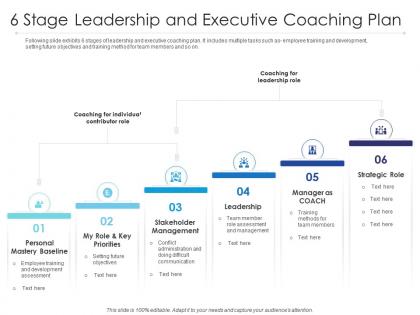
6 stage leadership and executive coaching plan




Try Before you Buy Download Free Sample Product
 Impress Your
 Audience
 100%
100% Editable
 Save Hours
 of Time


Following slide exhibits 6 stages of leadership and executive coaching plan. It includes multiple tasks such as- employee training and development, setting future objectives and training method for team members and so on.
People who downloaded this PowerPoint presentation also viewed the following :
6 stage leadership and executive coaching plan with all 2 slides:
Use our 6 Stage Leadership And Executive Coaching Plan to effectively help you save your valuable time. They are readymade to fit into any presentation structure.

FAQs for 6 stage leadership and
The six key stages include assessment and goal-setting, self-awareness development, skill-building and competency enhancement, practice and application, feedback integration, and sustainability planning. These stages interconnect systematically, with each phase building upon insights from the previous stage, enabling leaders to develop comprehensive capabilities while organizations benefit from improved decision-making, enhanced team performance, and sustained competitive advantage.
Leaders can identify their current coaching stage by assessing their comfort level with questioning techniques, feedback delivery methods, and goal-setting approaches, while evaluating their ability to facilitate rather than direct conversations. Through self-reflection tools, 360-degree feedback, and coaching assessments, organizations increasingly find that leaders progress from directive instruction to collaborative partnership, ultimately delivering more empowered teams and sustainable performance improvements.
The six stages focus on assessment and goal-setting, self-awareness development, skill-building, implementation planning, active coaching support, and evaluation with sustainability planning. These progressive stages streamline leadership development by identifying specific growth areas, enhancing emotional intelligence and communication abilities, and creating actionable strategies, with many organizations finding that this structured approach delivers measurable improvements in team performance and leadership effectiveness.
The 6 Stage Leadership Coaching framework adapts to different leadership styles through personalized assessments, flexible methodologies, and customizable development paths that address individual strengths, communication preferences, and decision-making approaches. This structured yet adaptable approach enables transformational, servant, autocratic, and democratic leaders to enhance their effectiveness while maintaining their authentic leadership identity, ultimately delivering improved team performance and organizational outcomes.
**INPUT**: What specific techniques or tools are most effective in facilitating progress through each stage? **OUTPUT**: Effective leadership coaching techniques include 360-degree feedback assessments, behavioral observation tools, goal-setting frameworks, reflective journaling practices, and peer mentoring sessions. These approaches streamline development by providing structured feedback, enabling self-awareness, and creating accountability mechanisms, with many organizations finding that combining multiple techniques accelerates leadership transformation and delivers measurable improvements in team performance.
Feedback integration varies by stage, from initial 360-degree assessments and stakeholder input during goal-setting to regular progress reviews, peer feedback sessions, and real-time performance observations throughout development phases. This continuous feedback loop enhances coaching effectiveness by providing multiple perspectives, accelerating skill development, and ensuring accountability, with many organizations finding that structured feedback mechanisms ultimately deliver measurable leadership improvements and sustained behavioral change.
The 6 Stage Leadership Coaching model differs from other methodologies by providing a structured, sequential framework that progresses through specific developmental phases, comprehensive skill assessment, goal alignment, strategic planning, implementation support, and measurable outcomes evaluation. Unlike traditional coaching approaches that may focus on single issues, this model delivers systematic leadership transformation across multiple competencies, with many organizations finding that the staged progression enables sustainable behavioral change and enhanced executive performance.
**INPUT**: What are common obstacles leaders face at each stage, and how can they be overcome? **OUTPUT**: Common leadership obstacles include self-awareness gaps in early stages, delegation resistance in development phases, change management challenges during transitions, communication breakdowns across teams, strategic vision misalignment, and succession planning delays. These barriers can be overcome through structured coaching frameworks, regular feedback mechanisms, and targeted skill development programs, with many organizations finding that systematic stage-by-stage approaches ultimately deliver stronger leadership pipelines and improved operational performance. [Word count: 60 words]
Organizations measure 6 Stage Leadership Coaching effectiveness through performance metrics, 360-degree feedback assessments, employee engagement surveys, retention rates, and goal achievement tracking. These measurement approaches enable companies to quantify leadership development progress, with many finding that systematic evaluation across all six stages delivers enhanced team performance, improved decision-making capabilities, and ultimately stronger organizational outcomes.
Emotional intelligence enables coaches to build trust, read client responses, and adapt their approach throughout each coaching stage, from initial rapport-building to sustainable change implementation. Through enhanced self-awareness and empathy, leaders in coaching programs develop stronger communication skills, better conflict resolution abilities, and more effective team management capabilities, with many organizations finding that emotionally intelligent leaders deliver significantly improved performance outcomes and workplace culture.
The 6 Stage Leadership Coaching model adapts seamlessly to virtual or hybrid sessions through digital collaboration tools, video conferencing platforms, and cloud-based assessment resources that maintain engagement and interaction. These technologies enable coaches to deliver personalized feedback, facilitate real-time discussions, and track progress across all six stages, with many organizations finding that virtual coaching actually increases accessibility and scheduling flexibility while reducing costs.
Incorporating peer coaching at different leadership development stages delivers enhanced self-awareness, accelerated skill acquisition, diverse perspective sharing, increased accountability, and stronger collaborative networks. Through structured peer interactions, leaders across industries like healthcare and financial services develop critical thinking abilities, receive real-time feedback, and build lasting professional relationships, ultimately creating more adaptive and emotionally intelligent leadership capabilities.
Leaders can track personal growth through self-assessment tools, 360-degree feedback, goal-setting frameworks, progress journals, and regular coach evaluations at each stage. These measurement approaches enable systematic monitoring by establishing baseline metrics, documenting behavioral changes, and measuring outcomes, with many executives finding that structured tracking accelerates development and delivers measurable improvements in leadership effectiveness.
Coaches need comprehensive training in the 6 Stage methodology, assessment tools for each phase, structured templates for goal-setting and progress tracking, and certification in behavioral coaching techniques. Additionally, they require access to 360-degree feedback systems, ongoing supervision or peer coaching networks, and practical experience with diverse leadership challenges, with many professional coaches finding that combining formal certification programs with hands-on mentoring accelerates their effectiveness.
Insights from each coaching stage enhance strategic decision-making by developing self-awareness, clarifying vision, strengthening communication skills, and building emotional intelligence. Through systematic skill development, leaders in healthcare, technology, and financial services make more informed choices about resource allocation, team dynamics, and organizational direction, ultimately delivering improved operational efficiency and competitive advantage in increasingly complex business environments.
-
Excellent work done on template design and graphics.
-
Unique design & color.
-
Best way of representation of the topic.
-
Colors used are bright and distinctive.
-
Awesome presentation, really professional and easy to edit.