


A Guide To Salary Negotiation Training Ppt




Try Before you Buy Download Free Sample Product
 Impress Your
 Audience
 100%
100% Editable
 Save Hours
 of Time


This set of slides discusses salary negotiations and negotiables in salary negotiation. It also mentions the reasons why salary negotiation is important, ways to negotiate your salary, followed by a role-playing exercise to negotiate your salary in the end.
People who downloaded this PowerPoint presentation also viewed the following :
Content of this Powerpoint Presentation
Slide 1
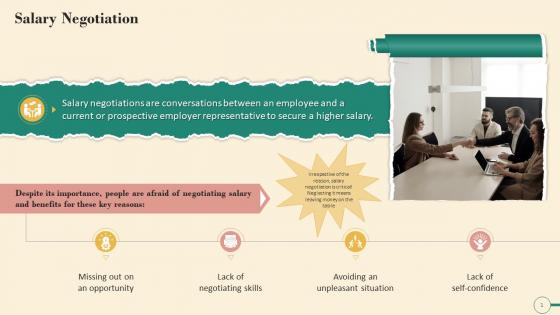
This slide provides information about salary negotiations. It emphasizes that salary negotiations are conversations between an employee and a current or prospective employer representative to secure a higher salary. It also mentions that, despite the importance of negotiating salary and benefits, people are afraid of doing so for various reasons:
- Missing out on an opportunity
- Lack of Negotiating skills
- Avoiding an unpleasant situation
- Lack of self-confidence
Slide 2
This slide describes what is negotiable during a salary negotiation. It states that the job offer is negotiable in every way. Salary, benefits, and working conditions, such as days and hours worked, work flexibility options, and so on, are all negotiable. It also emphasizes that salary negotiations differ by position and that salary negotiation leeway increases with position level within the organization. Executives and senior managers have the highest negotiating power in terms of salary, benefits, and perks.
Slide 3
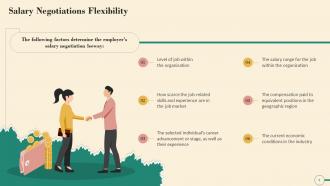
This slide discusses the factors that influence an employer's salary negotiation leeway. The following factors are considered: the job level within the organization, the scarcity of job-related skills and experience in the job market, the selected individual's career advancement or stage, as well as their expertise, and the salary range for the job within the organization, the compensation paid for equivalent positions in the geographic region, and the current economic conditions in the industry.
Slide 4
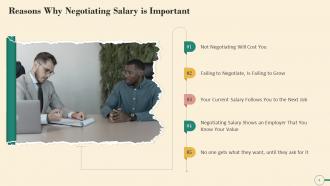
This slide provides information regarding reasons why negotiating salary is essential. The reasons are: Not negotiating will cost you; Failing to negotiate, is failing to grow; Your current salary follows you to the next job; Negotiating salary shows an employer that you know your value, one will never get what they want unless they ask for it.
Instructor’s Notes:
- Not Negotiating Will Cost You: When you negotiate your salary, you're not just negotiating the number on your next paycheck. Taking less than you deserve can harm your work performance. Underpaid employees are less satisfied and less productive, which means you may be less likely to earn that raise in the first place
- Fail To Negotiate, Fail to Grow: Salary negotiation provides benefits other than more money. It teaches you to handle difficult workplace conversations while remaining professional, cooperative, and non-adversarial
- Your current salary follows you to the next job: By not negotiating current salary, one reduces the amount they will have to show their next employer for them to evaluate their potential pay in that job. Negotiate a higher salary, and your next employer will be more likely to pay you more
- Negotiating salary shows an employer that you know your value: Salary negotiations demonstrate to your employer that you are competent, confident, and value your abilities. Those are the same skills that your employer will value when it comes to increasing your level of responsibility, entrusting you with critical clients, and promoting you to leadership positions
- One will never get what they want unless they ask for it: You're unlikely to get what you want unless you ask for it, whether money, perks, benefits, or job responsibilities
Slide 5
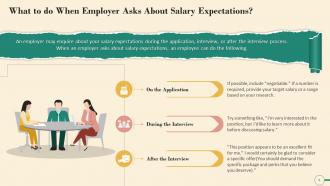
This slide depicts information regarding the points to be kept in mind when an employer asks about salary expectations. It highlights that an employer may enquire about your salary expectations during the application, interview, or after the interview process.
Slide 6
This slide provides information regarding things to do while receiving an offer. It highlights that it is usually advisable to take some time to reflect after receiving an offer in person, over phone, or by email. One must have complete information about benefits in addition to salary. It also mentions the process to be followed when a person receives an offer over a call/in-person and an offer received in writing.
Slide 7
This slide provides tips for negotiating salary effectively. The recommendations are: Start by calculating your economic worth, Research the market average, Prepare your talking points, Ask for more, Share expenses you’re incurring, and Be flexible.
Slide 8
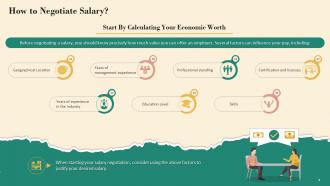
This slide depicts the salary negotiation tip “Knowing your Economic Worth." It emphasizes the importance of knowing exactly how much value one can offer an employer before negotiating a salary. Geographic location, years of experience in the industry, years of management experience, education level, professional standing, skills, certifications and licenses are all factors that can affect your salary.
Slide 9
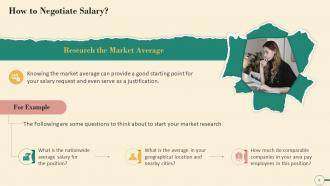
This slide depicts the salary negotiation tip "Research the Market Average." It mentions that knowing the market average can provide a good starting point for your salary request and serve as a justification as well. It also highlights the questions to consider while beginning your market research.
The questions are as follows:
- What is the national average salary for the position?
- What is the average in your geographical location and nearby cities?
- How much do comparable companies in your area pay employees in this position?
Slide 10
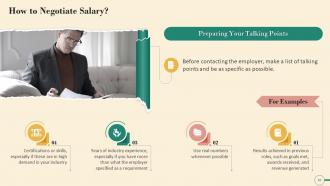
This slide emphasizes the significance of “Preparing your talking points" while negotiating a salary. It mentions that before contacting the employer, make a list of talking points that are as specific as possible. Among the possibilities are:
- Results achieved in previous roles, such as goals met, awards received, and revenue generated
- Years of industry experience, especially if you have more than what the employer specified as a requirement
- Certifications or skills, especially if they are in high demand in your industry
Slide 11
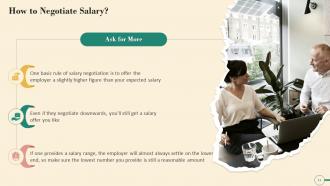
This slide depicts "Ask for more" as a salary negotiation tip. It emphasizes the one fundamental rule of salary negotiation: Offer the employer a slightly higher figure than your expected salary. Even if they negotiate downwards, you'll still get a good salary. It also states that while providing a salary range, make sure the lowest number you provide is still a reasonable amount.
Slide 12
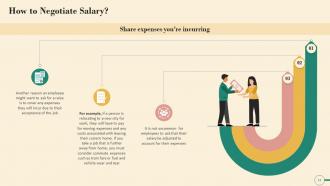
This slide explains “Sharing your expenses" as a salary negotiation tip. It emphasizes that another reason an employee might want to ask for a raise is to cover any expenses (such as commuting or vehicle wear and tear) incurred due to accepting the job. It also mentions that it is not uncommon for employees to request that their pay be adjusted to account for their expenses.
Slide 13
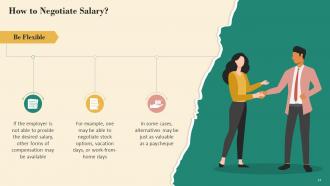
This slide depicts the salary negotiation tip Be Flexible. It emphasizes that if the employer cannot provide the desired salary, other forms of compensation such as stock options, vacation days, and work-from-home days may be available. In some cases, these benefits may be as valuable as a paycheque.
Slide 14
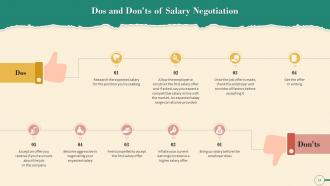
This slide depicts the salary negotiation dos and don'ts. The dos are as follows: Always research the expected salary for the position you're seeking, allow the employer to construct the first salary offer, and if asked, say you expect a competitive market salary, get the offer in writing, and so on. Don'ts includes: Raising your salary before the employer does, inflating your current earnings to receive a higher salary offer, feeling obligated to accept the first salary offer, becoming too aggressive in negotiating your expected salary, and accepting an offer if you're unsure about the job or the company.
Slide 15
This slide provides a role play exercise (Job Seeker’s and HR Manager’s perspective) on salary negotiation that trainees can perform.
A Guide To Salary Negotiation Training Ppt with all 31 slides:
Use our A Guide To Salary Negotiation Training Ppt to effectively help you save your valuable time. They are readymade to fit into any presentation structure.
















FAQs for A Guide To Salary
First thing - figure out what you're actually worth by checking Glassdoor and talking to people in similar roles. Write down all your wins so you don't blank out mid-conversation (trust me, it happens). Have your dream number and your walk-away number ready. Don't ask right after they announce budget cuts or whatever - pick a moment when you've just crushed a big project or it's review season. Oh, and practice saying it out loud first! You'll feel way less awkward when you're actually sitting across from your boss.
Honestly, I'd hit up Glassdoor and PayScale first - they're usually pretty reliable for getting a ballpark figure. Levels.fyi is great if you're in tech. LinkedIn has salary data too, though it feels kinda high sometimes? Also peek at your company's job posts for similar roles. But here's the thing - the best info comes from actually talking to people. Hit up your network, ask friends what they're making. People are way more honest in person than these websites are. Oh, and grab some industry reports from Robert Half or whoever does them for your field. You want like 3-4 solid data points before you walk into that conversation.
Oh man, timing is everything with this stuff. Wait until you get a verbal offer but haven't said yes yet - that's when you have the most power. They want you, but you're not committed. Never do it in the first interview (too soon) and definitely not after you've already accepted. That ship has sailed at that point. If you're going for a raise at your current place, performance review time works pretty well. I learned this the hard way tbh. Just read the situation and go for it when your value is super clear to them.
Okay so first thing - dig up some actual numbers from your recent work. Revenue you brought in, money you saved them, any processes you made better. Like "boosted sales 15%" or "cut down processing time by 3 hours each week." I get that talking yourself up feels super awkward, but honestly this is the one time you HAVE to do it. Also jot down any extra stuff you've been doing that wasn't in your original job description. Make a quick doc with 3-5 solid examples that show your impact in real dollars, percentages, or time. Then you'll have specific wins to point to when you're actually having the conversation.
Okay so first things first - start keeping a "wins" document right now because you'll totally forget half the cool stuff you did this year. Document everything with actual numbers, like how much money you saved or made them. Research what people in similar roles are getting paid too. Timing matters a lot - hit them up right after you crush a big project or during performance review season. Practice what you're gonna say beforehand (trust me on this one) and have specific dollar amounts ready. Don't just be like "I want more money" because that's super vague. Show them examples of when you went above and beyond or took on extra stuff. Makes it way harder for them to say no.
Honestly, don't just say yes immediately - you've got wiggle room here. Thank them first, then mention you were hoping for closer to [your target] based on what you've researched. I get that it's super uncomfortable, but they're probably expecting you to negotiate anyway. Give them concrete reasons why you're worth more - your experience, what similar roles pay, stuff like that. Base salary won't budge? Try asking for extra vacation days or remote work options instead. Just be polite about it and give them time to think it over. Most of the time they'll work with you.
Dude, there's actually a ton of stuff you can ask for besides just money. Extra vacation days, remote work (which honestly saves you so much on gas and lunch), flexible hours, professional development budget. Some companies will throw in conference tickets or pay for certifications too. Better health insurance coverage is another big one. Oh, and don't sleep on asking for an earlier performance review - gets you raises faster. A lot of places are weirdly more flexible with perks than actual salary because of how their budgets work. Just think about what would actually make your life better and start there.
Look, pushback is totally normal - just don't take it personally. First thing: acknowledge what they're saying like "yeah, I get that budgets are tight right now." Then hit them with concrete examples of what you've actually done for the company. Here's the thing though - repeating your original number won't work. Ask questions instead. Is this about money, timing, or just company rules? If salary's off the table, maybe push for bonus opportunities, extra vacation days, or training budget. Honestly, go in with a backup plan already mapped out. Makes the whole thing way less stressful.
Honestly, rapport changes everything. Your boss starts seeing you as an actual person instead of just some budget number they need to manage. Once they genuinely like you, they'll get creative about meeting your needs - maybe not always salary but other stuff like flexibility or better opportunities down the road. People really hate disappointing someone they have a good relationship with, it's weird but true. The trick is having real conversations way before you ever mention money. Ask about what's keeping them up at night, pitch some ideas, find stuff you both care about. Makes the whole negotiation feel like you're on the same team.
Honestly, you've gotta practice this stuff out loud. Grab a friend or just use your mirror - I know it feels ridiculous but it works. Run through the whole thing, especially the uncomfortable bits where they might shut you down. Work on your salary numbers and how you'll handle pushback. There are tons of negotiation scenarios online you can practice with too. Oh, and record yourself on your phone! You'll catch all those "ums" and weird habits you don't notice. The more you rehearse, the less you'll sound like you're reading from a script when you're actually in there.
Ugh, that sucks but try not to take it personally - budgets are weird sometimes. Ask your manager what specifically needs to happen for you to get that raise, and honestly? Get it in writing if you can. Also pin down when you can bring this up again, like in 6 months tops. Write down everything from this whole conversation because you'll need those notes later. Then figure out if this job is actually worth staying for. I'd start sprucing up your resume either way - even if you don't leave, knowing what else is out there puts you in a way better position next time around.
Oh man, this is SO true from my experience. Some cultures expect you to negotiate hard - it shows you're serious. But in others? You'll come off as totally rude. I bombed an interview once because I was way too aggressive with someone from Japan - they value relationship-building over pushy tactics. Germans though? They actually respect the direct, numbers-heavy approach. My advice: do your homework on whoever you're talking to first. Start conservative if you're unsure, then gauge their reaction. Better to ease into it than crash and burn like I did!
Okay so first things first - never do this over email or text. You need to be on a call or in person so you can actually gauge their reaction. Here's what I wish someone told me: even if their first offer sounds amazing, don't jump on it right away. I made that mistake once and probably left money on the table. Research what people in similar roles actually make beforehand. You don't want to just wing it with random numbers. And honestly? Don't make it about how you deserve more than Sarah from accounting - that gets weird fast. Only mention walking away if you're genuinely ready to do it. Also think beyond just your base pay - benefits and time off matter too.
Just be honest but smart about it. You've got another offer, so tell your preferred company that - say you'd love to work there but need to weigh everything. Don't make up fake offers though, that stuff always comes back to bite you. Give them maybe 3-5 days to get back to you. I'd frame it like you want what's best for everyone, not like you're trying to strong-arm them or whatever. The whole point is showing you're genuinely interested while proving you're worth something. Oh, and make sure you'd actually take that other job if they can't match what you need.
Okay so this might sound weird, but practice your main points out loud first. Like actually say them - it helps so much when you're nervous and your brain goes blank. Have your research pulled up during the call too. That way you won't be frantically googling salary ranges mid-conversation lol. Oh and focus on what you bring to the table, not just what you need money-wise. Don't rush your answers either. Those awkward pauses? Totally fine. Write down 3-4 bullet points about your wins beforehand. You can peek at them if you start freaking out.
-
I loved the hassle-free signup process. A few minutes and, I had this giant collection of beautiful designs.
-
It's always a delight to see new templates from you! I am extremely pleased with the fact that they are easy to modify and fit any presentation layout in seconds!