

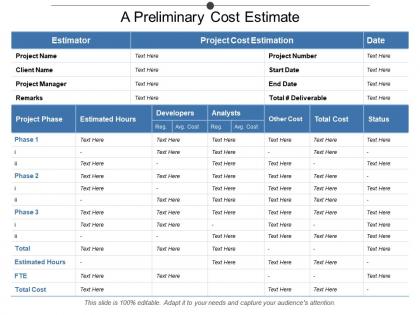
A preliminary cost estimate




Try Before you Buy Download Free Sample Product
 Impress Your
 Audience
 100%
100% Editable
 Save Hours
 of Time


Keep a clear head with our A Preliminary Cost Estimate. Focus on what actually counts.
People who downloaded this PowerPoint presentation also viewed the following :
A preliminary cost estimate with all 5 slides:
Stop boring your audience to death with bad presentations. Use our visually appealing A Preliminary Cost Estimate to keep your audience interested.




FAQs for A
Accurate cost estimation involves direct costs, indirect costs, labor expenses, material requirements, overhead allocations, contingency reserves, and risk assessments. These components work together by establishing baseline budgets, accounting for variable expenses, and incorporating buffer mechanisms, with many organizations finding that comprehensive estimation frameworks ultimately deliver better project outcomes and enhanced financial predictability.
Historical data improves cost estimation precision by providing baseline metrics, identifying recurring patterns, and revealing seasonal variations that impact project costs. Through systematic analysis of past projects, organizations can benchmark labor rates, material costs, and timeline factors more accurately, while accounting for inflation trends and resource fluctuations, ultimately delivering more reliable budget forecasts.
Cost estimation techniques in project management include analogous estimating, parametric modeling, bottom-up estimating, three-point estimation, and reserve analysis. These methods enhance project planning by leveraging historical data, statistical relationships, and detailed work breakdowns, with many organizations finding that combining multiple techniques delivers more accurate budgets, improved resource allocation, and ultimately stronger competitive positioning in project delivery.
Direct costs are directly attributable to specific project deliverables, including labor, materials, equipment, and subcontractor fees, while indirect costs support overall operations like overhead, administration, utilities, and shared resources. These categories streamline budget allocation by enabling precise tracking of project-specific expenses versus organizational support costs, ultimately delivering enhanced financial transparency and more accurate profit margin calculations for strategic decision-making.
Stakeholder input provides critical project requirements, resource constraints, timeline expectations, and risk assessments that directly influence cost accuracy and feasibility. Through collaborative workshops and structured feedback sessions, project managers can identify hidden costs, validate assumptions, and secure buy-in, while stakeholders contribute domain expertise that enhances estimation precision, ultimately delivering more realistic budgets and stronger project support.
Fluctuating market conditions can significantly impact cost estimates through changing material prices, labor rates, currency exchange rates, and supplier availability. These variables create uncertainty that requires organizations to build contingency buffers, implement regular estimate reviews, and use dynamic pricing models, with many project managers finding that flexible estimation approaches deliver more accurate budgets and better risk management.
Effective cost estimation software includes RSMeans for construction, Sage Estimating for manufacturing, Oracle Primavera for large projects, CostX for quantity surveying, and ARES PRISM for infrastructure development. These specialized tools streamline budget planning by automating calculations, integrating historical data, and providing industry-specific templates, with many organizations finding that targeted software reduces estimation errors and accelerates project approvals.
Common cost estimation mistakes include underestimating project scope, overlooking hidden costs, relying on outdated data, failing to account for risks, and ignoring stakeholder requirements. These errors can be minimized by conducting thorough scope analysis, building comprehensive cost databases, incorporating contingency buffers, and engaging cross-functional teams early, ultimately delivering more accurate budgets and stronger project outcomes.
Cost estimation directly influences budgeting accuracy, resource allocation, and financial forecasting by providing data-driven projections for operational expenses, capital investments, and project timelines. Through precise estimation methodologies, organizations streamline budget planning, minimize cost overruns, and enhance strategic decision-making, with many financial teams finding that accurate estimates ultimately deliver improved cash flow management and competitive advantage.
Construction cost estimation methodologies include quantity surveying, unit cost analysis, parametric estimating, analogous estimating, and bottom-up detailed estimation. These approaches enhance project planning by leveraging historical data, current market rates, and comprehensive material assessments, with many construction firms finding that combining multiple methodologies delivers greater accuracy, minimizes budget overruns, and ultimately provides competitive advantages in bidding processes.
Risk and uncertainty in cost estimates can be addressed through contingency reserves, scenario modeling, Monte Carlo simulations, sensitivity analysis, and historical data benchmarking. These approaches enable organizations to account for potential cost overruns by establishing buffer ranges, testing multiple variables, and incorporating lessons from past projects, ultimately delivering more accurate budgets and strategic financial planning in increasingly complex business environments.
Ethical considerations in presenting cost estimates include transparency in assumptions, realistic timeline projections, clear scope boundaries, honest risk assessments, and upfront disclosure of potential variables. These practices build trust by ensuring clients understand true project costs, avoiding scope creep surprises, and maintaining professional integrity, with many consulting firms finding that ethical transparency ultimately strengthens long-term client relationships and competitive positioning.
Continuous monitoring and updating of cost estimates ensures projects remain financially viable by tracking actual expenses against projections, identifying budget variances early, and adapting to changing market conditions, scope modifications, and resource fluctuations. This proactive approach enables organizations to make informed decisions, prevent cost overruns, and maintain profitability throughout project lifecycles, ultimately delivering better financial control and stakeholder confidence.
Collaborative approaches enhance estimation by combining diverse expertise, reducing individual biases, and leveraging collective experience from different departments and project perspectives. Cross-functional teams involving engineering, finance, and operations can identify potential cost factors others might miss, while shared accountability and transparent discussions ultimately deliver more accurate budgets and stronger project outcomes.
**INPUT**: What are the trends in technology that are influencing modern cost estimation practices? **OUTPUT**: Technology trends influencing modern cost estimation include artificial intelligence, machine learning algorithms, cloud-based platforms, predictive analytics, and automated data integration tools. These technologies streamline estimation processes by analyzing historical project data, identifying cost patterns, and delivering real-time insights, with many organizations finding that automated systems significantly enhance accuracy while reducing estimation timeframes. [Word count: 54 words]
-
The content is very helpful from business point of view.
-
Easy to edit slides with easy to understand instructions.