


Software project cost estimation it powerpoint presentation slides




Try Before you Buy Download Free Sample Product
 Impress Your
 Audience
 100%
100% Editable
 Save Hours
 of Time


Cost estimation allows businesses to outline the effort and time necessary for developing the project, also define the scope of outstanding work. Software projects IT is significant for stakeholders too that lets them decide how long the project will take to complete and how much product it will be for everyone. Check out our professionally designed template on Software Project Cost Estimation IT that will allow you to know about the cost, defects, and estimation of results for the project. The proposal presents assessments to agile project management for software development. One can even determine several agile estimation methods regarding efforts, productivity, complexity, project size, etc. Businesses focus on multiple key considerations for cost, such as fixed price contracts, release planning, proposal, high level scope, and more. The template guides you in defining ideal days for agile project cost estimation using various techniques like affinity mapping, COCOMO, planning poker, analog estimate, etc. You can exhibit factors associated with projecting development and, at the same time, assess cost attributes for time and quality factors. Firms get a chance to showcase work breakdown structure to keep an eye on software IT projects and the roadmap of each task every week. Talk to our expert team and take guidance from our research analysts for all your queries. Book a free demo and get access to our easily downloadable 100 editable templates.
People who downloaded this PowerPoint presentation also viewed the following :
Content of this Powerpoint Presentation
Slide 1: This slide displays the title i.e. 'Software Project Cost Estimation (IT)' and your Company Name.
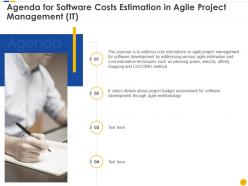
Slide 2: This slide presents the agenda for the project.
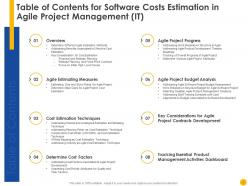
Slide 3: This slide exhibits the table of contents for the project.
Slide 4: This slide showcases the title for overview of the project.
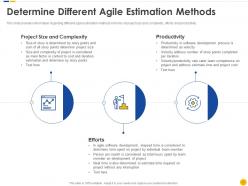
Slide 5: This slide provides information regarding different agile estimation methods in terms of project size and complexity, efforts and productivity.
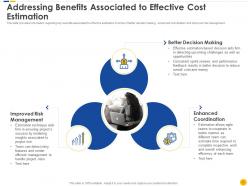
Slide 6: This slide explains key benefits associated to effective estimation in terms of better decision making, enhanced coordination and improved risk management.
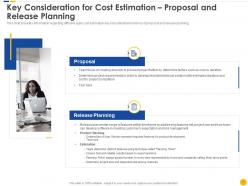
Slide 7: This slide provides information regarding different agile cost estimation key considerations in terms of proposal and release planning.
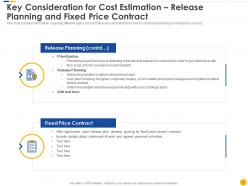
Slide 8: This slide provides information regarding different agile cost estimation key considerations in terms of release planning and fixed price contract.
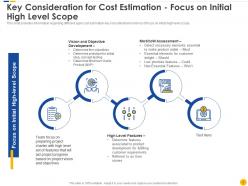
Slide 9: This slide provides information regarding different agile cost estimation key considerations in terms of focus on initial high level scope.
Slide 10: This slide displays the title for agile estimating measures.
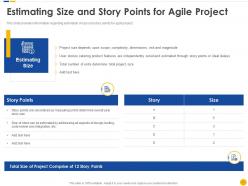
Slide 11: This slide provides information regarding estimation of size and story points for agile project.
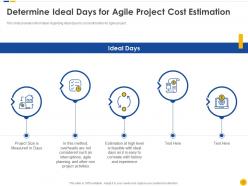
Slide 12: This slide provides information regarding ideal days for cost estimation for agile project.
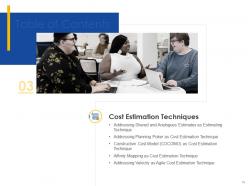
Slide 13: This slide exhibits the title for cost estimation techniques.
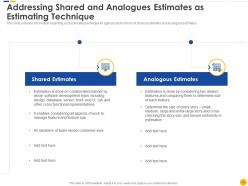
Slide 14: This slide provides information regarding cost estimating technique for agile project in terms of shared estimates and analogous estimates.
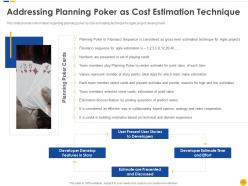
Slide 15: This slide provides information regarding planning poker as cost estimating technique for agile project development.
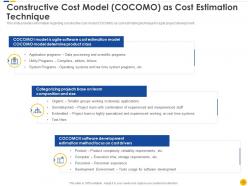
Slide 16: This slide provides information regarding constructive cost model (COCOMO) as cost estimating technique for agile project development.
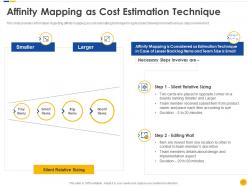
Slide 17: This slide provides information regarding affinity mapping as cost estimating technique for agile project development with various steps involved in it.
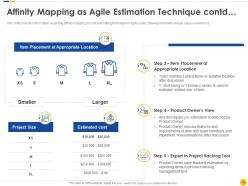
Slide 18: This slide provides information regarding affinity mapping as cost estimating technique for agile project development with various steps involved in it.
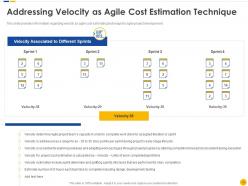
Slide 19: This slide provides information regarding velocity as agile cost estimating technique for agile project development.
Slide 20: This slide presents the title for determining cost factors.
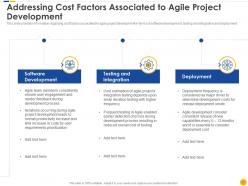
Slide 21: This slide explains cost factors associated to agile project development in terms of software development, testing and integration and deployment.
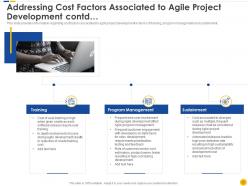
Slide 22: This slide provides information regarding cost factors associated to agile project development in terms of training, program management and sustainment.
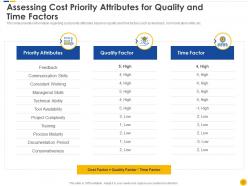
Slide 23: This slide provides information regarding cost priority attributes based on quality and time factors such as feedback, communication skills, etc.
Slide 24: This slide displays the title for agile project progress.
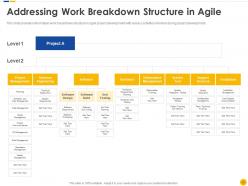
Slide 25: This slide provides information work breakdown structure in agile project development with various activities involved during project development.
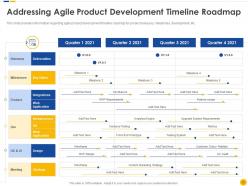
Slide 26: This slide provides information regarding agile product development timeline roadmap for product releases, milestones, development, etc.
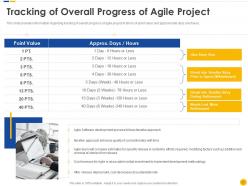
Slide 27: This slide provides information regarding tracking of overall progress of agile project in terms of point value and approximate days and hours.
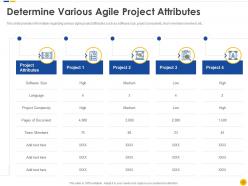
Slide 28: This slide provides information regarding various agile project attributes such as software size, project complexity, team members involved, etc.
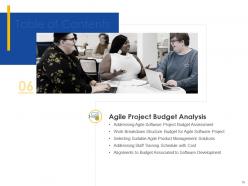
Slide 29: This slide exhibits the title for agile project budget analysis.
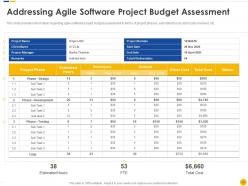
Slide 30: This slide provides information regarding agile software project budget assessment in terms of project phases, estimated hours, total costs involved, etc.
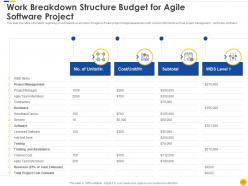
Slide 31: This slide explains work breakdown structure for agile software project budget assessment with various WBS items such as project management, hardware, software.
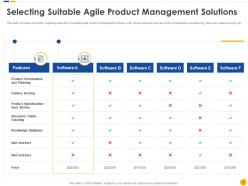
Slide 32: This slide showcases selection of suitable agile product management solution with various features such as product prioritization and planning, etc.
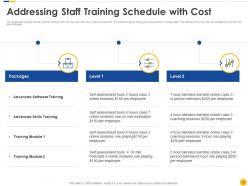
Slide 33: This slide displays the title for staff training schedule.
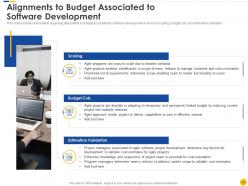
Slide 34: This slide provides information regarding alignments to budget associated to software development in terms of scaling, budget cuts and estimation validation.
Slide 35: This slide presents the title for agile project contract development.
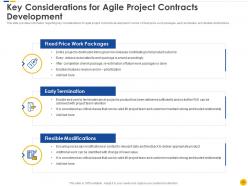
Slide 36: This slide explains key considerations for agile project contracts development in terms of fixed price work packages, early termination and flexible modifications.
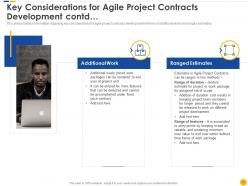
Slide 37: This slide provides information regarding key considerations for agile project contracts development in terms of additional work and ranges estimates.
Slide 38: This slide exhibits the title for product management activities dashboard.
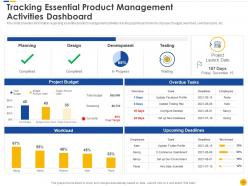
Slide 39: This slide provides information regarding essential product management activities tracking dashboard in terms of project budget, workload, overdue tasks, etc.
Slide 40: This is the icons slide for the project.
Slide 41: This slide displays the title for additional slides.
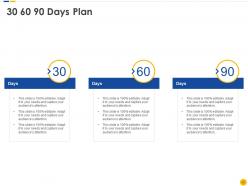
Slide 42: This slide displays the 30-60-90 days plan for your project.
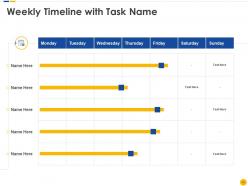
Slide 43: This slide exhibits the weekly timeline of the company.
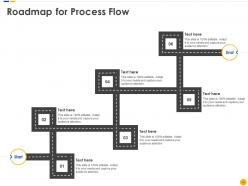
Slide 44: This slide exhibits the roadmap of the company.
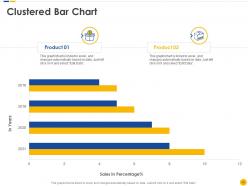
Slide 45: This slide showcases the clustered bar graph for different products. The graphs are linked to Excel.
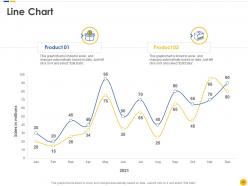
Slide 46: This slide showcases the line chart for different products. The charts are linked to Excel.
Slide 47: This slide presents the team responsible for the project with their names & designation.
Slide 48: This slide showcases the posts related to past experiences of clients.
Slide 49: This slide exhibits the venn diagram for your company targets.
Slide 50: This slide presents the goals of your company.
Slide 51: This slide explains the puzzle for your company.
Slide 52: This is the thank you slide and displays the contact details of the company i.e. office address, contact number, etc.
Software project cost estimation it powerpoint presentation slides with all 52 slides:
Use our Software Project Cost Estimation IT Powerpoint Presentation Slides to effectively help you save your valuable time. They are readymade to fit into any presentation structure.






FAQs for Software project cost estimation it
Honestly, start with your project scope and how complex it'll be - that's the biggest cost driver. Team size matters too, plus where they're located since rates vary like crazy by region. Your tech stack choice can make or break the budget. Clear requirements are everything though - I've seen projects double in cost because specs were all over the place initially. Factor in your timeline, any third-party stuff you need to integrate, testing, and ongoing maintenance. My advice? Break it down, estimate each piece, then tack on 25% extra because trust me, weird stuff always pops up mid-project.
Yeah so here's the thing - small projects? Pretty easy to nail down costs because you can actually see what you're dealing with. Once things get bigger and messier though, your estimates start going to hell. I've watched accuracy drop from like 90% on simple stuff down to maybe 50-70% on the really complex systems. There's just too many "oh crap, we forgot about that" moments waiting to bite you. Dependencies pop up everywhere, unknowns multiply... it's honestly kind of brutal. Break everything into smaller pieces if you can and keep updating your estimates as you go. Way less painful that way.
So there's three main approaches you'll see. **Parametric models** like COCOMO use algorithms and historical data - works great if you've got solid past data to work with. **Analogical estimation** is basically "hey, this reminds me of that project from last year." Then there's **bottom-up estimation** where you break everything into tiny pieces and add it all up. Takes forever but super detailed. Most teams I know just mix and match depending on what they need. Quick estimate? Go analogical. Need something bulletproof for stakeholders? Bottom-up all the way. Parametric's somewhere in the middle - though honestly it can be hit or miss.
Dude, start tracking your project data NOW - even in a crappy spreadsheet. Past projects with similar scope and team size are goldmines for realistic estimates. Don't just look at the wins though. Honestly, the disasters teach you way more than anything that went smoothly. I track stuff like effort per feature, how many bugs we hit, scope creep percentages. You'll spot patterns that beat guessing every time. Build your own little database with duration, team size, final costs. It's boring work but you'll thank yourself later when you're not pulling estimates out of thin air.
Okay so risk assessments are like your backup plan for project estimates - they stop you from being overly optimistic about timelines and budgets. Look at technical stuff (new frameworks, weird dependencies), team issues (people quitting, missing skills), and outside factors like scope creep or vendor problems. I know it sounds like fortune telling, but trust me on this one. Most projects that go over budget? They skipped this step. Just grab your biggest 5-10 risks and tack on 15-30% extra time/money based on how likely they are to bite you. Way better than explaining to your boss why everything's late.
Honestly, your team's experience is gonna make or break your timeline and budget. Junior devs? Add 20-40% buffer time for all the debugging and rework that's coming. I learned this the hard way lol. Senior developers cost more upfront but they're usually worth it - faster delivery, way fewer headaches. Mixed teams are where it gets weird though. You've got mentoring time, knowledge transfer, all that stuff to factor in. Here's the thing - when you're estimating, use their actual skill levels, not what you hope they'll become halfway through the project.
COCOMO II is pretty solid for algorithmic stuff, plus Jira and Azure DevOps handle story point tracking well. Monte Carlo simulators are great for risk analysis too. Honestly though? Spreadsheets still kick ass if you're not ready to dive into fancy tools yet. These actually help because they pull in historical data and factor in your team's velocity - stuff you'd probably miss just winging it. They make you break everything down systematically instead of randomly guessing. I'd start with whatever tracking system you're already using, then just add estimation features on top. Way less painful that way.
So with Agile, you basically throw out that whole "estimate everything upfront" approach. Break it down into sprints instead and adjust as you go. Your estimates get way more accurate once you see what your team actually cranks out each cycle. Honestly, the old "measure twice, cut once" mentality doesn't really work here. You're constantly tweaking based on real data from previous sprints. Story points and planning poker help, but velocity tracking is where the magic happens - that's your best bet for forecasting what's realistic. Start measuring your team's velocity ASAP. It'll save you so many headaches later.
Scope creep will destroy you - seriously, it's the worst. Also, we're all terrible at timelines so don't feel bad about that. I always forget to account for testing and debugging time because the actual coding is way more fun, but those parts take forever. Third-party APIs and waiting on other teams? Yeah, that'll mess up your schedule too. Honestly just add 30% to whatever you think it'll take. Trust me on this one. Oh and start writing down how long stuff actually takes vs what you guessed - you'll get way better at estimates after doing that for a few projects.
Look, you absolutely need stakeholders involved or you're just throwing darts blindfolded. They're the ones with all the actual context about what's needed. I watched a project blow past budget by 200% because the team assumed they knew what users wanted - spoiler alert, they didn't. Hidden complexities? Scope boundaries? Business constraints? Stakeholders catch all that stuff. Get the right mix too - end users see things differently than business owners or tech leads. Don't try doing this alone in a room somewhere. Set up regular estimation sessions with them instead.
Oh man, scope changes will absolutely wreck your budget. You think you're just adding one little feature? Nope - suddenly you're redoing the whole testing phase, reworking parts you thought were done, maybe even upgrading servers you hadn't budgeted for. It's wild how one "small" request spirals into this massive cost explosion. I've seen projects go 50% over budget from what seemed like tiny tweaks. My advice? Write down every single change with new cost estimates before you say yes to anything. Don't let them guilt you into "quick additions" either.
Honestly, talking to your team upfront saves you from those brutal "oh wait, we forgot about X" moments later. Developers will mention weird dependencies they've hit before. QA knows which features are testing nightmares. Your designer might casually drop that the "simple" button change actually needs database work - fun times. Quick estimation huddles are clutch for this stuff. Regular check-ins catch scope creep before it spirals (and it always tries to spiral). When everyone throws in their two cents early, you get real numbers instead of optimistic guesses that'll bite you later.
Track your estimated vs actual effort for each phase - that's the big one. Also watch your team's velocity and defect rates because bugs absolutely wreck timelines more than you think. Scope creep percentage matters too, plus how volatile your requirements are. Honestly, I just throw this stuff in a spreadsheet after each project and spend like 30 minutes figuring out where I screwed up. Those patterns become super obvious once you start looking. Your project management tool might capture some of this automatically if you're lucky. Compare predictions to reality consistently and your next estimates won't suck as much.
So here's what I do - assign cost equivalents or weighted scores to those fuzzy factors. Quality stuff is easier since you can estimate extra testing time, code reviews, potential rework. User satisfaction though? That's honestly a pain to measure, but you can at least ballpark UX research and usability testing cycles. I make a simple 1-10 scoring matrix and multiply by cost multipliers. The trick is staying consistent with your weighting across projects - that way you're comparing apples to apples. Then you can actually learn from what went wrong (or right) and tweak your estimates next time.
Honestly, you've gotta check those estimates at every big milestone. After requirements lock down, during design, definitely after each sprint. I learned this the hard way lol. Document what's changing and why because your stakeholders will 100% ask later. When scope creeps in (and it always does) or you hit unexpected tech issues, update everything immediately. Don't wait until the end to surprise people - that never goes well. Quick weekly check-ins with your team work great. Trust me, it beats those brutal "we're way over budget" meetings.
-
Innovative and attractive designs.