


Advantages of centralization ppt examples professional




Try Before you Buy Download Free Sample Product
 Impress Your
 Audience
 100%
100% Editable
 Save Hours
 of Time


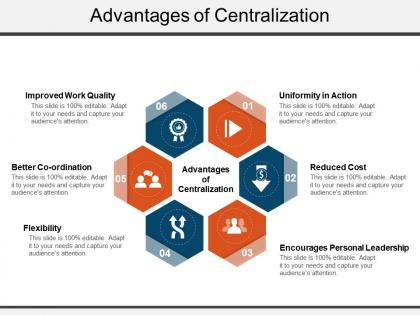
The advantages of centralization PPT examples professional slide has been created to showcase the important and major advantages of centralization through an effective and organized manner. In the advantages of centralization PPT examples professional template, you will find that the central icon is the advantages of centralization. Then, the outer icons will show the major focus areas and the key benefits of centralization. These can be uniformity of action, which is immensely important in a large organization. Reduced costs are again key in making the most of the available resources. The third benefit is encourages personal leadership. Flexibility of action of what follows next. Next is the better coordination between higher-ups and the employees and also between all the employees which also ensures a better work culture which is the last key advantage - improved work quality. This slide can be edited and modified completely to best suit the needs of your business or company. Doubt's don't haunt with our Advantages Of Centralization Ppt Examples Professional. They will all get exorcised.
People who downloaded this PowerPoint presentation also viewed the following :
Advantages of centralization ppt examples professional with all 5 slides:
Fill empty coffers with our Advantages Of Centralization Ppt Examples Professional. Your appeal is bound to generate the desired funds.


FAQs for Advantages of centralization
So basically centralization gives you way faster decisions and better cost control. Everything stays consistent across the whole company too. One person's in charge so accountability is clearer - no more finger pointing when stuff goes wrong. Resources get coordinated better instead of departments doing whatever they want (which honestly can be a total mess). Quality improves since there's actual oversight. The trade-off? Less flexibility locally. But if you need tight control and want things standardized, centralized setups usually crush it for efficiency and keeping costs down.
Honestly, centralization just cuts through all the BS. No more waiting for five different teams to argue for weeks about every little decision. One person makes the call, boom, you're done. Way faster approvals and everyone knows who's actually running the show. Sure, you might miss some details from people actually doing the work day-to-day, but when speed matters? Centralized wins every time. If your company can't make decisions quickly, you're probably letting too many people weigh in on everything. Sometimes collaboration is just procrastination in disguise.
Honestly, pooling everything together just makes way more sense. You get actual visibility into what's happening across departments instead of everyone doing their own thing with budgets and supplies. My old company was terrible about this - IT would order tons of software while HR bought the same stuff separately. With centralization you can catch those redundancies, move unused stuff around, and get way better deals buying in bulk. The data helps too since you'll spot usage patterns and predict what you actually need down the road. I'd start small though - maybe just office supplies or software licenses to see how it goes first.
Look, centralization definitely helps with accountability - you get clear reporting lines and everyone's measured the same way. No more "we handle things differently" excuses from different departments. Underperformers can't really hide when everything goes through central oversight. The trade-off though? Your star employees might feel micromanaged and lose that go-getter attitude. I've seen it happen before - kills the entrepreneurial vibe. But if you're dealing with accountability problems right now, centralizing performance stuff will probably solve it fastest. Just don't be shocked if some people push back initially.
So centralization is like your quality control for the brand - keeps all locations on the same page instead of everyone doing whatever they want. You set up one master template with your logos, colors, messaging, all that stuff. Without it? Your Seattle spot could feel totally different from Miami, which just confuses customers. I mean, think about how weird it'd be if every Starbucks looked completely different. Regular check-ins help too. It's honestly the only way to avoid that whole "brand dilution" mess where nobody knows what you actually stand for anymore.
Honestly, centralized data is a game changer. You get one reliable source instead of digging through random spreadsheets and databases scattered everywhere. Running queries becomes so much easier when everything's in one place. Patterns you'd never spot before suddenly jump out at you. Less time wasted on cleaning messy data from different sources too. Your reports get faster and way more accurate. Oh, and start by looking at whatever data you're currently pulling from like 3+ different places - that's your low-hanging fruit right there. Trust me on this one.
Honestly, centralization can bite you in three big ways: everything crashes when your main system goes down, teams get lazy and stop innovating, and decision-making becomes this slow bureaucratic mess. I've watched companies completely stall because people stopped pitching ideas they figured would just get shot down anyway. Your best bet? Set up backup systems and don't centralize literally everything. Keep those feedback loops going - both directions matter. Oh, and actually review your processes regularly so you're not just creating red tape for the sake of it.
So basically, centralization gives you clear lanes for info to flow through - you know exactly who handles what. No more "wait, who do I even ask about this?" moments. Messages don't get lost in some chaotic group chat situation. Think highway lanes vs everyone just driving wherever, you know? Decision-making actually speeds up since there's less ping-ponging between random people. The trick is making sure those channels work smoothly and don't turn into some bureaucratic mess that kills everything.
Okay so centralization works great when you need serious control - like in healthcare or finance where one screw-up means lawsuits. Startups love it too because founders are control freaks (in a good way). You'll want it for expensive specialized stuff that's too pricey to duplicate everywhere. Sure, it feels micromanage-y and people complain, but during a crisis? Total lifesaver. Quick decisions, coordinated response. If you value consistency over letting each location do their own thing, go centralized. Though honestly, it really depends on what kind of chaos you're trying to avoid.
Yeah, centralized definitely moves faster. Leadership just decides and boom - everyone's doing it. No waiting around for twenty different departments to argue about details. You skip all those endless meetings where nobody agrees on anything (which honestly sounds amazing). The downside? You'll probably miss out on good ideas from people actually doing the work day-to-day. But if you need speed and want the same thing happening everywhere, centralized wins hands down. Decentralized gives everyone veto power and that just slows everything to a crawl.
So pooling all your support people together definitely helps with response times and consistency - everyone gets the same quality service instead of it being a total crapshoot. Your team can actually specialize too, which is way better than having people who sorta know everything but aren't great at anything specific. Training becomes easier when you're not dealing with scattered locations. The trade-off? You'll probably lose some of that personal, local feel customers used to get. But honestly, most people would rather get their issue solved quickly than chat about the weather. Just make sure your centralized team doesn't sound like robots when they talk to customers.
So basically, you save money by not doing the same stuff multiple times across departments. Like instead of each team buying their own software licenses, you buy in bulk and get way better deals. Same with hiring - get one IT specialist for everyone instead of each department having their own mediocre tech person (no offense to generalists, but specialists just know their stuff better). HR, procurement, all that can be centralized too. The redundancy costs are honestly crazy when you add them up. I'd start by looking at where your teams are basically doing identical work separately and see how much that overlap is costing you.
Google and Apple are perfect examples - they push updates worldwide in minutes with crazy tight quality control. Banking's huge for this too since security and compliance has to be identical everywhere. Walmart centralizes their whole supply chain and pricing strategy. Airlines do the same thing with scheduling and ticket prices (imagine the chaos if each airport just winged it lol). Healthcare's getting there with patient data systems. Honestly, if you're in any of these industries, just look at what the biggest players are doing - there's usually some centralization move you can steal.
Honestly, tech makes centralization way easier because you get real-time visibility into everything. Cloud platforms pull data from all your locations into one place. AI analytics catch patterns you'd miss otherwise. Communication tools let your centralized team actually work together without being physically together - which is still kind of wild to me. The trick is finding tools that play nice together so you're not juggling a million different systems. I'd map out what you're doing now first. Then figure out where tech can cut out those annoying manual handoffs that bog everything down.
First thing - figure out what decisions actually need central control. Budget stuff, big strategy calls, resource allocation. That's your starting point. People hate losing autonomy (can't blame them honestly), so explain the reasoning upfront and keep explaining it. Don't flip everything overnight - phase it in gradually or you'll create chaos. Make super clear escalation rules so teams know when to loop in leadership vs. when they can just handle it themselves. The trick is not becoming a bottleneck for every tiny decision. Nobody wants that headache.
-
Very unique and reliable designs.
-
Very unique, user-friendly presentation interface.