


7 center of excellence ppt examples slides





Try Before you Buy Download Free Sample Product
 Impress Your
 Audience
 100%
100% Editable
 Save Hours
 of Time


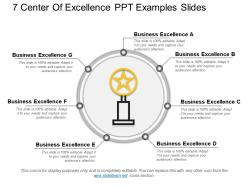
Get ready to set new standards in your business organization by using this most demanded and downloaded 7 center of excellence PPT examples slides. The use of high resolution and premium quality slides while designing this capability center business slides will allow you to raise the standard of your work. We know that business professionals do not always have time to sit and design the slides themselves that is why we bring to all of you this seven-stage business process PPT template. Using this competency center PowerPoint presentation you will be able to make a very attractive and eye catchy presentation because of its unique and original characteristics. Also, we promise you that you will not regret your decision of downloading and using our center of excellence business slides as it will take your business organization to new heights of success. So if you are ready to get applauded and become a star overnight simply hit the download button and make most of it. Our 7 Center Of Excellence Ppt Examples Slides create determined folks. Their effort will never be half hearted.
People who downloaded this PowerPoint presentation also viewed the following :
7 center of excellence ppt examples slides with all 5 slides:
You know you have a discerning audience. Appeal to their intellect with our 7 Center Of Excellence Ppt Examples Slides.


FAQs for 7 center of excellence
Honestly, three things make or break a CoE. Get executive buy-in first - without it you're basically useless. Mix your team right: subject experts plus people who can actually get others to adopt stuff. Oh, and document everything because nobody remembers anything these days. Standardized processes are key, but they've gotta be realistic ones people will follow. Metrics help prove you're not just burning budget. Biggest trap? Don't become some isolated expert group. Work directly with business units. I've seen too many CoEs fail because they sit in their corner acting all smart while everyone ignores them.
Track the obvious stuff first - adoption rates, delivery times, cost savings. But honestly, the soft metrics are where you'll really know if it's working. Survey teams about whether they actually feel supported or just micromanaged. Notice if other departments start coming to you instead of you chasing them down. That's a huge tell. Set up maybe 4-5 key things on a simple dashboard and check quarterly. Oh, and start measuring now before you lose track of your baseline - I've seen too many teams kick themselves for not doing this earlier.
Honestly, you need rock-solid leadership backing or you're basically screwed from day one. Get executive sponsorship locked down first - like, actually committed sponsors who'll fight for you, not just people who nod in meetings. They're the ones securing your budget and making other teams actually listen to what you're saying (good luck without that leverage). Your leaders also need to celebrate wins publicly when things go well. I've watched too many CoEs die because they couldn't get departments to adopt their standards. Short version: don't even bother starting until leadership is genuinely bought in.
So basically, a CoE gives teams this protected space to mess around with new ideas without getting shut down immediately. People from different departments actually start talking to each other - which honestly doesn't happen enough in most places. The budget piece is huge too - they get dedicated money for testing stuff instead of begging for scraps from other projects. What really matters though is whether your CoE can actually push through pilot programs and then roll out the wins company-wide. Otherwise you're just creating another committee that makes pretty slide decks. They're also good at turning experiments into actual best practices teams will use.
Honestly, the hardest part is getting other teams to actually care about what you're doing. I've watched so many CoEs turn into these isolated groups that just talk to themselves while everyone else ignores them. You gotta get your people working directly with business units instead of just sending over fancy reports nobody reads. Focus on fixing actual problems they're dealing with right now - not some theoretical stuff that sounds good on paper. Track real results too, like how much money you saved or what processes got faster. Start with small wins first. Build up some street cred before you go after the big initiatives.
Think of a CoE as the place where all your company's scattered knowledge finally gets organized. Different teams stop working in their own bubbles and start sharing what actually works. They'll set up workshops and training sessions - honestly, some are hit or miss, but the good ones are really helpful. The whole point is creating standard processes that everyone can access instead of reinventing the wheel constantly. What makes it work? They don't just collect information and sit on it. Figure out where your departments aren't talking to each other first, then build your CoE around fixing those gaps.
Track adoption first - how many teams actually use your stuff vs just nod politely in meetings. Business metrics come next: cost savings, faster delivery times, quality improvements. The "soft" metrics matter more than people think though - satisfaction surveys, knowledge sessions, response times to requests. Honestly, that last one can make or break relationships with other teams. Set up a basic dashboard so you're not scrambling for numbers when leadership asks "so what exactly does this CoE do for us?" Budget conversations are way easier with real data.
Look, CoEs are honestly where you want to be if you're serious about growing your skills. You'll get specialized training, mentorship from people who actually know their stuff, and hands-on experience with the latest techniques. The peer learning is incredible too – I mean, you're surrounded by the best people in that field. They also set up clear development paths and can get you on high-impact projects that really show off what you're learning. Oh, and certifications are usually part of the deal. If there's one in your area, definitely jump on it. It's basically career development on steroids.
Honestly, tech can totally transform your CoE if you do it right. Collaboration tools like Slack or Teams let experts connect across offices easily. Knowledge repositories actually work when people can find what they need - not like those awful SharePoint sites everyone ignores. Analytics help you see what's clicking with your team. Automation standardizes your processes, and AI pulls insights from all that expertise floating around. Don't just go with whatever IT pushes though. Pick tools that match how your people actually work day-to-day. Start simple with one solid collaboration platform, then expand from there once it's working.
Tech, finance, and healthcare get the most out of CoEs - they're just drowning in complexity. Manufacturing's big on them too for streamlining operations. Really, any industry with compliance headaches or fast-changing tech (AI, cloud stuff, data analytics) benefits. The sweet spot is when you've got scattered teams doing the same work differently. Scale matters though - you need enough moving parts to make it worth it. My old company waited too long to set one up, honestly. Start by figuring out where people are constantly reinventing the wheel. That's usually your biggest win.
Honestly, start with where you're hemorrhaging cash or where skill gaps are killing you. That's your sweet spot right there. Survey your teams about their biggest headaches, then see how that lines up with what leadership actually cares about for the next few years. If you're going digital-heavy, maybe data analytics or cloud makes sense. But don't get sucked into whatever's trending on LinkedIn if it won't solve real problems. I'd stick to just 1-2 areas tops when you're starting out. You can always add more once you've got some wins under your belt.
Start with a hub-and-spoke setup - your main CoE handles standards while you build up local talent at each site. Find champions in each location who can adapt your practices. Honestly, what kills most rollouts is trying to do everything everywhere at once. Pick 2-3 core things first, nail those, then expand. Communication between sites is huge - regular knowledge sharing sessions work well. Also, Tokyo isn't New York, you know? Let locations tweak things for their region. Build feedback loops so good ideas flow back to the center too. That's how you actually improve the whole system instead of just copying the same stuff everywhere.
So basically a CoE is like having that one friend who's really good at organizing stuff - they figure out what actually works and document it properly. They'll run training sessions and build templates so your team doesn't have to start from scratch every time. What's cool is they don't just dump a bunch of documents on you and disappear. They actually stick around to help you implement things. Honestly, I'd start by picking just a few key practices for them to focus on first - don't try to boil the ocean. Then work with them on a realistic rollout plan.
Honestly, you've gotta make people actually *care* about this thing, not just understand it. Figure out what keeps each group up at night - maybe it's budget cuts, maybe efficiency headaches. Then show how your CoE fixes those exact problems. Quick wins are everything here. Don't go for some massive transformation right away - I've watched that backfire too many times. Pick something small but visible that'll convert the doubters. Get your key players involved in planning so they feel like it's theirs too. Regular check-ins help maintain momentum. Oh, and frame everything around solving their headaches, not showing off what you know.
Your CoE needs to tie directly into what the business actually cares about - revenue, cutting costs, whatever the big goals are this year. Pick 2-3 specific outcomes you can move the needle on, then work backwards from there. Don't let it become this catch-all department that does everything (trust me, that's where CoEs go to die). Set up KPIs that roll up to the main business objectives. The hard part? Staying focused when everyone wants you to be their solution. Leadership has to see clear connections between your roadmap and their priorities, or you'll lose support fast.
-
Best way of representation of the topic.
-
Good research work and creative work done on every template.
-
Awesomely designed templates, Easy to understand.
-
The content is very helpful from business point of view.