

7 disciplines of agile unified process agile unified process it ppt information




Try Before you Buy Download Free Sample Product
 Impress Your
 Audience
 100%
100% Editable
 Save Hours
 of Time


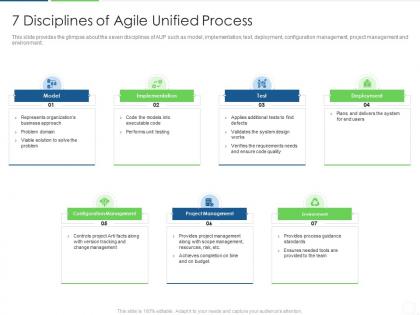
This slide provides the glimpse about the seven disciplines of AUP such as model, implementation, test, deployment, configuration management, project management and environment.
People who downloaded this PowerPoint presentation also viewed the following :
7 disciplines of agile unified process agile unified process it ppt information with all 2 slides:
Use our 7 Disciplines Of Agile Unified Process Agile Unified Process IT Ppt Information to effectively help you save your valuable time. They are readymade to fit into any presentation structure.
FAQs for 7 disciplines of agile unified process agile unified process
So it's basically RUP but way less bloated. Risk-driven development means you tackle the scary problems first - which honestly makes so much sense. Then there's the architecture-centric stuff to keep your foundation solid, plus use-case driven development so you're actually building what users want. Short iterations are huge here. Each one ends with working software instead of just endless docs. Stakeholders stay involved throughout, and when requirements change (they always do), you roll with it rather than panic. I'd start by figuring out your biggest risks and build your first iteration around those.
So AUP is basically RUP but without all the annoying paperwork that bogs everything down. You work in short sprints, constantly shipping stuff and getting feedback instead of planning forever upfront. Way more flexible when requirements inevitably change - and trust me, they always do. Still keeps the good RUP bits like managing risks and thinking about architecture, just does it bit by bit. My old team actually tried this once and it wasn't terrible. If you're sick of drowning in process docs, it's a decent compromise between full agile and the traditional heavyweight approaches.
So AUP breaks down into four phases that kinda blend together. You've got Inception where you figure out project scope, then Elaboration to lock down architecture and main requirements. Construction is where you actually build most of the system - honestly this phase eats up like 80% of your time. Finally there's Transition for deployment and user feedback. It's not like waterfall though, you can jump back between phases and you're always doing bits of requirements, design, testing throughout. Just focus on figuring out which phase you're in right now and what milestones you're shooting for.
So basically, take those long UP phases and chop them into 2-4 week chunks. Run mini versions of inception, elaboration, construction, and transition in each sprint - sounds weird but it actually works pretty well. Keep UP's solid approach to architecture and requirements, just do it more flexibly. Working software beats endless documentation every time. Map your current UP stuff to sprint cycles first, then figure out what you can break down incrementally. Honestly, I've seen teams struggle with this transition, but once you get the rhythm down it's way less bureaucratic than traditional UP.
AUP is all about keeping stakeholders in the loop constantly - not just at the very end when it's too late to fix anything. They're literally part of your whole development process. Requirements gathering, sprint reviews, giving feedback... they're involved in everything. Honestly, it's way better than the old "surprise them at launch" approach that never works out well. Regular check-ins help you catch problems early before they become huge headaches. The key is setting up those touchpoints from the start so everyone stays aligned on what you're actually building.
So AUP basically flips risk management on its head - instead of doing it once upfront, you're constantly checking for problems. Short iterations are great because issues pop up early when they don't cost a fortune to fix. During Elaboration, you're hunting down those architectural risks that could totally wreck your project later. I always tell people to tackle the scariest technical stuff first, plus prioritize your riskiest use cases. The whole iterative thing means you're validating assumptions as you go rather than crossing your fingers and hoping. Each iteration, review that risk list and actually address the big threats - not just the easy wins that make you feel productive.
So for project management, grab Jira or Azure DevOps to handle your iterations and stories. Documentation-wise, Confluence works well. Architecture stuff? Enterprise Architect's solid, but honestly I've seen teams do amazing work with just whiteboards - sometimes simple beats fancy. Jenkins or GitLab CI will handle your builds nicely. The trick with AUP is not going overboard with tools since you want that agile flexibility. Start basic: decent project management tool plus version control. Then build up from there once your team gets comfortable. Oh, and don't let anyone convince you that more tools automatically means better process.
Yeah, AUP's actually pretty solid for CI/CD stuff. Those short iterative cycles match up perfectly with how you're constantly building and testing code anyway. What I like is how the structured phases give you a consistent pipeline - each iteration basically follows the same pattern, which makes automation way easier. Since it pushes you to nail down architecture early, you can design everything with CI/CD in mind from day one instead of retrofitting later (been there, not fun). The whole risk thing means you catch integration problems fast too. Try mapping your CI/CD stages to AUP's workflow milestones - makes tracking way cleaner.
Honestly, AUP works great because it gets everyone actually talking to each other. Instead of devs, testers, and designers all hiding in their corners, they're collaborating through these short iterations. When requirements inevitably change (and they always do), those feedback loops let you pivot fast. The documentation stays light so people don't get buried in paperwork. Regular iteration reviews are clutch - the whole team demos together and stays aligned. Oh, and start with solid communication channels first. Make sure everyone knows what they're supposed to be doing each cycle.
Honestly, the hardest part is that AUP needs way more discipline than regular Agile stuff. Your team has to juggle those structured UP phases while staying flexible - and trust me, most people mess this up at first. There's also more paperwork than you'd get with straight Scrum or Kanban, which sucks. People get confused about when to be "Agile" and when to actually follow the process. Oh, and if your devs don't know RUP concepts? Good luck explaining elaboration and construction phases. I'd definitely run some training sessions on both Agile and UP basics before diving in.
So AUP basically keeps you glued to what users actually want through constant check-ins and feedback. Instead of guessing, you're validating everything against real needs. Early prototypes and regular demos are huge - seriously saves your ass later when things inevitably change. Each iteration lets you gather feedback and pivot fast if requirements shift. Business folks stay involved the whole time, not just at kickoff meetings. Oh and don't wait to start those user check-ins. Schedule them now before you get too deep into building the wrong thing.
Look at iteration velocity and story points per sprint - that's your bread and butter. Defect density matters too. From the UP side, track architectural coverage and requirements traceability. Customer satisfaction scores are huge, honestly. Those team retros? Gold mine of info if you actually pay attention to them. Business value per iteration helps when you're dealing with stakeholders who want numbers. Don't go crazy measuring everything though - pick 3-4 metrics that actually make sense for your project. ROI per iteration is solid too, especially if leadership's breathing down your neck about budgets.
AUP rocks for scope changes because you're constantly reassessing what matters most. Short iterations mean when stakeholders flip-flop on requirements (and trust me, they will), you can adjust without blowing up your timeline. Each planning session, you reprioritize based on what's actually valuable right now. Waterfall locks you into decisions made months ago - AUP lets requirements evolve as people see real working software. The feedback loop is everything. Just make sure your stakeholders get that this flexibility isn't chaos, it's the whole point.
Definitely start with daily standups and face-to-face time - that's your foundation right there. A shared dashboard is honestly a game changer for keeping artifacts and updates visible to everyone. Regular retrospectives help you catch communication breakdowns early, which saves tons of headache later. Cross-functional pairing is huge in AUP too, so get your developers, testers, and stakeholders working together during iterations. Oh, and I'd audit where you're currently communicating first. You might be surprised how much stuff gets lost in translation between different tools and channels.
Start with hands-on workshops covering AUP basics - the iterative approach, artifact management, how roles differ from regular UP. Certified trainers are nice but honestly peer mentoring works just as well. Pair your experienced people with newcomers for the first few iterations so they get the hang of short cycles and feedback loops. Regular retrospectives help catch problems early. Don't throw everything at them at once though - roll out practices gradually over 2-3 sprints. Oh, and definitely pick AUP champions for each team. Trust me, having someone to bug with questions makes all the difference when people inevitably get stuck.
-
Unique design & color.
-
Easily Editable.
-
The Designed Graphic are very professional and classic.
-
Graphics are very appealing to eyes.