


Agile scrum project procedure framework ppt infographic template rules




Try Before you Buy Download Free Sample Product
 Impress Your
 Audience
 100%
100% Editable
 Save Hours
 of Time


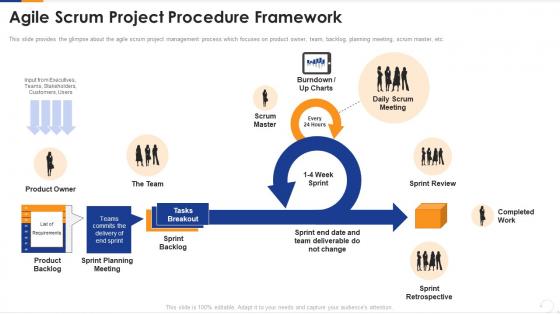
This slide provides the glimpse about the agile scrum project management process which focuses on product owner, team, backlog, planning meeting, scrum master, etc.
People who downloaded this PowerPoint presentation also viewed the following :
Agile scrum project procedure framework ppt infographic template rules with all 6 slides:
Use our Agile Scrum Project Procedure Framework Ppt Infographic Template Rules to effectively help you save your valuable time. They are readymade to fit into any presentation structure.





FAQs for Agile scrum project procedure framework ppt
The Agile Scrum Framework's core principles include iterative development, collaborative teamwork, customer-focused delivery, adaptive planning, and continuous improvement through regular retrospectives. These principles streamline project management by enabling faster response to changes, enhancing team communication, and delivering working solutions incrementally, with many organizations finding that this approach significantly reduces project risks while accelerating time-to-market.
Product Owners define priorities and requirements, Scrum Masters facilitate processes and remove impediments, while Development Teams build and deliver working software increments. These distinct roles create accountability through separation of concerns, with Product Owners focusing on what gets built, Scrum Masters ensuring how work flows smoothly, and Development Teams executing delivery, ultimately enabling faster product iterations and clearer stakeholder communication.
The key Scrum artifacts include Product Backlog, Sprint Backlog, and Product Increment, which provide transparency and inspection opportunities throughout development cycles. These artifacts streamline project visibility by defining requirements, tracking sprint progress, and delivering working software incrementally, with many development teams finding that this structured approach ultimately enhances collaboration and accelerates time-to-market delivery.
Scrum adapts to remote environments through enhanced digital communication tools, structured virtual ceremonies, and stronger documentation practices, while maintaining its core iterative principles. Remote teams leverage collaborative platforms for daily standups, sprint planning, and retrospectives, with many distributed organizations finding that clear communication protocols and time zone considerations actually strengthen their sprint discipline and deliverable transparency.
Effective Scrum backlog management strategies include regular grooming sessions, priority-based ranking using frameworks like MoSCoW, user story decomposition, stakeholder collaboration, and continuous refinement based on feedback. These approaches streamline development workflows by maintaining clear priorities, reducing scope creep, and ensuring alignment with business objectives, with many development teams finding that structured backlog practices ultimately deliver faster iterations and enhanced product quality.
Scrum ceremonies enhance team collaboration by establishing structured communication touchpoints, aligning priorities, and creating transparency across development cycles. Sprint Planning ensures shared understanding of goals, Daily Stand-ups facilitate quick problem-solving and coordination, while Sprint Reviews gather stakeholder feedback, ultimately delivering improved project visibility and faster iteration cycles for development teams.
**INPUT**: What metrics can be used to measure a Scrum team's performance and productivity? **OUTPUT**: Key Scrum performance metrics include velocity, sprint burndown charts, cycle time, lead time, and team satisfaction scores. These measurements enable organizations to track delivery consistency, identify bottlenecks, and enhance predictability, with many development teams finding that combining quantitative data with qualitative insights ultimately delivers improved sprint planning and sustained productivity gains. [Word count: 54 words]
Sprints differ from traditional project management by using fixed, short timeframes (typically 1-4 weeks) with defined deliverables, compared to longer, sequential phases in waterfall approaches. While traditional timelines follow rigid, predetermined schedules that can span months, Sprints enable iterative development, continuous feedback, and adaptive planning, with many organizations finding that this approach delivers faster value to customers and reduces project risks.
Organizations transitioning to Scrum often encounter resistance to cultural change, difficulty abandoning traditional hierarchical structures, challenges in redefining roles and responsibilities, and initial productivity dips during the learning curve. While these obstacles present implementation hurdles, many companies find that investing in comprehensive training, fostering cross-functional collaboration, and maintaining leadership support ultimately delivers enhanced team autonomy, faster delivery cycles, and improved adaptability in increasingly dynamic market conditions.
Teams mitigate Scrum risks through regular sprint retrospectives, daily standups for early issue identification, maintaining prioritized product backlogs, and conducting thorough sprint planning sessions. These practices enable proactive problem-solving, enhanced team communication, and adaptive resource allocation, with many organizations finding that consistent risk assessment throughout sprints ultimately delivers improved project outcomes and reduced delivery uncertainties.
Stakeholder engagement in Scrum ensures alignment between development teams and business objectives, facilitating continuous feedback, clear requirement communication, and rapid adaptation to changing needs. Through regular sprint reviews, stakeholder input, and product owner collaboration, organizations streamline decision-making, minimize costly revisions, and ultimately deliver products that meet market demands while maintaining competitive advantage.
Scrum integrates with Kanban through "Scrumban," combining Scrum's structured sprints and ceremonies with Kanban's continuous flow and visual workflow management. This hybrid approach enables teams to maintain sprint planning and retrospectives while leveraging Kanban boards for real-time task visualization, ultimately delivering enhanced flexibility and improved project transparency across development cycles.
Continuous improvement drives Scrum's effectiveness through regular retrospectives, sprint reviews, and daily standups that identify optimization opportunities. These ceremonies enable teams to refine processes, address blockers, and enhance collaboration iteratively, with many organizations finding that this systematic approach to improvement delivers faster delivery cycles, higher quality products, and improved team performance.
**INPUT**: How can a Scrum team effectively handle changes in project scope during a Sprint? **OUTPUT**: Scrum teams handle mid-Sprint scope changes through transparent communication with the Product Owner, immediate impact assessment, and strategic Sprint Goal evaluation. While the current Sprint typically remains protected to maintain focus and delivery commitments, teams can negotiate scope adjustments, defer non-critical items to the backlog, and use retrospectives to improve change management processes, ultimately delivering consistent value while maintaining team velocity. **Word count: 60 words**
Popular Scrum tools include Jira, Azure DevOps, Trello, Monday.com, and ClickUp for comprehensive project management and sprint tracking. These platforms streamline backlog management, facilitate daily standups, and enhance team collaboration through real-time updates, while many organizations find that integrated reporting features significantly improve sprint retrospectives and stakeholder communication.
-
Understandable and informative presentation.
-
Perfect template with attractive color combination.