

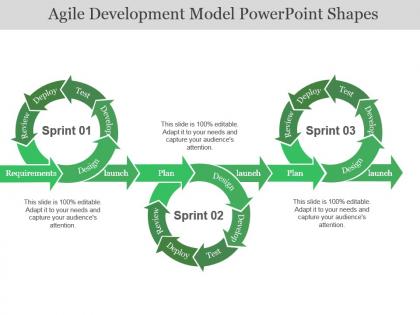
Agile development model powerpoint shapes




Try Before you Buy Download Free Sample Product
 Impress Your
 Audience
 100%
100% Editable
 Save Hours
 of Time


Our Agile Development Model Powerpoint Shapes are topically designed to provide an attractive backdrop to any subject. Use them to look like a presentation pro.
People who downloaded this PowerPoint presentation also viewed the following :
Agile development model powerpoint shapes with all 5 slides:
Use our Agile Development Model Powerpoint Shapes to effectively help you save your valuable time. They are readymade to fit into any presentation structure.




FAQs for Agile development
Agile development principles include customer collaboration, responding to change, working software delivery, and individuals over processes. These principles streamline project management by emphasizing iterative development, continuous feedback, and adaptive planning, with many software teams and organizations finding that this approach delivers faster time-to-market, enhanced product quality, and improved stakeholder satisfaction.
Agile differs from traditional project management through iterative development cycles, flexible scope management, continuous stakeholder collaboration, and adaptive planning versus rigid sequential phases. While traditional methodologies like Waterfall emphasize comprehensive upfront planning and documentation, Agile enables faster product releases, enhanced customer feedback integration, and improved risk mitigation, with many software development teams finding significantly reduced time-to-market.
The most popular Agile frameworks include Scrum, Kanban, Lean, Extreme Programming (XP), and Scaled Agile Framework (SAFe). These methodologies streamline project management by enhancing team collaboration, accelerating delivery cycles, and improving adaptability to changing requirements, with many organizations finding that strategic framework selection ultimately delivers faster time-to-market and increased operational efficiency.
Teams effectively implement Scrum through structured sprints, daily stand-ups, sprint planning sessions, retrospectives, and clearly defined roles like Scrum Master and Product Owner. This framework enables organizations to deliver iterative value while maintaining flexibility, with many software development teams, financial services firms, and healthcare organizations finding that regular ceremonies and cross-functional collaboration ultimately streamline project delivery and enhance customer responsiveness.
User stories serve as the primary communication tool in Agile development, capturing requirements from the user's perspective to guide feature development, prioritization, and sprint planning. These narrative-driven requirements enable development teams to maintain user focus while facilitating collaboration between stakeholders, product owners, and developers, ultimately delivering more relevant solutions and faster iteration cycles.
Agile enhances team collaboration through daily stand-ups, cross-functional teams, iterative planning sessions, and continuous feedback loops that promote transparency and shared accountability. These structured touchpoints streamline communication by breaking down silos, enabling real-time problem-solving, and fostering collective ownership, with many development teams finding that regular interactions ultimately deliver faster project outcomes and stronger team cohesion.
Common challenges include resistance to cultural change, inadequate training and communication, unrealistic expectations, lack of management support, and difficulty scaling across large organizations. These obstacles often emerge in traditional enterprises transitioning from waterfall methodologies, with many companies finding that addressing team dynamics, stakeholder alignment, and iterative planning processes ultimately delivers smoother implementations and enhanced project outcomes.
Agile accommodates changing requirements through iterative development cycles, continuous stakeholder feedback, and flexible sprint planning that allows for regular course corrections. This adaptive framework enables development teams to pivot quickly based on market demands, user feedback, and evolving business priorities, ultimately delivering products that better align with actual customer needs and competitive positioning.
Agile project success metrics include velocity, sprint burndown rates, cycle time, defect density, customer satisfaction scores, and team productivity indicators. These measurements enable organizations to track delivery speed, quality consistency, and stakeholder value, with many software development teams finding that combining quantitative performance data with qualitative feedback ultimately delivers enhanced project transparency and continuous improvement opportunities.
The Product Owner is crucial in Agile development, serving as the primary liaison between stakeholders and development teams, defining product vision, prioritizing backlogs, and ensuring deliverables align with business objectives. This role streamlines decision-making processes, reduces miscommunication, and accelerates product iterations, with many software companies finding that strong Product Owners ultimately deliver higher customer satisfaction and competitive market positioning.
Agile project management tools include Jira, Scrum boards, Trello, Azure DevOps, and Asana, which streamline sprint planning, backlog management, and team collaboration. These platforms enhance project visibility by automating workflow tracking, facilitating real-time communication, and enabling seamless integration across development cycles, ultimately delivering faster project completion and improved team productivity.
Agile practices can be scaled through frameworks like SAFe, LeSS, and Scrum of Scrums, which coordinate multiple teams while maintaining iterative principles. These approaches enable large organizations to streamline cross-functional collaboration, enhance product delivery cycles, and maintain customer focus across departments, with many enterprises finding that structured scaling delivers faster innovation and improved market responsiveness.
Iterative development enables Agile teams to deliver working software incrementally, gather continuous feedback, and adapt quickly to changing requirements throughout the project lifecycle. This approach significantly reduces project risks, accelerates time-to-market, and enhances product quality, with many organizations finding that iterative cycles ultimately deliver greater customer satisfaction and competitive advantage.
Agile teams manage backlogs through regular refinement sessions, sprint planning, stakeholder feedback integration, and continuous prioritization based on business value. These practices enable teams to adapt quickly to changing requirements, eliminate outdated tasks, and focus on high-impact deliverables, with many organizations finding that structured backlog management significantly enhances product quality and delivery speed.
Best practices for conducting Agile retrospectives include setting clear objectives, creating psychological safety, gathering diverse feedback, focusing on actionable improvements, and maintaining regular cadence. These approaches enhance team collaboration by encouraging honest reflection, identifying process bottlenecks, and implementing incremental changes, with many development teams finding that structured retrospectives ultimately deliver faster delivery cycles and improved product quality.
-
Visually stunning presentation, love the content.
-
Good research work and creative work done on every template.
-
Awesome presentation, really professional and easy to edit.