


Agriculture Proposal Template Powerpoint Presentation Slides





Try Before you Buy Download Free Sample Product
 Impress Your
 Audience
 100%
100% Editable
 Save Hours
 of Time


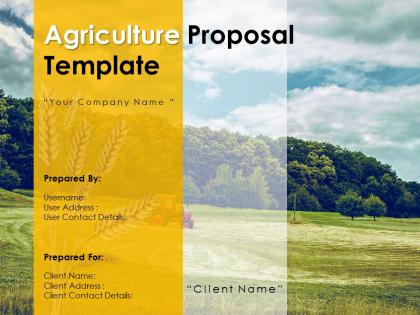
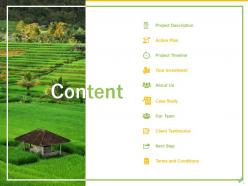
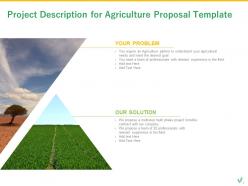
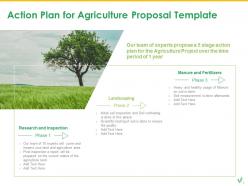
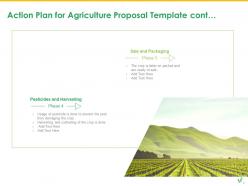
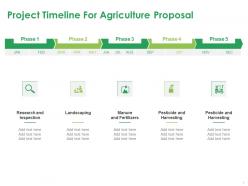
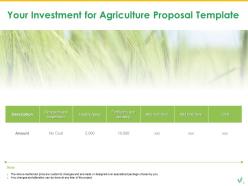
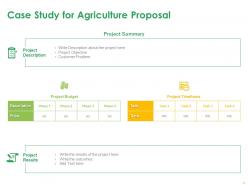
Agriculture plays a vital role in our lives as planting foods and flowers requires a lot of patience & hard work. There are various methods undertaken to promote agriculture services and their development. The agricultural department mainly focuses on producing high-quality agricultural products. Increasing food availability across the country is the main objective of this department. To enhance the productivity of food materials, it is important to collaborate with the best suppliers who offer advanced agricultural services. Organize the agricultural needs of your clients by using our topic-specific Agriculture Proposal Template PowerPoint Presentation Slides. With the aid of this outwardly engaging agricultural service proposal PPT layout, you can design an impressive proposal that grabs the attention of your clients. The slide contains a project description section where you can showcase the solutions your company has offered to the client’s problem. You can also highlight your five-stage action plans such as research & inspection, landscaping, manure & fertilizer, pesticides & harvesting, and sale & packaging. Use this eye-catching agriculture proposal presentation template to explain how much time your experts need to complete these phases. Employ our creatively designed agriculture proposal PowerPoint theme to provide a clear description of your services and their cost price to the clients. This will give them an idea of how much they have to invest in your proposed services. You can encompass your document with the various agricultural activities that are used in growing the crops. The slide comes up with ample space where you can add the logo of your company that helps you to stick to your brand’s identity. Use this interactive agriculture proposal PowerPoint theme and talk about the hard work and skills of your professional team that assists your clients in finishing their project. Download our ready-to-use agriculture proposal PowerPoint presentation template and turn your prospects into clients.
People who downloaded this PowerPoint presentation also viewed the following :
Agriculture Proposal Template Powerpoint Presentation Slides with all 23 slides:
Use our Agriculture Proposal Template Powerpoint Presentation Slides to effectively help you save your valuable time. They are readymade to fit into any presentation structure.



FAQs for Agriculture Proposal Template
So for your agriculture proposal, start with a killer executive summary - that's what grabs them. Then you need the obvious stuff: project overview, problem statement, your methodology, timeline, and expected outcomes. Budget breakdown is huge - be super detailed with equipment, labor, materials, overhead costs. Sustainability impact is basically mandatory now, funders eat that up. Also throw in your team's qualifications and how you'll measure if this thing actually works. Risk assessment too, though honestly that part's kinda boring. Most importantly, show how it helps local farmers or pushes agricultural knowledge forward somehow.
Dude, visuals are a game changer for agriculture proposals. People skim everything these days, so charts showing yield data or maps of your land use instantly grab attention. Before/after photos work great too. Break down costs with infographics - way easier than forcing people through paragraphs of numbers. I'd throw in maybe 2-3 solid visuals that actually back up your main points. Timeline graphics are clutch for showing implementation phases. Oh, and make sure they don't look like garbage - quality matters when you're asking for money.
For your farm financing pitch, grab historical yield data from similar local projects - that's your baseline credibility right there. Soil metrics matter big time: pH levels, nutrients, organic content. Weather data's equally crucial - rainfall patterns, temps, growing season length. Water access can honestly make or break the whole thing, so nail down irrigation capacity early. Oh, and don't forget market price projections to show actual revenue potential. Funders will absolutely verify your sources, so stick with recent, solid data. The climate stuff especially - they're getting pickier about that lately.
Okay so here's the thing - you've gotta totally change your approach depending on who's reading it. Investors? Hit them with ROI numbers and market size right away. They want to see money first, then maybe the feel-good stuff. But government agencies are completely backwards from that - they need to see environmental impact and community benefits upfront because that's literally what gets their budgets approved. I made this mistake with my first USDA proposal and it basically read like I was asking venture capitalists for funding lol. Also switch up your vocab - don't say "stakeholder value" to agencies, call it "public benefit." Really though, just research what each group actually wants and lead with that from sentence one.
Look, sustainability isn't just trendy anymore - it's literally make-or-break for getting funded. Funders are completely obsessed with it right now. You've gotta show how your project tackles environmental stuff: soil health, water conservation, cutting back on chemicals. Even old-school farmers are jumping on this bandwagon now, which honestly surprised me at first. Don't just throw sustainability into one random section either. Weave it through everything - your methods, your goals, how you'll track results. Show specific practices you'll actually use. Trust me, reviewers can spot the proposals where people just slapped on a "green" paragraph at the end.
Make a separate "Innovation & Technology" section that shows off whatever cool tech or new methods you're using. Could be precision ag tools, sustainable stuff, data solutions - anything that makes you different from regular farming. Don't just throw out a tech list though. Explain how each thing actually makes your project better or more efficient. Honestly, funders see so many boring proposals that anything genuinely innovative catches their eye. Add numbers or examples if you've got them. The whole point is proving this isn't just another standard farm project but something that actually moves things forward.
Organize your budget into sections - personnel, equipment, supplies, overhead. That way funders see exactly where money goes. Add 10-15% extra because stuff always costs more than you think it will. Get quotes for expensive items and show how you calculated everything. Oh, and make sure each budget line connects to actual project activities - reviewers need to see that link. Don't skip indirect costs if they're allowed either. Honestly, the more detailed you are upfront, the less explaining you'll have to do later.
Don't just stick all your case studies in one boring section - spread them around. Open with a killer success story to hook them right away. Then back up your main points with real examples that have actual numbers. Like "Farm X boosted yield by 30%" - way better than some fluffy statement. Pick cases that mirror their situation as much as possible. Oh, and throw in a challenge you solved too, not just the wins. Makes you look honest instead of too-good-to-be-true. Wrap each example by connecting it directly to their project.
Look into three things: what's the actual demand for your crops, pricing over the last few years, and who you're competing against locally. Investors want real numbers, not just your hunch about market potential. USDA reports are clutch for this - seriously, they have everything. Also hit up your agricultural extension office for regional data. You'll need market size and growth projections too. Oh, and don't skip identifying your customers and how you'll actually get products to them. The whole point is proving you get both the good and bad sides of your market.
Don't just shove all the tech stuff into one boring section. Pick 2-3 trends that actually fix their problems - like IoT sensors or drone monitoring. Then get specific with examples. GPS tractors cut costs 15% for another farm? Show them that. A simple timeline visual works great too, btw. Connect every trend to real numbers they care about - more yield, less labor costs, whatever moves the needle for them. Honestly, most proposals fail because they list fancy tech without proving it'll make money. ROI is everything here.
Honestly, risk management can make or break your agriculture proposal. Build a risk matrix covering weather disasters, market swings, pests, equipment breakdowns - the usual suspects that love to mess with farms. Map out how you'll handle each scenario. Always pad your budget for surprises because trust me, there will be surprises. Look into crop insurance, backup suppliers, maybe diversify your plantings. The goal is proving you've actually thought this through without sounding like you're expecting the apocalypse. Funders want to see you're prepared, not paranoid.
You absolutely need solid, measurable outcomes or your ag proposal is toast. Instead of saying "improve farming efficiency," go with something concrete like "increase crop yield by 15%" or "reduce water usage by 200 gallons per acre." Funders hate vague promises - they want numbers they can actually point to later. I'd pick 3-5 key metrics that tie directly to your main goals, then structure everything around proving you can hit those targets. Honestly, I've watched really good projects get rejected just because their outcomes were too fuzzy. Numbers sell proposals.
Dude, the infrastructure stuff will mess you up if you're not careful - power cuts, terrible roads, zero cold storage. Financial projections need way bigger safety margins since those markets swing wild. Regulations change constantly too, and each region's got its own weird rules. Honestly, the partnership thing is make-or-break though. You can't just show up with some cookie-cutter Western plan and expect it to work. Oh, and document everything about local conditions and cultural stuff in your proposal. Risk mitigation strategies are non-negotiable here.
So here's what I'd do - pick specific climate risks hitting your area first. Drought, crazy weather, whatever's actually happening there. Then show how your project tackles those exact problems with smart farming practices or tougher crops. Honestly, climate sections can get super dense and boring if you're not careful. Focus on current impacts plus what's coming down the road, but back it up with solid data. The key is connecting your solution to results funders can actually measure. Don't make them guess how you'll build climate resilience - spell it out clearly.
Pick metrics that actually matter to your funders - yield bumps, cost savings, water/fertilizer efficiency. ROI and payback period are huge since that's what investors obsess over. Adoption rates work great if you're rolling out new tech or methods. Soil health and environmental stuff like carbon reduction can be solid additions too, depending on your audience. Honestly, less is more here - stick to maybe 5-7 key metrics instead of overwhelming everyone with spreadsheets. Set clear baselines and targets for each one so progress is super obvious. The environmental angle is getting more important these days, which is cool.
-
Visually stunning presentation, love the content.
-
Colors used are bright and distinctive.
-
Excellent design and quick turnaround.
-
Design layout is very impressive.
-
Structure of the presentation is very good. Good use of colors.