


Approval Matrix Showcasing Responsibilities Scope And Change Approval




Try Before you Buy Download Free Sample Product
 Impress Your
 Audience
 100%
100% Editable
 Save Hours
 of Time


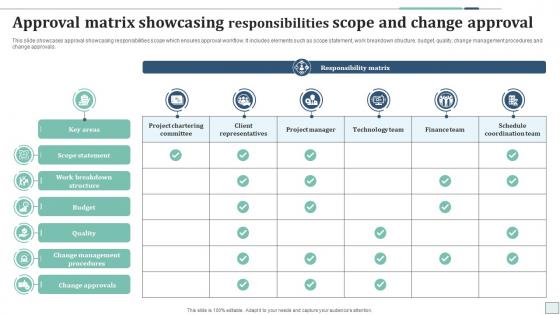
This slide showcases approval showcasing responsibilities scope which ensures approval workflow. It includes elements such as scope statement, work breakdown structure, budget, quality, change management procedures and change approvals.
People who downloaded this PowerPoint presentation also viewed the following :
Approval Matrix Showcasing Responsibilities Scope And Change Approval with all 9 slides:
Use our Approval Matrix Showcasing Responsibilities Scope And Change Approval to effectively help you save your valuable time. They are readymade to fit into any presentation structure.









FAQs for Approval Matrix Showcasing Responsibilities Scope
An approval matrix is a structured framework that defines who has authority to approve specific decisions, expenditures, or project phases based on predetermined criteria like budget thresholds, risk levels, and organizational hierarchy. It streamlines project workflows by eliminating bottlenecks, ensuring accountability, and maintaining compliance, with many organizations finding that clear approval pathways accelerate decision-making while reducing costly delays and miscommunications.
An approval matrix streamlines team decision-making by defining clear approval hierarchies, establishing spending thresholds, automating routine decisions, and reducing bottlenecks through predetermined workflows. This structured approach enables faster project approvals, minimizes delays in procurement processes, and enhances operational efficiency, with many organizations finding that teams can focus on strategic initiatives rather than navigating unclear approval pathways.
Key components include approval levels based on transaction amounts, designated approvers for each organizational level, clear escalation pathways, defined timeframes for decisions, and segregation of duties to prevent conflicts. These elements work together by establishing transparent decision-making processes, reducing bottlenecks, and ensuring appropriate oversight, with many organizations finding that well-structured matrices significantly enhance operational efficiency while maintaining robust financial controls.
Approval matrices vary significantly across industries, with marketing typically requiring creative review stages, brand compliance checks, and campaign budget approvals, while finance emphasizes regulatory compliance, risk assessment levels, and monetary thresholds. These industry-specific frameworks streamline decision-making by incorporating sector requirements, compliance standards, and stakeholder hierarchies, ultimately delivering faster approvals and reduced operational risks.
**INPUT**: What tools or software can assist in developing and managing an approval matrix? **OUTPUT**: Approval matrix management tools include workflow automation platforms like Monday.com, process mapping software such as Lucidchart, ERP systems, document management solutions, and specialized approval workflow applications. These technologies streamline authorization processes by automating routing, tracking approval status, and maintaining audit trails, with many organizations finding that integrated solutions significantly reduce processing times while enhancing compliance oversight. **Word count: 60 words**
An approval matrix mitigates risks by establishing clear authorization levels, defining accountability chains, and ensuring regulatory compliance through systematic review processes. By requiring appropriate stakeholders to validate decisions at each project stage, organizations streamline operations while maintaining oversight, ultimately reducing financial exposure and compliance violations across departments.
Organizations should avoid creating overly complex hierarchies, failing to define clear approval thresholds, and neglecting regular matrix updates as roles evolve. Many companies find that unclear escalation paths, excessive approval layers, and inadequate staff training significantly slow decision-making, while successful implementations focus on streamlined processes, defined dollar limits, and regular reviews to maintain operational efficiency.
Stakeholder identification ensures approval matrices include all relevant decision-makers, budget holders, subject matter experts, and process owners who impact project outcomes. Proper identification prevents bottlenecks, reduces delays from missed approvals, and establishes clear accountability chains, with many organizations finding that comprehensive stakeholder mapping ultimately streamlines workflows and enhances operational efficiency.
An approval matrix enhances team accountability by clearly defining decision-making responsibilities, establishing transparent approval hierarchies, and creating documented audit trails for all authorization processes. This structured approach enables team members to understand their specific roles and limits, while managers can track decision patterns and identify bottlenecks, ultimately delivering improved oversight and faster resolution of accountability issues.
Visual presentation techniques enhance approval matrix clarity by incorporating color coding for different approval levels, hierarchical flowcharts showing decision pathways, and clear role-based icons or symbols. These design elements streamline understanding by eliminating confusion around authority levels, reducing processing time for decision-makers, and ensuring consistent interpretation across departments, ultimately delivering faster approvals and improved operational efficiency.
Feedback plays a crucial role in identifying bottlenecks, outdated approval levels, and process inefficiencies within existing matrices, enabling organizations to optimize workflows and decision-making hierarchies. Through regular stakeholder input and performance analytics, companies streamline approval processes, reduce delays, and enhance operational efficiency, with many finding that continuous refinement ultimately delivers faster project execution and improved organizational agility.
Organizations adapt approval matrices for remote work by implementing digital approval workflows, establishing clear virtual escalation paths, and integrating cloud-based authorization systems with real-time notifications. These technologies streamline decision-making by enabling mobile approvals, automated routing, and transparent tracking, with many companies finding that digital matrices actually accelerate approval cycles while maintaining proper oversight and accountability across distributed teams.
Approval matrix complexity typically increases with project size and scope, requiring more stakeholders, approval levels, and decision points for larger initiatives. While smaller projects might need 2-3 approvers, enterprise-wide implementations often involve department heads, executives, and specialized reviewers, with many organizations finding that streamlined processes prevent bottlenecks while maintaining necessary oversight.
**INPUT**: What metrics can be used to evaluate the effectiveness of an approval matrix? **OUTPUT**: Approval matrix effectiveness metrics include processing time, approval bottlenecks, decision accuracy rates, compliance adherence, and cost per transaction. These measurements enable organizations to streamline workflows, reduce delays, and enhance operational efficiency, with many financial institutions and manufacturing companies finding that tracking these indicators ultimately delivers faster decision-making and improved resource allocation. [Word count: 54 words]
Incorporating a digital approval process significantly enhances approval matrix efficiency by automating routing, eliminating paper bottlenecks, and providing real-time tracking capabilities. Digital systems streamline decision-making workflows through instant notifications, parallel processing, and automated escalations, with organizations across banking and healthcare finding that approval times decrease by 60-80% while maintaining comprehensive audit trails.
-
SlideTeam is a great place for PPT templates. They have many templates on a single topic. It has made my life a lot easier.
-
What a stunning collection of customizable templates! Really a time-saver..