


Blockchain Technology Use Cases In Healthcare Industry Training Ppt





Try Before you Buy Download Free Sample Product
 Impress Your
 Audience
 100%
100% Editable
 Save Hours
 of Time


These slides in-depth cover how blockchain technology resolves multiple healthcare sector issues with single longitudinal patient records,master patient indices,claims adjudication,effective supply chain management,and interoperability.
People who downloaded this PowerPoint presentation also viewed the following :
Content of this Powerpoint Presentation
Slide 1
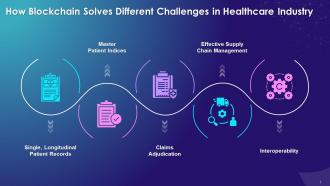
This slide illustrates issues that blockchain technology resolves in healthcare industry such as single, longitudinal patient records, master patient indices, claims adjudication, supply chain management, and interoperability.
Instructor’s Notes:
The multiple issues blockchain resolves in healthcare industry are as follows:
Single Longitudinal Patient Records:
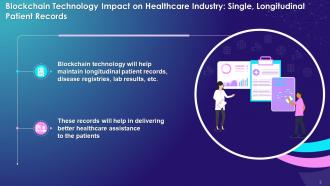
- Blockchain technology will help maintain longitudinal patient records, disease registries, lab results, etc.
- These records will help in delivering better healthcare assistance to the patients
Master Patient Indices:
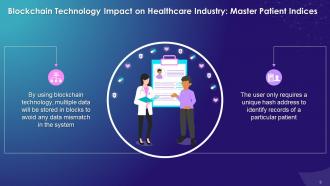
- By using blockchain technology, multiple data will be stored in the blocks to avoid any data mismatch or overlapping in the system
- The user only requires a unique hash address to identify the records of a particular patient
Claims Adjudication:
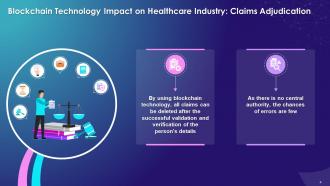
- By using blockchain technology, all claims can be delivered after the successful validation and verification of the person's details
- As there is no central authority, the chances of errors are few
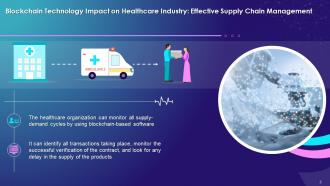
Effective Supply Chain Management:
- The healthcare organization can monitor all supply-demand cycles by using blockchain-based software
- It can identify all transactions taking place, monitor the successful verification of the contract, and look for any delay in the supply of the products
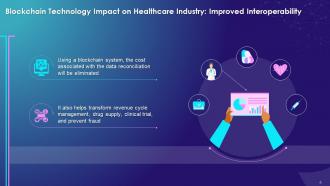
Interoperability:
- Using a blockchain system, the cost associated with the data reconciliation will be eliminated
It also helps transform revenue cycle management, drug supply, clinical trial, and prevent fraud
Slide 2
This slide highlights the impact of blockchain on healthcare industry with single, longitudinal patient records. It explains that with the help of blockchain, longitudinal patient records, disease registries, lab results are recorded. It helps in delivering better healthcare assistance to patients.
Slide 3
This slide highlights the impact of blockchain on healthcare industry with master patient indices. It explains that using of blockchain technology, multiple data will be stored in the blocks to avoid any data mismatch in the system. It also explains that users only requires a unique hash address to identify the records of a particular patient.
Slide 4
This slide highlights the impact of blockchain on healthcare industry with claims adjudication. It explains that
by using blockchain technology, all the claims can be delivered after the successful validation and verification of the person's details.
Slide 5
This slide highlights the impact of blockchain on the healthcare industry in supply chain management. It explains that healthcare organizations can monitor all supply-demand cycles using blockchain-based software. It also identifies all the transactions taking place, monitors the successful verification of the contract, and looks for any delay in the supply of the products.
Slide 6
This slide highlights the impact of blockchain on healthcare industry with interoperability. It explains that the cost associated with data reconciliation will be eliminated by using the blockchain system. It also helps in transforming revenue cycle management, drug supply, clinical trial, and prevents fraud.
Blockchain Technology Use Cases In Healthcare Industry Training Ppt with all 22 slides:
Use our Blockchain Technology Use Cases In Healthcare Industry Training Ppt to effectively help you save your valuable time. They are readymade to fit into any presentation structure.








FAQs for Blockchain Technology Use Cases In Healthcare
Honestly, blockchain's biggest wins in healthcare are pretty solid - you've got bulletproof data security and patients actually owning their medical records for once. No more of that ridiculous faxing situation we're somehow still dealing with. Interoperability gets way better since different providers can access the same secure records. Smart contracts can handle insurance claims automatically, and drug traceability helps catch counterfeit meds. Patients control who sees their data too, which is huge for research participation. My advice? Don't go crazy trying to revolutionize everything - pick one specific problem and pilot it first.
So blockchain basically makes this super secure ledger that can't be tampered with - like having multiple different locks on your data. Each time someone accesses patient info, it gets recorded permanently, so you'll always know who looked at what. The encryption is way stronger than regular databases too. What's cool is patients can actually control who sees their records through smart contracts. Though honestly, the tech can be a bit overhyped sometimes. My advice? Don't go all-in right away. Test it out with small pilot programs first before you commit to overhauling your whole system.
So basically blockchain acts like a universal translator for all these healthcare systems that usually can't talk to each other. Your hospital's records system and your doctor's clinic? They'll actually be able to share your info without the whole fax machine nightmare we're still dealing with in 2024 (seriously, why are we still faxing?). Smart contracts handle the data sharing automatically, and everyone works off the same ledger. No more phone tag between offices. I'd start by figuring out which systems in your network are the worst at sharing data - that's where you'll see blockchain make the biggest difference right away.
Honestly, you're gonna hit three big walls right away. Scalability is brutal - most blockchain networks just can't handle the crazy amount of healthcare data flowing through. Getting different systems to actually work together? Still a total mess. HIPAA compliance makes everything 10x harder than normal blockchain projects too. Implementation costs are pretty steep, and let's be real - a lot of healthcare staff aren't super comfortable with new tech. Oh, and don't even think about overhauling everything at once. Start small with one specific problem first.
Honestly, smart contracts are perfect for all that boring healthcare paperwork that takes forever. Insurance claims are a great example - right now you're waiting weeks for approvals, but a contract could verify coverage and pay out instantly once treatment's done. Super useful for appointment scheduling and prescription refills too. The best part? No more human screwups slowing everything down. I'd start by looking at whatever tasks your team does over and over again - that repetitive stuff is where you'll see the biggest impact. It's like having someone working 24/7 but they actually get things right the first time.
So blockchain basically gives you this tamper-proof record of everything - patient consent, data entries, protocol tweaks, all of it. Nobody can go back and mess with the data once it's logged, which is honestly a game-changer for clinical trials since they're always dealing with integrity issues. You can see exactly when stuff was entered and by who. Plus regulators love it because they can verify everything actually happened the way you say it did. Oh and if you're running multi-site trials, there are specific blockchain platforms built just for clinical research that might be worth checking out.
So blockchain basically creates this permanent record that follows drugs from the factory all the way to you. Can't be tampered with, which is pretty cool. Every step gets logged - where it's been, storage temps, expiration dates, all that stuff. Makes it way harder for fake meds to slip through since you can verify everything instantly. Plus recalls happen faster when something goes wrong. Honestly, the transparency aspect is probably the biggest win here. Companies like Walmart and Pfizer are already running pilots with this tech, so it's not just theoretical anymore. Worth checking out what they're doing if you want real examples.
Honestly, blockchain could be a game-changer for telemedicine security. Patient records would be tamper-proof and way easier to share between different doctors and platforms. All those remote health readings get locked into an unchangeable ledger, which is pretty cool for data integrity. Patients actually get real control over who sees their info too - finally! The downside? Most telehealth systems today just aren't ready for blockchain yet. It's still early days for this stuff. When you're looking at remote monitoring options, definitely ask about their security plans or if they're working on any blockchain partnerships.
So basically blockchain gives you this tamper-proof record of every single change to health data. Each transaction gets hashed and linked to the one before it - kinda like a digital chain that's spread across multiple computers. If someone tries to mess with a patient's file, you'd spot it right away because the hash wouldn't line up anymore. No single database to hack either, which is pretty smart. I'd honestly start with those permissioned blockchain systems built for healthcare - they're already set up for all the compliance stuff you'll need.
So blockchain basically creates this shared record that everyone - insurers, doctors, patients - can see at the same time. Claims get processed way faster since there's no arguing over what actually happened. Smart contracts can even trigger automatic payments when things get approved. The fraud prevention is honestly incredible because once something's on the blockchain, you literally can't change it. I mean, healthcare billing is such a mess right now anyway. If you're struggling with billing stuff, definitely watch for pilot programs starting up - could be a game changer for the worst parts of dealing with insurance.
So blockchain basically gives you control over your own health records instead of having them stuck at random hospitals. You get this digital wallet thing that holds everything - labs, prescriptions, scans, whatever. The best part? You decide who gets access. Need a new doctor? Just give them permission instead of waiting forever for records to transfer (seriously, why does that take weeks?). Everything's encrypted so nobody can mess with it. Oh, and check out MedRec or Patientory if you want to see how it actually works. Pretty cool stuff honestly.
Honestly, AI integration is going to be massive. Think blockchain protecting your medical data while AI spots patterns doctors might miss. Different hospital systems will finally start talking to each other - took long enough, right? Smart contracts should handle the boring stuff like insurance claims automatically. No more endless paperwork. Patients get real control over their records too through decentralized systems. I'd keep an eye on how big hospitals test this stuff first, since that's where you'll actually see it work in practice.
So basically, blockchain gives every medication this digital fingerprint that tracks it from factory to pharmacy. Each bottle gets its own "passport" you can actually verify. Pretty wild stuff, honestly. Fake drugs can't sneak in because they won't match the manufacturer's original digital signature - the system catches them right away. It's like having this bulletproof paper trail for meds. You should probably check if any pharma companies in your network are using these verification systems yet. My cousin works in supply chain and says it's becoming huge.
Honestly, the biggest headache you'll face is getting proper patient consent - like, what happens when someone's medical data is stuck on a permanent ledger forever? Then there's the whole access thing. Not everyone can afford or even understand blockchain tech, so you might accidentally create a system that leaves vulnerable people behind. Privacy gets weird too since patients usually have the right to delete their info, but blockchain doesn't really work that way. Oh, and depending on which network you use, the environmental impact can be pretty brutal. Just make sure people actually understand what they're signing up for and don't build something that makes healthcare less accessible.
So blockchain basically makes one shared database that all the healthcare people can access - doctors get full patient records while researchers get the anonymized stuff they need. No more waiting forever for data sharing paperwork (though let's be real, there'll still be some red tape). The cool part? Everyone's looking at the same verified info, so research is way more solid and doctors aren't missing half your medical history. Oh, and you don't have to deal with those annoying back-and-forth requests anymore. I'd say pick one collaboration that's currently a total mess and test it there first.
-
They helped us design the pamphlets for our church’s food drive! The people loved the design, and I’m happy to say it was successful. Thank you, SlideTeam!
-
SlideTeam is my one-stop solution for all the presentation needs. Their templates have beautiful designs that are worth every penny!