


Blockchain Technology for Social Media Training Ppt





Try Before you Buy Download Free Sample Product
 Impress Your
 Audience
 100%
100% Editable
 Save Hours
 of Time


This PowerPoint training module covers the applicability of blockchain to make social media platforms more decentralized. It covers the major concerns regarding centralized social media platforms, which are easy to hack, biased, and polarization. Further, it covers how blockchain helps create decentralized social media platforms with open-source code, decentralized control, and democratic decision-making. It also includes PPT slides on top blockchain-based social networks Fediverse, DeSo, and Mastodon. The PowerPoint module also has key takeaways, discussion questions, and MCQs related to the topic to make the training session interactive. It also includes additional slides on about us, vision, mission, goal, 30-60-90 days plan, timeline, roadmap, training completion certificate, energizer activities, detailed client proposal, and training assessment form.
People who downloaded this PowerPoint presentation also viewed the following :
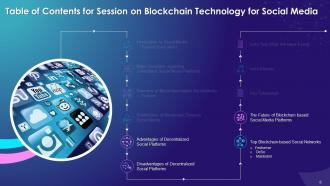
Content of this Powerpoint Presentation
Slide 4
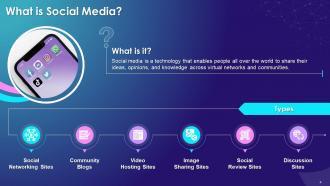
This slide defines social media technology and its various types such as social networking sites, community blogs, video hosting sites, image sharing sites, social review sites and discussion sites.
Instructor’s Notes:
What is it: Social media is an internet-based platform that gives people a platform to share personal details, documents, videos, and pictures digitally. People communicate with social media using web-based software or applications on a computer, tablet, or smartphone.
Types:
- Social networking sites: Facebook, Twitter, and LinkedIn are all social networking services that most people are familiar with. Friends, relatives, and brands can all be reached through these networks. These value intimate, human-to-human engagement and encourage knowledge sharing
- Community blogs: Community blogs are primarily websites where a large number of writers can post journal entries at a single location and where readers can respond to the posts by leaving comments on the blog
- Video hosting sites: YouTube is a major video hosting site that aids creators in bringing together content and sharing it on a platform that is suited for streaming. Because of its accessibility, video has become a very essential medium
- Image sharing sites: Images, animations, and drawings, capture our hearts, eyes, and imaginations. People create, curate, and share one-of-a-kind photos that can stimulate conversation
- Social review sites: Yelp and TripAdvisor, for instance, present evaluations from members of the public for a variety of destinations and activities. This eliminates a lot of the guesswork involved in making a restaurant or a hotel reservation
- Discussion sites: Reddit and Quora are two discussion sites that are expressly meant to start a conversation. Anyone can pose a question or express an opinion, which draws together, individuals’ similar interests and curiosities
Slide 5
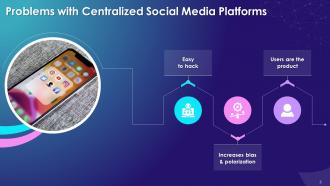
This slide illustrates three major problems pertaining to centralized social media platforms which are that these platforms are easy to hack, increase bias and polarization. The other major concern is that the users themselves are the product that such platforms work upon.
Instructor’s Notes:
- Easy to hack: When a corporation stores user data in a single location, any compromise of that system exposes massive amounts of data in one go. The question now appears to be when, rather than whether, a database will be hacked. Every corporation, every organization, and every individual is vulnerable
- Increases bias & polarization: A lot of us rely on our social media feeds for most of our news or connections to news stories. How our social media feeds display information is critical to our lives. Someone who is branded as a liberal will most likely view news stories vastly different from someone who is classified as a conservative. Occasionally, users do seek out biased news sources that support their point of view. To make a mindful decision to do so yourself is one thing; it's quite another to have your social media platform do it. What is even more of a concern is that this happens because its advertisers, which include media outlets, have recognized you as a specific type of person based on your likes and other information the platform has gathered, analyzed, and packaged about you
- Users are the product: Using centralized social media to link people is not a good idea. Advertisers aren't simply companies that want us to buy their products and services; they're also people who want us to think in a particular way about a political candidate or a social problem. Advertisers are the customer, and user data is the product, with centralized social media platforms like Facebook, Instagram, LinkedIn, Twitter, and YouTube
Slide 6
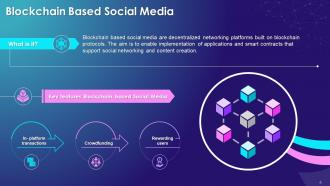
This slide introduces the concept of blockchain social media platforms which are decentralized and enable end-to-end encryption for every interaction.
Instructor’s Notes:
What is it: Since Blockchain social media platforms are decentralized, there is no central proprietary authority in-charge of all data. Rather, data is distributed across servers at each network node in a homogeneous and decentralized manner. These platforms support social networking, content sharing, and even blogging.
Slide 7
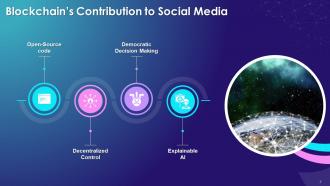
This slide lists solutions that blockchain brings to the problems in existing social media platforms. The solutions include open-source code, decentralized control, democratic decision making and explainable AI.
Instructor’s Notes:
- Open-source code: It is feasible to retain an open-source code using blockchain technology. This has the advantage of allowing you to inspect data algorithms
- Decentralized control: Blockchain technology allows the network to remove centralization. As a result, no single entity will be able to exert undue influence on the platform
- Democratic decision making: Everyone agrees that a democratic system is the best option. The adaptation of social media to a networked structure will actually allow this to happen
- Explainable AI: Incorporating blockchain into social networks and adopting explainable artificial intelligence (AI) could be a significant step forward in the digital transformation process. This system is capable of explaining the reasoning behind each decision
Slide 9
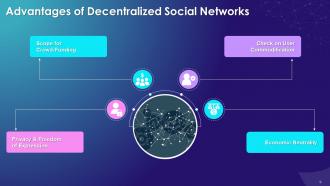
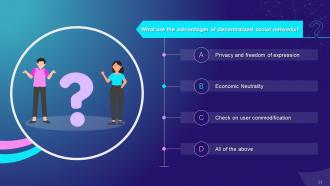
This slide illustrates the advantages of establishing a decentralized social network. The main features include privacy & freedom of expression, scope for crowdfunding, a check on user commodification, and economic neutrality.
Instructor’s Notes:
- Privacy & freedom of expression: Those in-charge of managing centralized social media sites have access to every activity, even private messages. This poses a severe threat to the users' privacy, among other things. Blockchain-based social media networks guarantee better anonymity and let users fulfill their right to express themselves freely thanks to its decentralized consensus methods.
- Scope for crowd-funding: Apart from non-monetary advantages, blockchain-based social media also provides material benefits. Users are rewarded for posting on most decentralized social networks. Like those in other blockchain ecosystems, such benefits are in the form of the network's native cryptocurrency. The process of using mechanisms comparable to token sales enables users to run effective crowdfunding campaigns.
- A check on user commodification: User data is currently one of the most profitable assets, and those who control data control data producers’ and consumers’ thinking, behavior, and other factors. Distributed social media systems eliminate the fear of user commodification due to their peer-to-peer connection, end-to-end encryption, and lack of third parties.
- Economic Neutrality: Economic neutrality is a must-have ideal for many people who use decentralized social networks. They want to be free of intrusive advertising and the risk it brings to their privacy. To keep operations running, they frequently employ a digital currency such as Bitcoin.
Slide 10
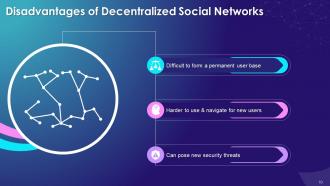
This slide talks about the disadvantages that decentralized social media platforms present. Some of the drawbacks include the difficulty to attract a permanent user base, maybe harder to navigate for new users, and the fact that it may give rise to new security threats.
Instructor’s Notes:
- Difficulty to form a permanent user base: These platforms will have a hard time attracting users' and developers' attention. Diaspora and FreedomBox, for example, had trouble establishing a long-term user base, and it's probable that new platforms will as well. Due to network effects, social networks, in particular, are difficult to bootstrap — we join these because our friends are there and not for ideological reasons such as decentralization
- Harder to use & navigate: Established social media sites have optimized their interfaces based on millions of user feedbacks, but new social media sites are typically tricky to navigate for new users
- Can pose new security threats: Decentralized networks, in general, enable anybody to join and do not associate accounts with real-world identities such as phone numbers. To ensure account security, these systems employ public-key cryptography. However, most users find managing public keys challenging, and developing software that is both cryptographically safe and easy to use is difficult
Slide 11
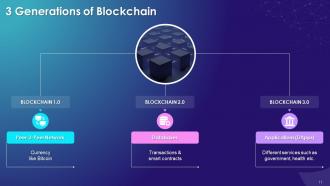
This slide depicts the 3 levels of blockchain, namely cryptocurrencies, smart contracts, and governance mechanisms.
Instructor’s Notes:
- Blockchain 1.0: Blockchain 1.0 enables financial transactions based on blockchain and is carried out using Bitcoin. This version is permissionless; thus, any participant can conduct a legitimate Bitcoin transaction. Currency and Payments are the most common applications
- Blockchain 2.0: Blockchain 2.0's most major contribution, heralded by the advent of Ethereum, is the creation of smart contracts, that are small computer programs that "live" in the blockchain. They are self-contained systems that perform autonomously under predetermined conditions, such as facilitating, verifying, or enforcing contract execution. Smart Contracts lower the cost of verification, implementation, arbitration, and fraud protection and allow for clear contract definition, which eliminates the issue of moral hazard
- Blockchain 3.0: The abbreviation DApp refers to a decentralized application that does not rely on centralized infrastructure. As it relies on decentralized storage and communication, most DApps execute their backend code on a decentralized peer-to-peer network, such as a blockchain
Slide 12
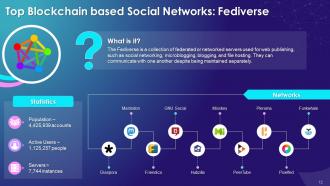
This slide presents the basic definition of Fediverse along with some statistics related to the number of accounts on it, the active users and servers. It also lists networks that are on the Fediverse such as Mastodon, Diaspora, Pleroma etc.
Slide 13
This slide explains DeSo, a decentralized social blockchain network.
Instructor’s Notes:
How does DeSo work?
- Token-based structure: DeSo is based on the Ethereum (ETH) blockchain and uses a token-based structure. This means that DeSo tokens can be traded between peers to pay for network microservices like content creation, tagging other users, commenting, and liking
- Token Curated Registries: These are the foundation of the DeSo Network. Token Curated Registries (TCRs) are lists that differ from ordinary lists in one crucial way. These give list members the ability to curate which items are allowed
Slide 14
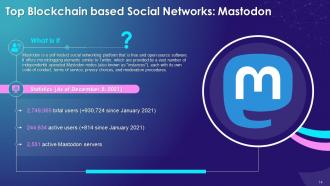
This slide introduces the decentralized social media platform, Mastodon. It tells us what it is and gives some general statistics such as the number of total users, active users and mastodon servers.
Slide 15
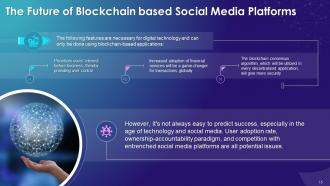
This slide gives us an overview about what could happen with the decentralization of social media with blockchain technology in the future. The challenges that it may face and the reasons why it may be adopted.
Slide 17
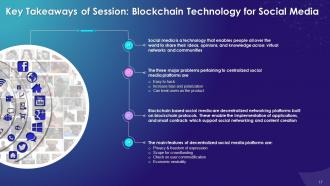
This slide lists key takeaways from this training session on blockchain-based social media.
Slide 35 to 49
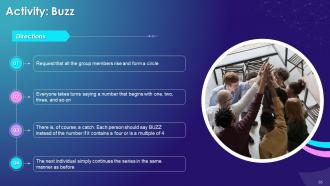
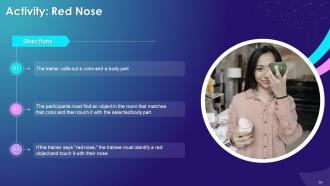
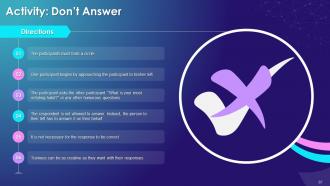
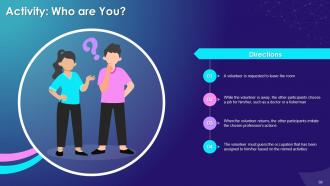
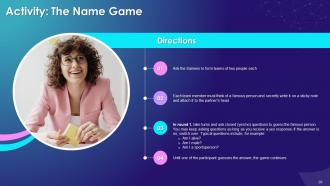
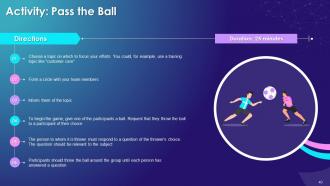
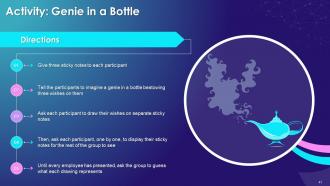
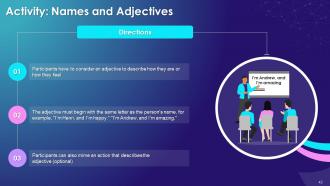
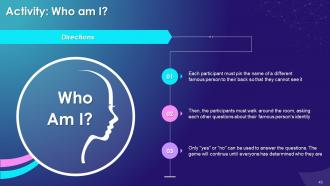
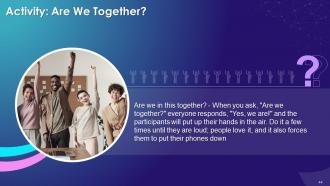
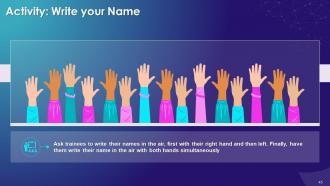
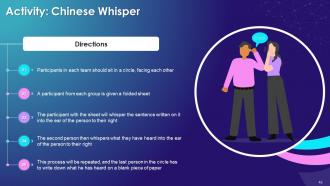
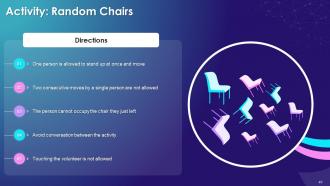
These slides depict energizer activities to engage the audience of the training session.
Slide 51 to 77
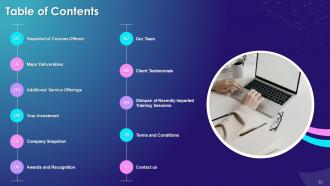
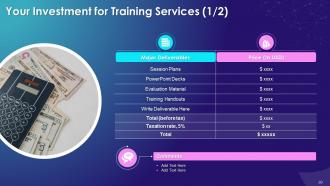
These slides consist of a client training proposal highlighting what the company providing corporate training can accomplish for the client.
Slide 78 to 80
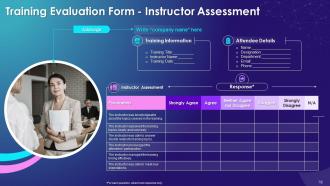
These slides highlight the training evaluation form for instructor, content, and course assessment.
Blockchain Technology for Social Media Training Ppt with all 85 slides:
Use our Blockchain Technology for Social Media Training Ppt to effectively help you save your valuable time. They are readymade to fit into any presentation structure.

















FAQs for Blockchain Technology for Social
So basically with blockchain social media, you actually own your stuff instead of just handing everything over to Meta forever. Your posts and data get tied to your wallet cryptographically - not sitting on their servers getting monetized without you seeing a dime. Wild how much we've already given away, honestly. The cool part? You can take your followers and content with you when switching platforms since it all lives on the decentralized network. I'd mess around with something like Lens Protocol first to get a feel for it.
Hey! So decentralized platforms are pretty interesting for fighting misinformation. Community governance lets multiple nodes verify content instead of just trusting one company's fact-checkers. Blockchain tech creates permanent records of edits and sources - though honestly, some of it still feels overly complicated. Your reputation builds based on accuracy, and bad actors get penalized. No single algorithm controlling what you see either. Mastodon's decent to try, or check out Lens Protocol. The trick is finding ones that don't sacrifice usability for decentralization.
Yeah so the biggest problem is speed and cost - you'll be waiting forever for stuff to load and paying crazy fees when traffic gets heavy. Like $5 just to like a post, which is honestly ridiculous. Most people also hate dealing with wallets and private keys and all that crypto stuff just to use what should be a simple app. Content is pretty sparse too since barely anyone's on these platforms yet. Classic catch-22 situation really. If you're gonna check any out, look for ones using layer-2 tech and easier sign-up processes.
Dude, blockchain social media is actually pretty cool - you own your data instead of Facebook hoarding it all. Your posts live on decentralized networks where you control everything. Wild that you can permanently delete things, right? No creepy companies tracking your every click to spam you with ads either. I've been messing around with Mastodon lately and it's refreshing honestly. Lens Protocol is another solid option. The whole thing's transparent too, so you can see exactly what's happening with your info instead of wondering what Mark Zuckerberg's doing with your vacation photos.
Okay so there's actually a bunch of ways to make money that regular platforms don't have. Fans can pay you directly in crypto, you can sell NFTs of your stuff, plus there's token rewards just for getting engagement. The best part? You're not losing like 30% to YouTube or whoever taking their cut. Some creators are doing this crazy thing where they launch their own tokens - basically fans can invest in you directly. Wild, right? Oh and the money usually comes from real engagement, not just having a million fake followers. Building an actual community matters way more than vanity metrics.
So basically crypto tokens are like the currency that runs these blockchain social media sites. You earn them by posting good stuff, commenting, getting upvotes - that kind of thing. Then you can spend them on boosting posts or getting into exclusive groups. What's kinda neat is you're not just scrolling mindlessly, you're actually making money from it. Oh, and the tokens let you vote on how the platform should change too. Honestly I'd say just try earning some first before you put any real cash in - see if you even like how it works, you know?
So basically you vote on platform stuff using tokens - kinda like owning stock but for social apps. More tokens or activity = bigger voice in decisions about moderation, features, that sort of thing. Way better than some tech bro calling all the shots, you know? Though it does mean rich people still get outsized influence, which... yeah, not ideal. You're actually helping build the platform instead of just scrolling mindlessly. I'd say jump into community chats first before diving into the voting stuff - get a feel for how things work.
Honestly? Steemit was the big winner early on - they pay creators in crypto which is pretty cool. Minds took a different approach, going all-in on free speech and letting users handle moderation themselves. Then there's Hive, which basically split off from Steemit when the community got fed up with governance drama. Here's what's wild though - they all hit the same wall. Turns out making something decentralized AND easy to use is really hard. People want those crypto rewards and can't-be-censored benefits, but they also don't want apps that feel clunky or broken. My take? Find platforms solving actual problems first. The blockchain stuff should make things better, not worse.
So basically everything you post gets locked into this permanent record - can't go back and sneakily edit or delete stuff later. It's like having receipts for every dumb thing you've ever said online lol. Smart contracts also let you see who actually owns your data and what they're doing with it, which is pretty cool. No single company can mess with algorithms or secretly hide your posts either since it's all decentralized. Oh and if you're checking out these platforms, definitely look at the transaction history to see what's really going on with posts.
Honestly, community-driven reporting is your best bet - get multiple users flagging stuff instead of one person making all the calls. Build reputation scores that track how people behave over time. Bad actors won't be able to do as much damage that way. Smart contracts can auto-limit accounts with crappy scores too. The whole free speech vs safety thing is messy though, since you can't just nuke posts like Facebook does. I'd say start with solid community guidelines from the beginning. Make sure your enforcement is transparent or people will lose their minds about it.
So blockchain lets your data move between platforms with universal standards - like having one passport that works everywhere instead of separate IDs for each social network. Your posts, followers, reputation? They follow you across different apps since everything's stored on shared protocols instead of locked-up silos. Honestly took me a while to get it, but it's pretty cool once you do. No more starting from scratch when switching platforms - your whole social graph transfers over. Check out Lens or Farcaster if you want to see how this actually works.
Dude, blockchain social media is totally flipping the script on how brands have to approach advertising. Users actually own their data now, so you can't just rely on those creepy targeted ads anymore. Brands need to build real communities instead - like actually rewarding people with tokens for participating or creating stuff that's genuinely useful. Honestly, it's way better than the current spam-fest we're stuck with. My advice? Start messing around with token loyalty programs now. Oh, and focus on community-first strategies because this change is happening whether companies like it or not. Better to get ahead of it, you know?
So blockchain basically lets marginalized creators own their stuff without big tech deciding what gets seen. No more algorithm nonsense or random shadowbans. Your content, followers, monetization - you control it all. Can't really get deplatformed when there's no single company calling the shots, which is huge. The whole transparency thing means you'll actually know if your posts are being buried. Honestly, traditional social media is such a mess for underrepresented voices. Check out Lens Protocol or Farcaster - they're solid alternatives worth exploring.
Honestly, blockchain regulation is a mess right now. GDPR's your biggest nightmare - how do you delete immutable data when Europeans demand it? Spoiler: you can't really. Content moderation rules vary everywhere, plus if you're doing tokens, securities laws might bite you. Cross-border stuff gets weird fast since every country has different rules. Oh, and definitely get a lawyer before you launch anything - I learned that one the hard way. Start by figuring out where your users are located and what content policies you'll actually need to follow.
Hide all the blockchain stuff behind normal social media buttons people already get. Handle wallets and gas fees in the background - users just see "post" and "like" buttons. It's like email, nobody cares about SMTP when they hit send. Start with a regular web2 feel, then slowly show off the cool blockchain perks once they're hooked. Power users can dig into advanced settings if they want, but honestly most people just want things to work without thinking about it. Progressive disclosure is your friend here.
-
SlideTeam just saved my project! Thank you so much. The variety of templates helped me showcase multiple perspectives easily.
-
This design is not only aesthetically pleasing but it has many uses making the cost worthwhile. The graphics look stunning, and you can edit them as per your needs.