

 0 Comment
 Customer Reviews

From high-yield billion-dollar buyouts to booming returns, private equity is undoubtedly a high-stakes game. But under the multi-dollar buyouts lies one important pillar: a meticulously crafted investment thesis. This guiding document directs deal teams, garners investor trust, and, above all, shapes a portfolio company’s journey into a shining success tale or a sobering cautionary tale.
The Growing Importance of Investment Thesis in Private Equity Strategy
Let’s take a quick look at the numbers.
As indicated in Bain and Company’s 2024 Private Equity Report:
- The available capital in Private Equity reached $3.7 trillion underscoring the necessity of competition in capital deal sourcing.
- 71% of managers claimed their deals were based on clearly defined investment theses instead of being purchased opportunistically.
- Those with a succinct Value Creation Thesis outperformed the competition with 2.5 times more Internal Rate of Return in a five-year period.
In modern markets, having a PE Investment Framework isn’t simply a good practice but rather a prerequisite for success.
To be fair, building an effective thesis from the ground up is a very time-consuming and perplexing endeavor. It is not a surprise why so many have turned to SlideTeam's PE Investment Thesis Templates, which seek to organize, visualize, and simplify complex tasks for the user.
Who Should Use These Templates?
SlideTeam’s PE Investment Thesis Templates can be used for a wide array of deal presentations and analyses, as they cater to diverse professionals working with private equity deals. From writing first drafts to proposing acquisition strategies to buyers, from building investment-grade decks to telling inspiring stories as founders, our private equity investment thesis templates are your one-stop shop!
Eager to sharpen the focus on your upcoming PE deal thesis? Let’s dive into these private equity investment thesis templates together.
Template 1: Strategies For Crafting A Compelling Investment Thesis In Private Equity PPT Outline
With this Presentation Template, you will not have any trouble capturing a coherent and compelling Investment Hypothesis for private equity. It allows practitioners to construct a substantiated deal rationale, effectively outline critical value drivers, and articulate a persuasive growth equity thesis.
It helps to achieve the objectives set by highlighting the understanding of the markets alongside granular financial details, improving decisions and analyses related to investments.
[product_image id=1420003]
Template 2: Investment Thesis Your Unique Proposition In Private Equity PPT Structure
This private equity Presentation Preset is created to help private equity practitioners communicate their distinctive investment opportunities effectively. It allows the articulation of strategic intent, financial goals, and how value will be created. Enhanced with slide frameworks for investment opportunity analysis, it guarantees comprehensive assessment including market opportunity, competitive landscape, and risk profile—ultimately sharpening the pitch and creating consensus amongst stakeholders through a sound, evidence-based, data-driven PE investment strategy.
[product_image id=1434283]
Template 3: Market Analysis for Investment Decisions
This PPT Slide offers a schematic for assessing changing trends in the market to aid decision-making for investments. It directs them in performing assessments on marketplace movements, industry trends, competition, and broader economic statistics with a sector investment focus approach. It organizes data concerning clientele, pace of development, and regulatory frameworks, which helps in recognizing opportunities with a great benefit and associated risks. It equips private equity groups to adjust spending to business objectives and manage portfolio investments to maximize shareholder value.

Template 4: Due Diligence Process in Private Equity
This PPT Slide captures the procedural steps of the due diligence process within private equity, detailing precisely how the investor moves from defining an investment strategy to compiling a report. It automates the analysis of the finances, risks, and compliance to aid decision-making. The illustration assists comprehension of the self-explanatory due diligence rationale, enabling the stakeholders to assess investment feasibility while validating the legal, financial, and strategic frameworks of the deal prior to closing.

Template 5: Common Pitfalls to Avoid
This Presentation Template outlines crucial mistakes that need to be avoided when creating a private equity strategy, such as overconfidence, poor due diligence, and inadequate exit strategies. The template helps enhance strategic decision-making, risk mitigation, and alignment with overarching goals. By recognizing these blunders, firms can reinforce their strategies, leading to more enduring and optimized investment results amid the challenges of the private equity sector.

Template 6: Market Analysis and Trends in Private Equity
This Presentation Template provides a graphical representation of private equity activity per sector along with investment and fundraising patterns, helping to analyze the sector's performance. It assists in making strategic decisions by exposing areas with growth potential and highlighting the sector’s performance. This chart aligns with investment screening criteria, enabling investors to understand industry focus, evaluate capital movement, and deploy data-based decisions to optimize portfolio value and market position.

Template 7: Valuation Methodologies in Private Equity Deals
This PPT Slide outlines primary valuation approaches in private equity deals, enabling stakeholders to analyze different models. It assists in selecting the appropriate approach depending on the deal specifics and integrates smoothly with a powerful value creation thesis. Understanding the merits and drawbacks of valuation gives investors insight to strategically pursue opportunities that amplify returns while keeping risk exposure to a minimum.

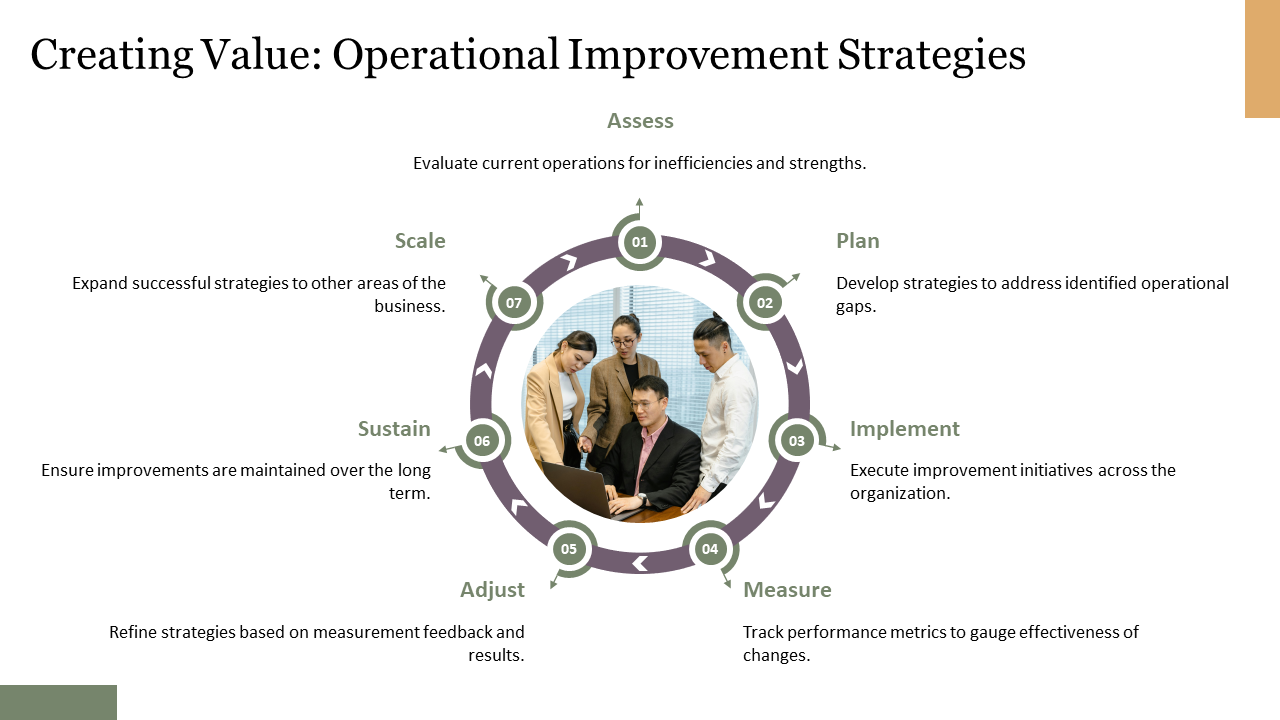
Template 8: Creating Value: Operational Investment Strategies
This PPT Slide describes a methodical approach to achieving operational improvements, beginning with an evaluation and culminating with strategic scaling across various functions. It allows companies to manage and refine business performance while ensuring all actions taken are aligned with overarching objectives. If accompanied by industry investment focus, it makes sure the strategies have relevance to a specific sector, thus increasing the efficacy and precision of operational improvements for private equity-sponsored companies.
Template 9: Exit Strategies: Planning for Return on Investment
This Presentation Template shows an exit strategy plan intended to optimize returns on private equity investments. It spans the entire cycle from acquisition to reinvestment, highlighting roadmaps for value creation, market timing, and exits. This PPT Slide ensures that every transition is strategic and profitable concerning the investor’s ROI goals by boosting operational efficiency, expanding market share, and courting ideal buyers.

Template 10: Fund Structuring and Capital Raising Strategies
This framework highlights various methods within the PE investment framework, providing insights on equity, debt, hybrids, and fees. It helps stakeholders devise a strategic approach to fund structuring and capital raising. The template shows private equity firms how various methods of fund-raising do have trade-offs, increasing the likelihood of making optimal decisions while directing resources intended for long-term investments and growth of the portfolio, which can be efficiently scaled.

Template 11: Legal and Regulatory Considerations in PE
This Presentation Template emphasizes crucial frameworks such as legal and regulatory considerations needed for developing a successful strategic acquisition thesis or growth equity thesis in private equity. It addresses all requirements: compliance, due diligence, taxation, reporting, and risk control, safeguarding and optimizing legality and litigation exposure for each acquisition or investment made. The inclusion of these elements enables stakeholders to drive decisions that promote growth, bolster the investment's lifecycle, and ensure that all actions and choices are legally defensible.

Lead the Pack with a Winning Thesis
As you prepare investment theses, problematic issues such as deal-dependent story-building, investor skepticism, format inconsistency, and slow prep times will spring up. This is where SlideTeam’s private equity investment thesis templates become an absolute game-changer.
Whether it is assembling your next pitch deck, deploying an analyst training session for Private Equity Strategy, or fostering a new cohort of analysts, SlideTeam ensures time is saved with consistent deliverables, giving you the freedom to evaluate deal terms and drive high post-acquisition performance.
PS:
FAQs on Capital Deployment Thesis
Q1. What is the core investment rationale behind the thesis?
Ans: The primary reasoning for the investment thesis includes accentuating the untapped potential opportunities in the market and considering how high performing they can be with qualitative and quantitative backing.
Q2. Which industry or sector is the primary focus?
Ans: The focus is mainly on the academic and research areas related to researchers, who require professionally designed and formatted thesis proposal templates.
Q3. How does the investment align with current market trends?
Ans: By focusing on high-growth industries like technology, renewable energy, and digital transformation, the investment aligns with today’s market trends. It also takes advantage of newly emerging consumer behavior and regulatory changes, guaranteeing relevance and the potential for substantial returns.