


Key investment highlights layout example of ppt





Try Before you Buy Download Free Sample Product
 Impress Your
 Audience
 100%
100% Editable
 Save Hours
 of Time


Designed with the best visual solutions in the industry, our key investment highlights layout example of PPT lets you build your presentation fast and with crystal clarity. And because entire slide graphics are vector based, highly customizable and instantly downloadable, the user can easily modify it. Irrespective of the industry or market you are in highlights layout PPT model is of great use to you, when you need to talk about the investment. The versatility of graphics and unique handling of the design further makes the key highlights PowerPoint infographic an aesthetic means to communicate the idea well. The slide visual is such that it gives you enough freedom to mold your ideas into most attention-grabbing illustration. Thus, by simply changing a slight amount of the designing elements and adding your own customized content the presenter is ready to impress his audience. So, you don't just make your audience marvel at you but also help them clearly comprehend your message. Colors come alive on our Key Investment Highlights Layout Example Of Ppt. They conjure up a fascinating blend.
People who downloaded this PowerPoint presentation also viewed the following :
Content of this Powerpoint Presentation
Businesses seeking funding sometimes encounter the challenge of capturing and maintaining investor interest. This situation happens because they don't have a reliable tool with them to perform effective storytelling.
Show the investment details of your e-commerce platform using our PowerPoint Template.
However, with a professional PowerPoint Template filled with robust data and visuals, you can set the stage to keep an investor engaged. Keeping this need in mind, SlideTeam has developed a PowerPoint Framework to turn raw data into professional investment narratives.
Our expert team has designed this PowerPoint Template with the intention of enhancing business communication with their clients about the investments. It provides a platform to present vital information that decision-makers should know. Furthermore, this presentation is fully customizable, which means you can input your desired content, have a different color palette, change your logo, adjust alignments, etc.
Share important investment details with our PowerPoint Layout.
With our expert-backed PPT Template, you can outline the potential for high growth within your market, show your differentiated business model, and highlight the strengths and incentives of your management team. Thus you can present a robust financial profile with strategies for long-term growth. Let’s analyze these PPT Slides in detail.
Template 1: Key Investment Highlights Layout
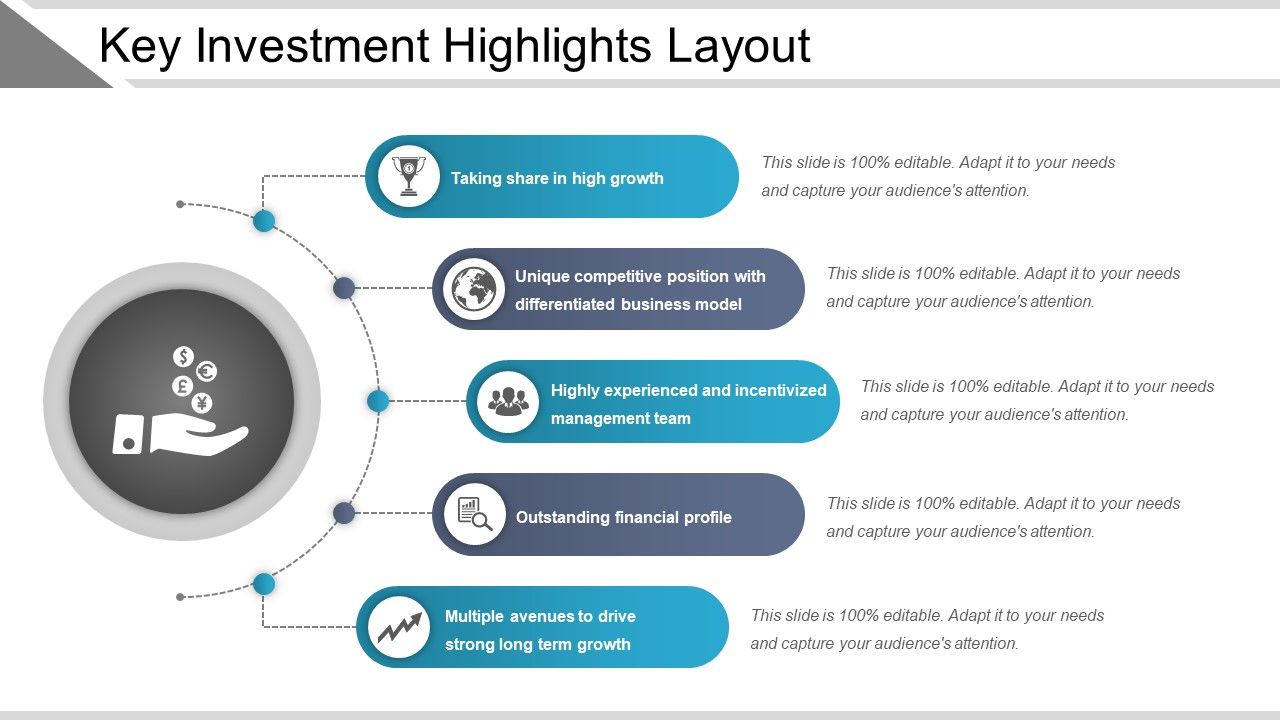
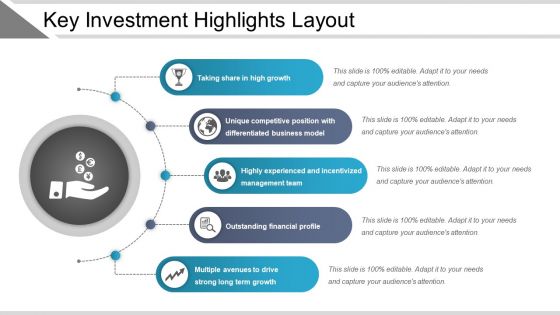
Show the strengths of your investment opportunities to potential stakeholders with our PowerPoint Template. In other words, use this presentation design to demonstrate the core advantages of your investment proposals. You can highlight important areas like your stake in high-growth markets and the unique competitive position driven by a differentiated business model. Moving further, it provides you ample space to display your expertise and incentives to your management team. Furthermore, you can show your outstanding financial profile and make several strategies for long-term growth.
Show Organized Investment with Our PowerPoint Layout
In conclusion, our PowerPoint Template is an important solution for any finance professional. They can win the trust of potential investors through it. Moreover, you can easily display various investment opportunities in an organized way so everybody can understand. You can focus on your strengths by leveraging this PowerPoint Layout.
PS: Display the main investment details with consistent cash flow using our PowerPoint Theme.
Key investment highlights layout example of ppt with all 5 slides:
Follow the guidelines with our Key Investment Highlights Layout Example Of Ppt. Your thoughts will acquire accurate alignment.

FAQs for Key investment highlights layout
Start with revenue growth - if that's not trending up consistently, major red flag. Then check profit margins to see how efficiently they're running things. ROE shows whether management actually knows what they're doing with investor money (spoiler: many don't). Debt-to-equity ratio is huge too. Companies can look profitable on paper but get crushed when the market turns if they've borrowed too much. I learned that one the hard way back in 2020. These four metrics give you the foundation before you dig into the weird industry-specific stuff.
Think of market trends as your timing guide - they show where momentum's going so you know when to jump into certain sectors or back off. Tech's crushing it? Load up on growth stocks. Inflation heating up? Value plays and commodities become your friends. Honestly, I see it like surfing - way easier to ride the wave than fight it. You want your sector picks matching whatever the economic cycle's rewarding right now. Interest rates, consumer spending, regulatory stuff - these are your early warning signals. Been tracking this for years and it's wild how predictable some shifts can be.
Look, risk assessment is just figuring out if an investment is actually worth your stress levels. What could go wrong vs what you might make - pretty straightforward stuff. If something's super risky, you better be getting paid well for that anxiety, right? Nobody wants measly 2% returns on something that could crash tomorrow. I always check the worst-case scenarios first (learned that one the hard way). The goal is finding investments where the risk actually matches the potential payoff for your situation.
Look, diversification basically lets you sleep better at night while still chasing decent returns. You spread your money across different stuff - stocks, bonds, maybe some international markets. One thing tanks? Something else usually picks up the slack. I learned this the hard way during that crypto mess last year lol. But seriously, when you're not stressed about every market swing, you won't make dumb emotional decisions like selling everything during a crash. The trick is finding that sweet spot between playing it safe and actually making money. Don't go crazy with it though - too much diversification can water down your gains.
Hey! So emerging markets can be pretty solid for growth - countries like India, Brazil are still building up their infrastructure and middle class, so there's more upside potential. Their economies grow way faster, like 5-7% vs our measly 2-3%. Good for diversification too since you're not just betting on the US. But honestly? They're volatile as hell. Political drama, currency swings, the whole nine yards. I'd probably start with a small position in an ETF rather than trying to pick winners yourself. Think long-term though - these aren't get-rich-quick plays.
Yeah, you should totally pay attention to economic indicators - they're like a heads up before markets move. Rising inflation? Maybe look at commodities or real estate. GDP changes and unemployment data tell you which sectors might take off or tank. Smart investors watch this stuff closely, and honestly, it beats guessing. The trick is adjusting your portfolio before everyone else catches on. I learned this the hard way a few years back when I ignored the warning signs. Don't just react after the fact - that's when you miss the good opportunities.
Tech breakthroughs create whole new markets out of nothing. Smartphones birthed the entire app economy, right? Now AI's driving crazy investment into self-driving cars, drug discovery, all kinds of stuff. You're basically getting in early on sectors that could blow up. The hard part is figuring out what's real vs just hype - I mean, remember when everyone was obsessed with blockchain? Look what actually stuck around. If you want exposure without gambling on individual companies, maybe check out some innovation-focused ETFs. Way less stressful than trying to pick winners yourself.
First thing - check if they've actually grown companies before, especially in similar spaces. Team chemistry is underrated, so see how long the core group has worked together. Do they own decent stakes in the business? That skin in the game thing is real. I'd also look at how they've handled past meltdowns and where they put their capital. Their investor communication style tells you a lot too - are they straight about problems or just spinning everything? Oh, and earnings calls are weirdly revealing for getting a read on how they think. Worth the time.
Where you invest makes a huge difference in returns. Economic growth varies wildly between countries, plus you've got currency swings and different regulations to deal with. Emerging markets can give you better growth but they're way more volatile - honestly, sometimes it feels like a rollercoaster. Developed markets are steadier but don't grow as fast. Political stability matters too, along with how good the infrastructure is. I learned this the hard way with one investment. Do your homework on local conditions before putting money anywhere new.
Ugh, taxes on investments are annoying but here's the deal. When you sell stuff for profit, you'll pay capital gains tax. Hold for less than a year? Gets taxed like regular income which totally sucks. Longer than that and you get better rates. Don't forget about dividend taxes too if your investments pay out. 401ks and IRAs are clutch since they're tax-sheltered - honestly wish I'd maxed mine out earlier. When you sell matters more than you think. Maybe talk to someone who actually knows tax stuff before doing anything major?
So ESG basically filters your investments through three lenses - environmental impact, social stuff, and how well companies are actually run. You'll end up avoiding places with sketchy labor practices or massive carbon footprints. Instead you're looking at companies with diverse leadership and sustainable operations. Honestly, it's gone pretty mainstream now. Not just some hippie investment thing anymore. Performance-wise? Most ESG funds do just fine compared to regular ones. The trick is figuring out what ESG issues you actually care about, then finding funds that match those priorities without tanking your financial goals.
Honestly, ignore the flashy numbers they wave around and dig into what's actually behind them. They love cherry-picking timeframes to make returns look way better than reality. Ask for the complete performance history - not just their greatest hits. I've noticed these presentations always skip the messy parts like what market conditions were during those "incredible" gains. Super sketchy when they only show best-case scenarios too. Cross-check everything with independent sources because they're definitely not telling you the full story. What are they hiding, you know?
Look, liquidity is basically how fast you can turn your investment back into cash without getting screwed on price. Stocks? You can dump them instantly. Houses take forever to sell and you're paying realtor fees out the ass. More liquid stuff is usually more attractive since you won't get trapped if you need money fast. Though honestly, sometimes the illiquid investments pay better returns because they know you're stuck with them for a while. Just make sure you won't need that cash anytime soon before you tie it up in something you can't easily exit.
Honestly, looking at past performance is pretty overrated when it comes to picking investments. Markets change so fast that what worked last year might totally flop next year. I mean, there's barely any correlation between past and future returns according to most studies. The better approach? Try to figure out *why* something did well before and see if those reasons still make sense. Like, maybe a tech fund crushed it because of low interest rates - but rates are different now, you know? I'd focus more on understanding the actual fundamentals and spreading your money around instead of chasing whatever's hot.
Honestly, just set up alerts through your broker - saves you from doom-scrolling all day. Google alerts for your companies work great too. I spend maybe 15-20 minutes each morning scanning Reuters or Bloomberg headlines, plus checking any overnight notifications. Fed meeting dates are huge since they can tank or pump everything at once. Oh and those investment newsletters can be solid if they match what you're doing. Way better to stay consistent with quick daily check-ins than burning yourself out with those 3-hour research binges. Trust me on that one.
-
cooooool
-
Best way of representation of the topic.
-
Best Representation of topics, really appreciable.